


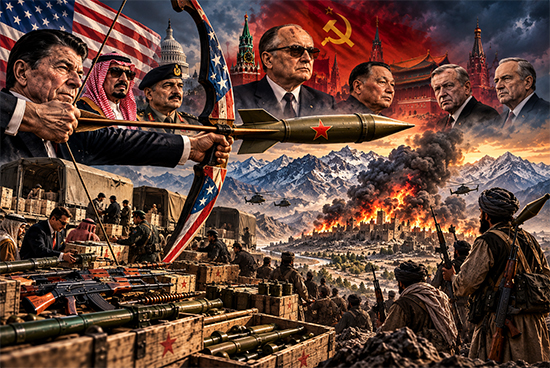
How Did the Soviet Union’s “Friends” Supply Afghan Mujahideen with Soviet Weapons?
By Muhammad Arif Irfan, Analyst (Afghanistan)
The Afghan War of the 1980s was far more than a military confrontation between the Democratic Republic of Afghanistan and the Soviet Union on one side and mujahideen groups on the other. It became a vast arena of intelligence rivalries, clandestine arms deals, and the geopolitical interests of global powers.
In this war, the United States, Saudi Arabia, and Pakistan were the principal architects of an extensive network of financial and military support for the mujahideen. Yet one of the historical paradoxes was that socialist China, along with certain networks operating within Warsaw Pact member states, also participated in supplying weapons used in this operation.
Investigative reports by American media outlets and the accounts of Prince Turki al-Faisal, the former head of Saudi intelligence, presented in his book The Afghanistan File, shed light on the extent of these covert relationships. These revelations raise serious questions about political divisions, the erosion of ideological solidarity, and the growing dominance of economic interests within certain parts of the socialist bloc even before its formal collapse.
China's Role in the Afghan Jihad
Despite its socialist political system, China became one of the principal sources of arms for the Afghan mujahideen amid its intense rivalry with the Soviet Union.
According to an investigation by The Washington Post, during the early years of the war, the Central Intelligence Agency (CIA) purchased a substantial portion of the weapons needed by the mujahideen directly from the Chinese government. These supplies included automatic rifles, rocket launchers, mines, and anti-aircraft weapons, which were transported to Pakistan through the port of Karachi.
According to one American official, by the mid-1980s, China's revenues from arms sales to the CIA had reached approximately $100 million annually. In addition, China provided roughly 10–15 percent of the weapons and ammunition supplied to the Afghan mujahideen free of charge.
On page 42 of his book The Afghanistan File, Prince Turki al-Faisal also identifies China as one of the major suppliers of weapons to the mujahideen. He highlights the satisfactory quality of the equipment, timely deliveries, and China's consistent cooperation with the arms supply network managed by Pakistani intelligence.
Poland and Czechoslovakia: Secret Arms Deals Within the Warsaw Pact
The roles of Poland and Czechoslovakia remain among the lesser-known aspects of the Afghan War.
On page 42 of The Afghanistan File, Prince Turki al-Faisal, the former head of Saudi intelligence, explicitly states that the CIA purchased some of the weapons and military equipment it required directly from Poland and Czechoslovakia. According to his account, there was even the possibility of financially bribing certain officials in these countries.
These transactions were conducted within the broader network supplying weapons to the Afghan mujahideen. His account also mentions financial assistance provided by Poland to the mujahideen, a matter that should be distinguished from revenues generated through arms sales.
An investigation published by The Washington Post on February 14, 1994, indicates that the CIA paid approximately $150–200 million for Soviet-made military equipment through secret transactions involving Polish sources. A significant portion of these funds reached Poland through intermediaries.
During the initial transactions, more than 1,000 shoulder-fired anti-aircraft missiles and launchers, valued at approximately $20–30 million, were purchased from Polish suppliers and subsequently transferred to the Afghan mujahideen.
These connections demonstrate that within certain segments of the arms supply networks of Warsaw Pact member states, financial interests and clandestine transactions came into conflict with officially proclaimed political and ideological commitments.
The United States and Saudi Arabia: Billions of Dollars to Sustain the War
Support for the Afghan mujahideen by the United States and Saudi Arabia developed into one of the largest covert operations of the Cold War.
Declassified U.S. documents confirm that Washington's covert support for opponents of the Afghan government began in July 1979, approximately six months before Soviet troops entered Afghanistan in December of that year. Initially limited in scope, this assistance evolved into a massive arms supply program over the following years, with total American aid reaching billions of dollars.
Saudi Arabia, coordinating its efforts with the United States, also provided substantial financial assistance through Pakistani intelligence. During a significant phase of the program, Saudi contributions roughly matched the level of American funding.
As the operation expanded, the annual U.S. budget increased to hundreds of millions of dollars, while combined American and Saudi assistance reached billions. These funds played a crucial role in sustaining and prolonging the Afghan mujahideen's war.
Prince Turki al-Faisal, the former head of Saudi intelligence, provides a detailed account of how this cooperation began in his book The Afghanistan File. He writes that General Akhtar Abdul Rahman, the head of Pakistan's military intelligence, traveled to Riyadh and conveyed a message from General Zia-ul-Haq to Saudi officials concerning the need to provide financial and military support to the mujahideen.
According to Turki al-Faisal, several days after this meeting, one of his associates, Ahmad Badib, traveled to Islamabad carrying two million dollars in cash packed into travel suitcases. He further explains that financial and military cooperation with Pakistan gradually expanded and became one of the fundamental pillars of the system supporting the mujahideen.
This testimony is particularly significant because it comes from an individual who stood at the center of Saudi intelligence decision-making and personally played a direct role in organizing the operation.
Pakistan: Monopoly Over Aid Distribution and Corruption in the Arms Supply Network
Pakistan became the principal hub for transferring funds and weapons to the Afghan mujahideen and providing them with military training. Pakistan's military intelligence agency, which controlled the distribution network for foreign assistance, played a decisive role in determining who received that support.
Investigative reports by The Washington Post and the accounts of Muhammad Yousaf, the former head of Afghan operations within Pakistani intelligence, expose questionable arms transactions, profiteering by intermediaries, and corruption within this network.
Thus, beyond its political and military objectives, the Afghan War also became an arena for the pursuit of economic interests and clandestine deals.
Zia-ul-Haq's Strategy: A War That Had to Simmer at a Controlled Temperature
Accounts of the policies pursued by General Zia-ul-Haq, Pakistan's president at the time, frequently refer to a well-known metaphor: Afghanistan was to simmer like a pot of water kept at a carefully controlled temperature.
The essence of this strategy was that the war should be intense enough to exhaust Soviet and Afghan government forces, but not so intense as to provoke a direct military confrontation between the Soviet Union and Pakistan.
This approach turned Afghanistan into a theater of prolonged attritional warfare, where the strategic calculations of foreign powers overshadowed the fate of the Afghan people.
Israel’s Role in the Afghan Jihad
Another lesser-known aspect of the Afghan War was Israel’s role in the network supplying weapons to the mujahideen.
Charlie Wilson, a former member of the U.S. Congress and one of the principal organizers of covert assistance to the mujahideen, revealed Israel’s involvement in supplying arms to the Afghan fighters during a 2003 interview on the radio program Fresh Air.
According to Wilson, Israel had captured a number of Kalashnikov assault rifles and RPG rocket-propelled grenade launchers from Palestinians and other adversaries. When some American officials expressed doubts about whether the mujahideen would accept Israeli-supplied weapons, Wilson raised the issue with Gulbuddin Hekmatyar, the leader of the Islamic Party of Afghanistan.
According to Wilson’s account, Hekmatyar replied:
“We use weapons that we obtain from wounded and dead Soviet soldiers. So I do not see why we cannot use weapons that God provides to us through Israel.”
When interviewer Terry Gross asked Wilson whether the Israeli weapons captured from Palestinians had actually been delivered to the Afghan mujahideen, he gave an unequivocally affirmative answer.
This firsthand testimony is regarded as an important piece of historical evidence concerning the transfer of Israeli-captured weapons to the Afghan mujahideen through the U.S.-backed arms supply network.
Gorbachev: The Final Nail in the Coffin of the Democratic Republic of Afghanistan
While foreign intervention and prolonged warfare had undermined the foundations of the Democratic Republic of Afghanistan over many years, a decision by the Soviet leadership in 1991 dealt one of the decisive blows to the state’s ability to survive.
Following the withdrawal of Soviet troops in February 1989, the Afghan state did not collapse immediately, contrary to the expectations of its opponents. The Afghan armed forces continued to put up determined resistance, while the government still received military assistance, oil, food supplies, and equipment from the Soviet Union.
However, on September 13, 1991, under the leadership of Mikhail Gorbachev, the Soviet Union and the United States agreed to halt arms supplies to the opposing sides in the Afghan conflict, effective January 1, 1992.
This decision was made in the context of Gorbachev’s pro-Western policies and the sweeping transformations that led to the collapse of the socialist regimes in Eastern Europe and ultimately the Soviet Union itself.
Formally, the agreement was based on the principle of a mutual cessation of military assistance. However, subsequent reports indicated that weapons continued to be transferred to Afghanistan, or that their procurement continued to be financed, despite the commitments that had been announced. By contrast, the termination of Soviet assistance had devastating consequences for the Afghan state, which depended heavily on the Soviet Union for military equipment, fuel, and logistical supplies.
The dissolution of the Soviet Union in December 1991 and the policies of the new Russian government under Boris Yeltsin further aggravated Afghanistan’s crisis in securing fuel, ammunition, and financial resources.
As a result, a state that had managed to survive for more than three years after the withdrawal of Soviet troops collapsed in the spring of 1992, amid a logistical crisis, political and military divisions, and a shifting balance of power among domestic forces.
From this perspective, the deliberately engineered decision of September 1991 can be described as the final political and logistical nail driven by Gorbachev’s leadership into the already weakened structure of the Democratic Republic of Afghanistan. Nevertheless, the state’s ultimate collapse resulted from a combination of internal and external factors and occurred after Gorbachev had left office.
Conclusion
Having endured years of bloodshed and fire, the Democratic Republic of Afghanistan ultimately collapsed.
The great tragedy was that some of the instruments of war used against the Democratic Republic of Afghanistan came from within the very bloc that proclaimed ideological solidarity with it. And in the final stage, a decision by the Soviet leadership destroyed one of the principal pillars of its survival.
This remains one of the bitterest paradoxes in the political history of Afghanistan and the Cold War.
London, October 2026
SOURCES AND REFERENCES:
[1] Prince Turki Al-Faisal Al Saud, with Michael Field. The Afghanistan File. Arabian Publishing, 2021, pp. 42–43.
[2] Benjamin Weiser. “Poland Helped U.S. Buy Soviet Weapons.” The Washington Post, February 14, 1994.
[3] Steve Coll. “Anatomy of a Victory: CIA’s Covert Afghan War.” The Washington Post, July 19, 1992.
[4] Steve Coll. “In CIA’s Covert Afghan War, Where to Draw the Line Was Key.” The Washington Post, July 20, 1992.
[5] Mohammad Yousaf and Mark Adkin. The Bear Trap: Afghanistan’s Untold Story. Leo Cooper, 1992.
[6] Don Oberdorfer. “U.S. Asks Afghans to Return Missiles.” The Washington Post, April 23, 1992.
[7] U.S. Department of State. Foreign Relations of the United States, 1977–1980, Volume XII, Afghanistan.
https://history.state.gov/historicaldocuments/frus1977-80v12
[8] National Security Archive, George Washington University. Afghanistan: Lessons from the Last War, 2001.
[9] Charlie Wilson. Interview with Terry Gross. Fresh Air, National Public Radio (NPR), 2003.
https://freshairarchive.org/segments/charlie-wilson
[10] Amnesty International. Afghanistan, 1995, discussion of continued arms transfers following the September 1991 agreement.
[11] Doyle McManus. “U.S. and Soviets Will Halt Afghan Arms Aid by Jan. 1.” Los Angeles Times, September 14, 1991.


