


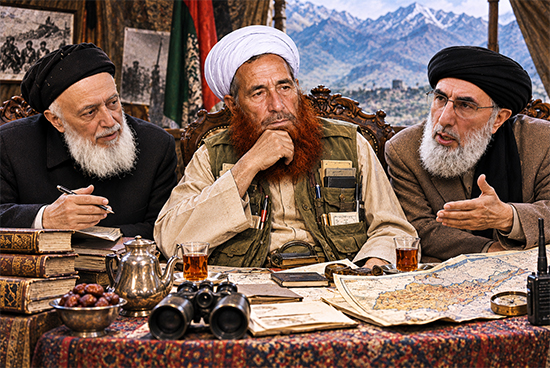
Mawlawi Khalis instructed members of his party to join Ustad Rabbani after his death.
By Hafiz Mansur, politician and writer, one of the leaders of Jamiat-e Islami and the National Resistance Front of Afghanistan
Mawlawi Muhammad Yunus Khalis (1919–2006) was one of the leaders of the seven jihadist organizations headquartered in Peshawar during the years of jihad. Although he had received his education at religious madrasas, even before the jihad, he maintained ties with leaders of the Islamic movement who had emerged from Kabul University.
He wrote articles and delivered speeches at various gatherings and conferences. During those same years, he translated Ibn Taymiyyah’s well-known work Al-Siyasah al-Shar'iyyah (“Governance According to Sharia”) from Arabic into Pashto.
Initially, Mawlawi Khalis cooperated with the Islamic Party led by Engineer Gulbuddin Hekmatyar. However, he soon established another organization, the Islamic Party of Afghanistan, which became known as Hezb-e Islami Khalis (Khalis’s Islamic Party).
Among the leaders of the jihadist organizations, he stood out for his henna-dyed beard and his witty, often sarcastic remarks. Mawlawi Jalaluddin Haqqani, Haji Abdul Qadir Khan, and Commander Abdul Haq were among the prominent military commanders serving under Mawlawi Khalis.
Among the jihadist leaders, Khalis maintained particularly warm and sincere relations with Ustad Burhanuddin Rabbani, who likewise held him in high regard and affection. On one occasion, the late Ustad Rabbani praised Mawlawi Khalis by calling him an “old guerrilla.” In another speech, when Mawlawi Khalis had declined to join an alliance of jihadist organizations, Rabbani declared: “An alliance without Khalis is an impure alliance.” This was a play on words, since the name “Khalis” means “pure,” while “nakhalis” means “impure.”
It is said that during the final years of his life, while living in Nangarhar, Mawlawi Khalis instructed members of his party to continue their activities under the leadership of Ustad Rabbani after his death.
Many stories have been told about Mawlawi Khalis’s sense of humor. For example, when he married for a second time, his marriage became a subject of discussion, as often happens in such circumstances. During a meeting of the council of jihadist organization leaders, Engineer Hekmatyar made a sarcastic remark about the marriage. Mawlawi Khalis responded: “Hey, Gulbuddin, my boy! My marriage seems to have upset you far more than it upset my first wife.”
Another story is also attributed to him. Once, commenting on Hekmatyar’s constantly shifting political positions, Mawlawi Khalis remarked: “Hekmatyar, you have become like a pair of burning trousers to us: if we take them off, we will be left naked and disgraced before everyone; but if we keep them on, you will burn our backside.”
During those years, I visited his office several times in my capacity as a journalist. It was a simple place, entirely free of pomp and ceremony. On those occasions, we were served shorba, a traditional meat soup, although the late Mawlawi himself ate only the meat. The reason for this remained unknown to me.
The late Mawlawi usually wore a European-made, khaki-colored vest with numerous pockets. I had heard that fishermen in the West wore such vests, though Allah knows best. Interestingly, the pockets of his vest always appeared to be filled to capacity.
As those around him explained, each pocket effectively served as a separate department of his party’s organizational apparatus: one contained documents relating to military affairs, another held political papers, a third contained cultural materials, and so on.
How accurate these stories were is known only to God. Nevertheless, this was how people in his circle described the situation.


