


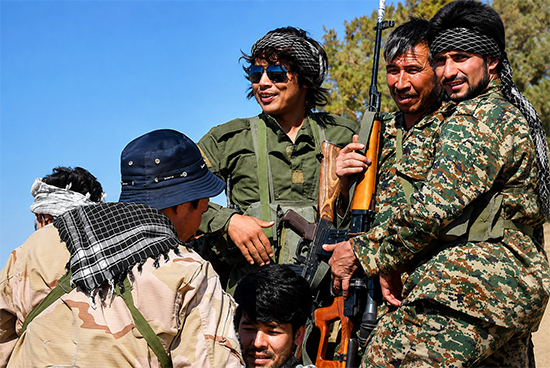
The creation of the Fatemiyoun Brigade became a cornerstone of Iran’s strategy of asymmetric warfare.
By Ubaid Noori, “Kateb Media”
The formation of the Fatemiyoun Brigade cannot be reduced to a single military event. The emergence of this group was the result of a complex intersection of Iran’s geopolitical needs, its strategy of proxy warfare, and the vulnerable socio-economic position of Afghan migrants. To understand why and how this structure emerged, it must be examined from strategic, sociological, and tactical perspectives.
With the outbreak of the Syrian crisis and the threat of the fall of Bashar al-Assad’s government in 2012–2013, Iran’s regional strategy required preventing the collapse of its most important Arab ally. However, deploying large numbers of regular army forces or Islamic Revolutionary Guard Corps troops to Syria would have faced two major obstacles:
Political and diplomatic costs: An official military presence could have led to confrontation with regional and global powers.
Domestic public opinion: Iranian society was not prepared to accept heavy casualties among regular military personnel in a foreign war.
At this stage, the Quds Force doctrine of the IRGC — namely, the use of proxy forces — was activated. However, unlike Lebanon’s Hezbollah, which had an indigenous structure, Iran needed an inexpensive, readily available and combat-ready infantry force in Syria capable of filling the vacuum created by the weakening and exhaustion of the Syrian army.
It was at this point that attention turned toward a vast resource within Iran’s borders: the multimillion-strong community of Afghan migrants.
Afghan migrants in Iran, particularly Shiite Hazaras, had lived on the margins of society for decades. In order to transform this community into an effective military force, the Islamic Revolutionary Guard Corps employed a combination of “pull” and “push” factors:
Identity and ideology:
Migrants who occupied a marginalized position in Iranian society could, after joining the group and receiving the status of “Defenders of the Shrine,” suddenly acquire a heroic and sacred identity. The defense of Shiite holy sites against Takfiri groups became a powerful ideological and religious factor capable of motivating many people to go to war voluntarily and based on deeply held convictions.
Economic leverage and residency:
For a significant portion of undocumented migrants who constantly faced the threat of deportation, low-paid labor, and deprivation of basic civil rights, the promise of receiving salaries in dollars and, more importantly, obtaining legal residency and citizenship for themselves and their families was seen as a unique opportunity to change their social status and escape a crisis of rootlessness and lack of identity.
Systematic pressure:
Alongside volunteers, analysts also point to the use of coercive and systematic pressure. This included cases in which people detained for illegally crossing the border or accused of minor offenses were reportedly faced with a choice between deportation/prison or deployment to Syria.
The Fatemiyoun project was launched in a highly calculated manner. At the initial stage, the central core of the group was built around experienced Afghan commanders such as Alireza Tavassoli, who had combat experience fighting alongside Iran — during the eight-year war with Iraq — or fighting against the Taliban.
The IRGC’s strategy was to give the group a distinctly “Afghan” identity and preserve its outward appearance of independence, while logistical support, training, weaponry, and senior command remained directly under the control of the Quds Force.
The effectiveness and battlefield courage of these forces in guerrilla and urban warfare, combined with their high “casualty tolerance” — that is, the relative indifference of Iranian public opinion to the deaths of migrants compared with the deaths of Iranian citizens — allowed the project to rapidly expand from a small brigade into a division numbering tens of thousands. They became the principal “shock troops” on the most difficult fronts in Syria and consequently suffered the highest casualties among the forces supporting Bashar al-Assad.
The creation of the Fatemiyoun Brigade became a cornerstone of Iran’s strategy of asymmetric warfare. The Islamic Republic succeeded, at minimal diplomatic cost and by exploiting the intersection of the “religious fervor” and “material needs” of a marginalized minority, in creating one of its most effective overseas military forces.
The group, which was initially formed in response to the Syrian crisis, now represents an elite military force and a permanent geopolitical factor at Tehran’s disposal.


