


What Are Moscow's Plans for Afghanistan?
By Fayazuddin Ghiasi, Political Analyst (Afghanistan)
Recent statements by Russian Foreign Minister Sergey Lavrov regarding the need to transfer responsibility for managing the Afghan issue to regional countries have once again drawn attention to Moscow's strategic objectives in Afghanistan.
Speaking at the Fourth International Conference on Eurasian Security, held in Minsk on November 4, 2026, Lavrov emphasized that countries outside the region had failed to resolve Afghanistan's problems and that neighboring states should assume greater responsibility for its future. He also described the Moscow Format as one of the most important mechanisms for building regional consensus. At first glance, this position appears aimed at strengthening regional cooperation. At a deeper level, however, it forms part of Russia's efforts to limit Western influence, consolidate the Taliban's position, and expand its own political, military, economic, and strategic presence in Central Asia and Afghanistan.
Since the Taliban returned to power in August 2021, Afghanistan has become one of the most significant security and political challenges facing regional countries. Despite the end of the military presence of the United States and NATO, the activities of armed groups, drug trafficking, extremism, and ongoing political and economic crises continue to affect regional stability. Under these circumstances, Moscow seeks to establish itself as one of the principal actors in managing the Afghan issue and, by strengthening multilateral mechanisms, shift decision-making concerning Afghanistan toward regional frameworks more closely aligned with Russian interests.
Russia's first strategic objective is to prevent the return of the United States and NATO's military and security presence to Afghanistan and its surrounding region. From the Kremlin's perspective, the withdrawal of American forces in 2021 created an opportunity to reshape the regional balance of power. Moscow does not want this opportunity undermined by the return of Western military infrastructure to Afghanistan or the establishment of new military bases in Central Asia.
Earlier, at the eighth meeting of the Moscow Format on October 5, 2026, Lavrov had already declared the deployment of NATO military infrastructure in Afghanistan and neighboring countries unacceptable, regardless of its designation or form. Consequently, the emphasis on regional management of the Afghan issue should be understood as part of Russia's broader policy of limiting the West's strategic presence within the Eurasian security sphere.
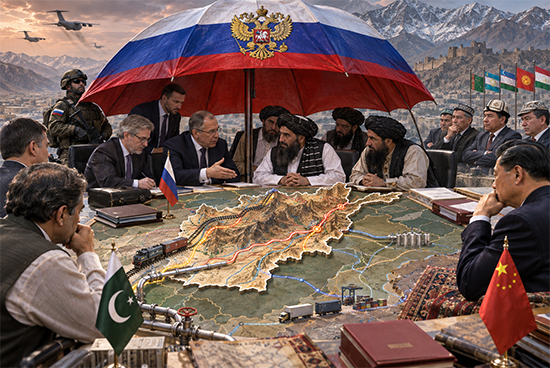
Moscow's second objective is to transform the Moscow Format into the primary mechanism for coordinating regional policies toward Afghanistan. Established in 2017, this framework has provided a platform for dialogue among Russia, China, Iran, Pakistan, India, and the Central Asian states. By strengthening this mechanism, the Kremlin seeks to move beyond being merely one of several interested parties and assume a more central role in shaping the region's political agenda and security architecture.
The significance of this approach became even more evident following Russia's decision to formally recognize the Taliban regime in July 2025. Moscow thus became the first country to take such a step. The decision marked a gradual shift in Russian policy from cautious engagement with the Taliban toward establishing more formal relations and seeking to strengthen the regime's political standing in regional affairs.
However, the eighth meeting of the Moscow Format in October 2026 demonstrated that achieving regional consensus is far from straightforward. Disagreements between the Taliban and Pakistani delegations over the activities of Tehrik-i-Taliban Pakistan (TTP), as well as the wording concerning terrorism in the final document, prevented the adoption of a joint statement. This episode illustrated that shared security concerns do not necessarily translate into political convergence.
For Moscow, such disagreements, while hindering the formation of a regional consensus, also create opportunities to strengthen Russia's role as a mediator. The Kremlin seeks to reconcile conflicting positions and establish itself as the central coordinating actor in the Afghan issue. At the same time, the participants' failure to reach a common position demonstrated that translating this role into meaningful influence over regional decision-making continues to face serious limitations.
Another important factor in Russia's strategic calculations is the security of Central Asia. Afghanistan shares borders with Tajikistan, Uzbekistan, and Turkmenistan, meaning that the spread of instability within Afghanistan could have direct consequences for the countries of the region. The activities of ISIS-Khorasan, the presence of transnational armed groups, drug trafficking, and the potential infiltration of extremist movements are among Moscow's primary security concerns. Russia recognizes that instability in Afghanistan could threaten Central Asian security and, consequently, its own political and military interests. For this reason, the Kremlin seeks to expand intelligence and security cooperation through engagement with the Taliban and persuade them to counter cross-border threats. However, disagreements between the Taliban and Pakistan over the activities of Tehrik-i-Taliban Pakistan (TTP) raise questions about the Taliban's ability and willingness to contain armed groups.
Alongside security considerations, Russia seeks to capitalize on Afghanistan's geographical position to expand its economic and trade relations with South Asia. Afghanistan could serve as a vital link connecting Central Asia with Pakistan, Iran, and South Asian markets. This potential has become particularly important at a time when Russia's economic relations with the West face extensive restrictions. Expanding exports, participating in energy projects, developing railway infrastructure, and gaining access to new markets are among Moscow's economic objectives in this area. Projects such as TAPI, CASA-1000, and other regional transport and energy connectivity initiatives could also create new opportunities for economic cooperation, provided that stability is established in Afghanistan, although Russia is neither the principal initiator nor the primary owner of all these projects.
The Russian deputy prime minister's third visit to Kabul on November 12, 2026, accompanied by a delegation of more than 70 Russian businesspeople, can also be viewed in this context. The visit formed part of Moscow's efforts to expand economic relations and capitalize on Afghanistan's transit potential. During the visit, representatives of the private sectors of both countries signed ten trade agreements worth a total of $103 million.
Russia's relationship with China represents another important dimension of Moscow's policy toward Afghanistan. Both countries share similar positions in opposing the return of a US and NATO military presence, but their priorities in Afghanistan differ. China focuses primarily on securing the borders of Xinjiang, gaining access to mineral resources, investing, and developing trade routes. Russia, by contrast, prioritizes preserving its political and military-strategic influence in Central Asia and preventing the expansion of rival powers' presence. China possesses significantly greater economic capacity to invest in Afghanistan, while Russia seeks to maintain its political standing and influence in security affairs. Consequently, despite their shared interests, cooperation between Moscow and Beijing may also be accompanied by competition over their respective levels of influence in Afghanistan.
Another important dimension of Russian policy is its political support for the Taliban and its efforts to transform the movement into a regional partner of Moscow. Russia expects the Taliban to prevent the expansion of ISIS-Khorasan's activities, stop instability from spreading into Central Asia, and create conditions for developing security and economic cooperation. In turn, the Taliban view relations with Russia as an opportunity to reduce their political isolation and strengthen their position on the international stage. However, Moscow's approach contains a fundamental contradiction: on the one hand, Russia seeks stability and security in Afghanistan; on the other, political support for the Taliban without meaningful emphasis on establishing an inclusive political system could perpetuate internal divisions and deepen the country's crisis of political legitimacy.
Russia's changing approach toward anti-Taliban forces should also be examined in this context. During the 1990s, Moscow supported the Northern Alliance and other forces opposed to the Taliban. In recent years, however, it has prioritized engagement with the regime established in Kabul. This shift could restrict the diplomatic opportunities available to the Taliban's opponents in Russia. At the same time, the Kremlin may maintain limited contacts with various political and ethnic movements in Afghanistan to preserve its leverage and room for diplomatic bargaining. Nevertheless, under current circumstances, Moscow's primary priority remains its relationship with the Taliban.
For Tajikistan and other Central Asian countries, Lavrov's statements are particularly significant, as developments in Afghanistan directly affect their security and prospects for regional cooperation. Given its long border with Afghanistan, Tajikistan occupies an important position in regional political and security affairs and could play a substantial role in shaping a common approach among neighboring states. Alongside its emphasis on border security and preventing the spread of extremism, Dushanbe supports stability in Afghanistan, the development of trade, and the expansion of regional economic and transit connections. Furthermore, Tajikistan's position on the participation of various ethnic groups and political forces in Afghanistan's governance reflects an understanding of the relationship between long-term stability and political inclusivity.
Greater responsibility for regional countries could create new opportunities to strengthen Tajikistan's role in Afghanistan's political and security affairs, provided that this process is based on the genuine and equal participation of neighboring states and respect for their shared interests. Drawing on its geographical position, accumulated experience, and regional connections, Tajikistan could play a more constructive role in strengthening stability in Afghanistan while expanding security and economic cooperation with Russia and other regional partners. At the same time, Dushanbe could continue emphasizing the need to establish an inclusive political system that enjoys broad domestic support.
Ultimately, Lavrov's statements should not be viewed merely as a call for regional cooperation to resolve the Afghan crisis. This position is part of Russia's efforts to redefine Eurasia's security architecture and consolidate its status as one of the key powers shaping decisions concerning Afghanistan. Moscow seeks to limit Western influence, turn the Taliban into political and security partners, expand cooperation among regional states through the Moscow Format, and exploit Afghanistan's geographical position to strengthen its own economic and strategic influence.
However, tensions between Pakistan and the Taliban, Tajikistan's security concerns, the independent interests of China and India, and the Taliban's crisis of political legitimacy significantly complicate the achievement of these objectives.


