


Why Do Religion and Ethnicity No Longer Guarantee the Taliban Political Protection?
By Fazl Ahmad Manawi, Former Minister of Justice of Afghanistan
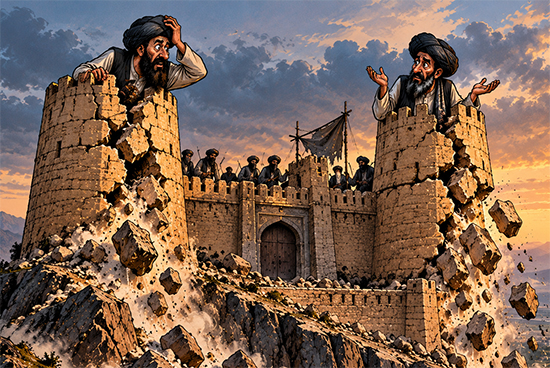
From the very beginning, the Taliban built two strongholds, two sanctuaries for themselves: religion and ethnicity.
The first stronghold — religious slogans and the claim to govern according to Sharia law — served as the Taliban’s most important source of support for many years. They responded to every form of political dissent with their own interpretation of religion. However, after the Taliban came to power, this stronghold gradually began to crack. Today, voices challenging them are emerging from within the very religious circles from which the Taliban had drawn their legitimacy for years.
It is in this context that the recent statements by Mufti Abdul Rahim, head of the Jamia Tur Rasheed Islamic seminary in Karachi, acquire particular significance. When a prominent religious scholar and teacher from the Deobandi school describes the Taliban as “Kharijites” and challenges their religious legitimacy, the issue is no longer merely a political disagreement between Pakistan and the Taliban. The blow is directed at the movement’s very religious stronghold.
At the same time, allegations that the Taliban have received assistance from India and used Israeli military technology also raise difficult questions for the movement. After all, a government that presents itself as the representative of a pure and independent interpretation of Islam must inevitably provide clear answers about its foreign relations and sources of external support.
The Taliban have another sanctuary as well: ethnicity.
In recent years, the Taliban have increasingly sought to shield themselves behind ethnic identity and exploit ethnic sentiments to preserve their political position. Yet this sanctuary, too, no longer possesses its former strength.
Today, some politically conscious Pashtuns have come to realize that defending the Taliban in the name of ethnic solidarity could ultimately impose a high historical cost on the Pashtun people themselves.
Under these circumstances, the emergence of a new voice from within Pashtun society takes on particular importance. Gulbuddin Hekmatyar — one of the most prominent, controversial, and influential figures of Afghanistan’s jihad era and political history — is now taking a more outspoken and decisive stance against the Taliban after years of complex and often ambiguous relations with the movement. He emphasizes the need to transfer power to the people, ensure political representation, and transform the political system.
The significance of this position lies in the fact that the Taliban’s ethnic sanctuary has also entered a new phase. In this regard, if Mr. Hekmatyar intends to play a more active role in Afghanistan’s political life, his extensive experience in political mobilization and social organization could enable him to reconnect with segments of society that the Taliban have long claimed to represent.
But will the Taliban’s ethnic sanctuary now lose its effectiveness, just as their religious stronghold appears to be weakening? The Taliban can no longer hide indefinitely behind the walls of religion and ethnicity.
If Mr. Hekmatyar decides to return to the political arena this time, his greatest test will be precisely this: can he move beyond the experiences and mistakes of the past and re-enter politics with a new, inclusive approach that is acceptable to society?
After all, Afghanistan needs a fundamental change in the rules of the political game.


