


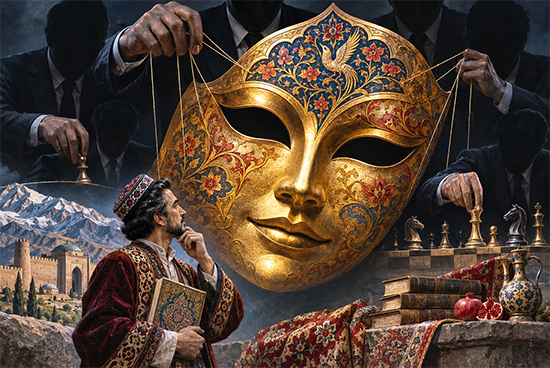
How could cultural rapprochement lead to the political weakening of Tajiks?
By Abdul Naser Noorzad, a researcher in politics and geopolitics, especially for Sangar
Afghanistan’s political discourse, particularly in the sphere of ethnic and tribal politics, has gradually become familiar with the concept of a “Persian-speaking sphere.” In recent years, this concept has entered the country’s political debate. Although it may appear relatively harmless and uncontroversial at first glance, its underlying substance and ultimate objectives have received insufficient scrutiny.
Since much of the concern among Tajiks centers on the Pashtun question and Pashtun ethnic dominance, many approach this concept without examining its nature, objectives, political agenda, or the historical contradictions concealed behind it. Yet a closer examination of the issue and the historical relationships within the Persian-speaking sphere, particularly with those groups that, in essence, borrowed their language from the Tajiks, would reveal that our problem is not limited solely to Pashtun ethnic dominance.
At the same time, there are individuals who outwardly identify themselves as Tajiks but, having fallen under the influence of this concept, actively advocate rapprochement and alignment with its supporters. They seek to establish a common platform with this movement for a joint struggle against the Pashtuns. However, I would advise these individuals to examine at least the history of the past three decades carefully and critically. They should ask themselves at what point there has ever been lasting coordination, political alignment, unity, or consensus between non-Tajik groups and us that would justify placing our hopes in the future of such a heterogeneous, immature, hollow, and insincere alliance.
The problem becomes apparent when we look beyond the seemingly moderate and harmless language of the “Persian-speaking sphere.” The idea involves a joint struggle by Tajiks and non-Tajik groups against the Pashtuns, whether under the framework of federalism, the banner of Persian-speaking unity, or within small non-Tajik movements that, in my view, represent a dangerous and unacceptable phenomenon for Tajiks.
In the context of today’s political struggles and competition over identity, such concepts appear to be less about defining and consolidating the Tajiks’ position than about establishing a new identity-based order centered on non-Tajik groups.
I would like to elaborate on this issue. The underlying objective, as I see it, is to exploit the capabilities, strength, emotions, knowledge, and language of Tajiks in the struggle against the Pashtuns. It is the Tajiks who would be imprisoned, tortured, and turned into direct enemies of the Taliban and the Pashtuns, while others would remain safely on the political sidelines, waiting for the Tajiks to bear the costs of the struggle before benefiting from its outcome.
Moreover, certain individuals whose non-Tajik identities I consider questionable regard such criticism as a form of Tajik apostasy and interpret it as an expression of hostility toward themselves. In my opinion, the identity and ethnic origins of these individuals should first be examined to determine whether they are genuinely Tajiks.
Even if their Tajik ancestry is confirmed, they should undergo appropriate political education and continuous reassessment of their views concerning Tajik national consciousness, belief in Tajik political power, recognition of the reality and objective nature of the Tajik question, and awareness of the insincere intentions of certain non-Tajik movements.
In other words, if this childish tendency to invite others to the Tajik table without understanding their interests and objectives persists, it will amount to a betrayal of Tajik rights and an injustice against the Tajik people.
From this perspective, those who lack a Tajik spirit and political outlook while presenting themselves as representatives of the Tajik community must be held accountable for their positions and actions. If betrayal is proven, they should face political and social rejection.
Now a fundamental question arises: who are these unidentified agents who, under the guise of being Tajiks, support the project of a “Persian-speaking sphere”? What motivates them, and what political calculations guide their promotion of this project? Do they genuinely believe that the Persian-speaking sphere can offer a solution to the Tajiks’ struggle for political power, or have they deliberately and systematically infiltrated the Tajik political environment with a specific mission?
Are we dealing with a project that seeks to exploit the potential of the Persian language to establish a new sphere of cultural and political influence without recognizing the historical and social standing of the Tajiks? Or does this initiative conceal consequences that could lead to the weakening and even political marginalization or elimination of the Tajiks?
If this is indeed the case, what distinguishes the actions of the Pashtuns and the Taliban from those of this non-Tajik Persian-speaking sphere? Where exactly does the difference lie between the injustices they inflict upon us and the objectives pursued by this movement?
There are no convincing answers to these questions. Indeed, from whom do we expect honest and transparent explanations? From externally appointed agents, or from those individuals who, without understanding the interests of the Tajiks, seek to dissolve this community into a non-Tajik political project and pave the way for its disappearance from Afghanistan’s political landscape? Who should be held accountable for answering these questions?
Unfortunately, when we encounter infiltrators and movements lacking political sincerity within the Tajik community itself, identifying and confronting the opposing side becomes increasingly difficult. Under such circumstances, the capabilities and trust of the Tajiks are turned against them. This is one of the most complex dimensions of the problem.
Our position, however, is clear: any project that seeks to exploit the geopolitical, cultural, and linguistic potential of the Persian-speaking world while disregarding the role and standing of the Tajiks in its calculations will inevitably face a structural contradiction. Nevertheless, some shortsighted individuals who operate in the name of the Tajiks and under the banner of fighting their enemies are either incapable of recognizing this contradiction or unwilling to confront it.
On the other hand, an indiscriminate willingness to incorporate other groups into the Tajik community, particularly under the banner of the “Persian-speaking sphere,” could undermine the Tajiks’ position, blur the red lines protecting their interests, and deprive the community of a clear understanding of its own interests and political future. The fundamental question is this: how will the Tajiks’ governance, leadership, leading role, political representation, and command authority be guaranteed within such a structure?
This approach, which I consider a form of political naivety, could weaken the Tajiks’ position, create ideological divisions, and fragment the broader sphere of Tajik political thought. It almost seems as though the objective is to prevent the Tajiks from ever achieving unity and consensus or recognizing the importance of establishing their own independent leadership and command structures.
This is precisely where the fundamental difference between our position and the views of some of these individuals lies. We continue to recognize a significant distinction between cultural integration and the political appropriation of a shared identity space. Others, however, fail to appreciate this distinction, approach the issue superficially, and regard the struggle against the Pashtuns as the sole solution to every problem.
We argue that the Tajiks have effectively been left alone on the political stage, without a sincere and trustworthy ally by their side. Therefore, they must not be deceived by empty slogans. We value and accept integration only when it is based on mutual respect, recognition of differences, acknowledgment of the historical roles of various groups, and equal participation. However, what we are witnessing today is the instrumental exploitation of the broad concept of a “Persian-speaking sphere” within a political project that, in our view, is fundamentally anti-Tajik in nature.
Such a project seeks to deprive the Tajiks of their spiritual, cultural, linguistic, and civilizational heritage, push them to the margins, and strip them of initiative in the cultural, political, military, and linguistic spheres. Ultimately, the objective is to transform the Tajiks into a passive force deprived of independent decision-making and action within the framework of a carefully managed political agenda.
From a geopolitical and security perspective, another challenge also exists. Incorporating the Tajiks into initiatives promoted under the banners of federalism and the Persian-speaking sphere could undermine their territorial rights and sense of belonging to their ancestral lands. In such a process, cultural institutions, instruments of power, economic ties, diplomatic initiative, and even the capacity to establish political institutions necessary to strengthen and restore Tajik political influence would gradually weaken, lose significance, and become ineffective.
Certain networks are attempting to create precisely such a situation, and they possess a convenient instrument for doing so: disoriented Tajiks who have fallen victim to a psychological and political game without sufficiently understanding its true nature.
In this context, the questions of who sets the agenda, who benefits from it, and which groups are pushed to the margins are far more important than the attractive and seemingly inclusive names of such projects. These are initiatives in which the Tajiks are expected to play a subservient role, while their independent standing and interests remain without any guarantees.
The project of a “Persian-speaking sphere” benefits from the lack of transparency regarding the interests, status, leadership, territorial rights, and political future of the Tajiks. From this perspective, the Tajiks themselves would emerge as the principal losers of such a project. What may begin under the banner of integration could, in practice, develop into a struggle over identity, representation, and power.
We know that in the power struggle, no one shows mercy to anyone. History is written by those who hold power, political privileges are claimed by the victors, and it is they who determine the rules of the game. The division of political structures, this time under the banners of federalism and the creation of a supposedly unified Persian-speaking sphere based on a heterogeneous, opaque, and biased coalition, could become a means of circumventing the Tajiks and disregarding their interests.
It is precisely when we are consumed by internal confrontations and conflicts, failing to recognize the principal threat, that others exploit the consequences of our divisions. Therefore, we must not allow the political potential of the Tajiks to be exploited under the banner of the “Persian-speaking sphere.” We must not become an instrument for legitimizing non-Tajik political projects.
At every level and with whatever resources we possess, we must clearly distinguish between our own sincerity, interests, standing, and leadership aspirations and those of other groups. Which non-Tajik ethnic community or group genuinely desires Tajik political leadership and supremacy? Who can provide a convincing answer to this simple yet profoundly important question?


