


How did humanity leap from the horse and carriage to the age of rockets and atomic destruction in 40 years?
By Arif Hasan Khan Akhundzada, researcher, regional affairs analyst, and member of the Sangar Advisory Council
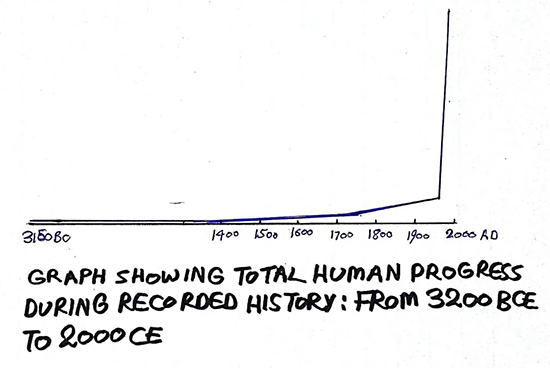
From the very start of known Recorded Human History in about 3200 BCE (the commonly accepted datum) -- till about 1750 AD (now CE), the line of human progress was very flat and low: the same sword, dagger, horse, cart, sailing or rowed vessel defined the lifestyle limits of technology. In the 14th Century, gunpowder made its appearance and changed warfare but remained fairly primitive for the next 450 years. Clockwork and the printing press appeared at around the same time. In the 1750s, the burning of coal followed by steam power enabled modern industrialisation followed by train travel and steamships.
But all this was a slow crawl compared to the course things were to take from around 1900.
I call the "event" of 20th Century progress the "Lipton Paradox" -- named after an obscure American writer Kenneth Lipton who wrote a book titled "Yellow Sky" in which he raised the possibility that the present technologically advanced civilisation may not be the first in human history. Although that point of view constitutes the separate genre of "Alternative History", my main concern is with a point he raised in his discussion of this issue.
Kenneth Lipton posited:
"How did humanity leap from the horse and carriage to the age of rockets and atomic destruction in 40 years?"
Although he posed this question quite innocently and with essential simplicity -- the magnitude of what it implies is immense, explosive and underlying secret of the human condition, that is at once basic to the issue but also invisible in broad daylight at the same time.
Let us give a breakup of 20th Century human progress, accompanied by charts to help us understand. One of these charts concerns the corresponding increase in human population -- which during known Recorded History had never exceeded 1 billion till 1804, and which reached the unprecedented ceiling of 8 billion in 2024.
The Twentieth Century of the "Common Era" was peculiar, in that it was the stage for a phenomenally unprecedented "spike" in the graph of the technological ability in the known recorded history of human (European) civilisation.
Most of these stages overlapped from the late nineteenth and over into the early twenty first -- and they are described below:
TWENTIETH CENTURY START:
1) Electricity and radio.
2) Modern firearms.
3) Automobiles.
4) Aircraft.
AFTER 1945 (WW2):
5) The Atomic Age.
6) The Space Age.
7) The Computer and Electronics Age and Television.
This is not a stray thought, but one carrying immensely significant weightage...
Bibliography:


