


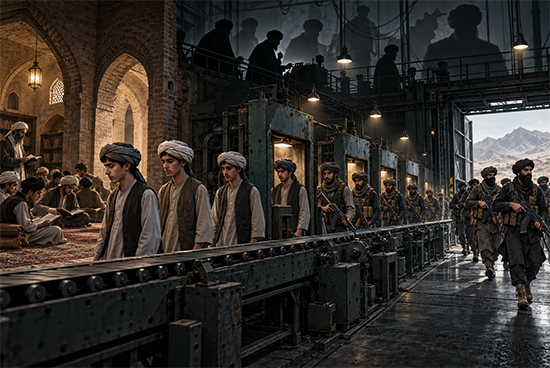
Most Taliban leaders are illiterate or poorly educated and lack even the most basic skills necessary to understand and interpret religious texts.
Author: Shamsurrahman Forutan (Afghanistan)
The prevailing narrative portrays the Taliban primarily as a religious organization, while its nationalist and ethnic dimensions have received little attention. In this part of the article, I intend to examine whether the Taliban truly constitute an Islamic movement or whether they are essentially an ethnic group that adheres to the ideas of Afghan/Pashtun nationalism. To better understand this question, I will examine four key components.
The first component: the word “Taliban” and the expression “Islamic Emirate of the Taliban.”
The dominant interpretation depicts this organization as a religious movement. Consequently, many people analyze the Taliban exclusively through the lens of religious movements, viewing it as a military, political, and religious organization established on the principles of “Islamic fundamentalism” and Hanafi Islamic jurisprudence, particularly the Deobandi school. This perception rests on two factors: first, the very name of the group, “Taliban,” and second, the name of the political system it seeks to establish, namely the “Islamic Emirate.”
The first factor concerns the word “Taliban,” which is the plural form of “talib.” A talib is someone who seeks to study religious sciences in Islamic educational institutions. For centuries, this term was widely used in Muslim society and was regarded as one of the most honorable and perhaps most valued designations in Islamic culture.
In the past, access to knowledge was limited, and acquiring an education was an extremely difficult undertaking. For the overwhelming majority of people, knowledge was a rare and largely inaccessible privilege. Seekers of knowledge traveled thousands of kilometers, endured numerous hardships, and spent many years away from their families to gain access to scarce sources of scholarly knowledge.
The sciences were not as diverse or specialized as they are today. Most fields of learning in the Islamic world were closely connected to religious sources, and traditional knowledge was largely classified within the realm of religious sciences. In other words, theology, philosophy, logic, Islamic jurisprudence, literature, and other disciplines were approached through a religious worldview. Thus, Sufi thinkers, poets, philosophers, and other intellectual figures were all considered seekers of knowledge and scholars.
In reality, seekers of knowledge and scholars were not merely the bearers and transmitters of learning but also the custodians of religious values. Therefore, it can be argued that seekers of knowledge enjoyed exceptional respect and honor because of their association with religion, their engagement with scholarship and human knowledge, and their pursuit of one of the most valuable and difficult-to-obtain privileges of their time.
The second factor is the name of the political system that the Taliban movement seeks to establish, namely the “Islamic Emirate.” For the Taliban, this expression serves as a religious and political slogan, while the movement’s declared objectives are the establishment of an “Islamic Emirate” and the “implementation of Islamic Sharia.”
An “emirate” refers to a territory under the authority of an emir — a geographical area governed by an “emir” or “Amir al-Mu'minin,” meaning the Commander of the Faithful. In Islamic culture, this expression carries a distinctly religious meaning and is most commonly applied to Muslim political and religious leaders. Although such titles may initially suggest the religious nature of the Taliban movement, and this conclusion may appear logical and well-founded, closer examination reveals that such an interpretation does not necessarily reflect reality. It is essential to distinguish the outward appearance of a phenomenon from its underlying nature.
Pakistan had approximately 30,000–36,000 religious madrasas, which, at least officially, had been established to provide Afghan refugees with an education in Islamic sciences. Students attending these institutions were called “talibs.” The term carried an appealing meaning and significance, helping attract thousands of young people to these madrasas. Consequently, tens of thousands of Afghans traveled to Pakistan to study religious sciences at these institutions. Although enrollment was formally open to citizens of all countries, most students at the lower levels were from Afghanistan, while students from other countries, including Pakistan itself, were relatively rare.
The quality of education and learning conditions in these madrasas was extremely poor and, at times, entirely inadequate. Each institution accommodated dozens of Afghan teenagers and several teachers, most of whom were also from Afghanistan. There was no standardized curriculum. The teachers lacked the necessary academic and even religious qualifications, and the conditions required for proper, systematic education were absent. Most students spent their time memorizing selected passages of the Quran. However, the teachers themselves did not understand the content of the holy text and, consequently, were unable to convey its meaning to their students.
Rational disciplines, such as Islamic theology, philosophy, and other fields of Islamic knowledge, were practically neither studied nor understood. The textbooks were written in Arabic, yet the overwhelming majority of teachers did not know the Arabic language. At the lower levels of education, students memorized the Quran, while at more advanced levels they were taught certain elementary principles of Islamic jurisprudence (fiqh) and hadith. The quality of education in these madrasas remained extremely poor.
Despite the fact that hundreds of thousands of Afghan seekers of religious knowledge studied at these institutions, these madrasas failed to produce a single graduate for Afghanistan with adequate academic and religious qualifications. Among all the graduates of these madrasas, it is impossible to find anyone capable of understanding religious texts even at an intermediate level or possessing a solid command of Islamic sciences.
The leaders of the Taliban movement, most of whom studied at these madrasas, provide a clear example. They are largely illiterate or poorly educated and lack even the most basic skills required to understand and interpret religious texts. Even the Taliban's highest-ranking leaders, who consider themselves qualified to issue fatwas, possess only a superficial and extremely limited understanding of religious texts. They lack even elementary knowledge of theology, philosophy, Sufism, Quranic interpretation, hadith studies, logic, Persian and Arabic literature, and Islamic history, although an understanding of these disciplines is essential for comprehending the Islamic religion. Even the most prominent religious leaders of the Taliban consistently speak only about the most elementary matters of Islamic jurisprudence and hadith.
Thus, contrary to widespread belief, it can be argued that the Taliban have no proper understanding of the Deobandi school, Hanafi Islamic jurisprudence, or religious texts and Islamic sciences in general.
Living conditions in these madrasas were also catastrophic. Students obtained most of their food through the practice known as “wazifa,” which involved visiting local residents' homes every day to receive a loaf of bread or a small portion of cooked food. There were no legal guarantees protecting the psychological and physical safety of the adolescents living in these institutions. Moral standards were also insufficient to prevent the criminal conduct of certain individuals present in these madrasas. At times, appalling acts occurred in these institutions that were entirely incompatible with Islamic and universal human values.
Students in these madrasas lived in almost complete isolation and often lacked both permission and the means to travel to other parts of Pakistan. These educational institutions existed separately from Pakistani society, and their students had virtually no opportunity to become familiar with its cultural and social values.
These institutions resembled peculiar factories specifically designed to produce a particular “product” for a particular country. The version of Islam instilled in Afghan students at these madrasas differed from the Islam practiced in Pakistan itself. This explains the enormous difference between students attending religious educational institutions in Pakistan and madrasa graduates sent to Afghanistan. As Mansour (2022–2023) writes:
“For many years, Pakistani Taliban have supported elected governments and participated in their activities, while their students in Afghanistan declare elections forbidden. There are numerous examples of this kind.”
Most of these madrasas were established in Pashtun-populated areas of Pakistan, and the religious views prevailing in them largely corresponded to the interpretation of Islam characteristic of Afghan/Pashtun tribes. These circumstances shaped the overall atmosphere within these educational institutions. The information presented here is based on conversations with individuals who traveled to Pakistan to study religious sciences and spent extended periods attending these madrasas.
Thus, regardless of how we examine this issue, it becomes evident that these institutions were far removed from genuine religious educational establishments. Under such circumstances, it is difficult to accept the claim that their primary purpose was to disseminate religious knowledge and Islamic values.
In reality, these madrasas were established from the very beginning to pursue political and security objectives. For more than four decades, they have been used for precisely these purposes. Teaching religious sciences was by no means the principal objective behind their establishment. Their true goals were concealed beneath the outward appearance of religious education.
These madrasas were established primarily in the 1980s, during the Afghan people's jihad against the Soviet Union, following the arrival of millions of Afghan refugees in Pakistan. Their activities continued thereafter. The principal function of these institutions was to train combat personnel. They became major centers for recruiting, enlisting, and training fighters, who were subsequently dispatched to Afghanistan to participate in the war against the Soviet Union (Blanchard, 2008).
Saudi Arabia served as the financial sponsor of this program, the United States provided military and political support, and Pakistan's Inter-Services Intelligence (ISI) was responsible for organizing it.
“International media outlets have exposed the roles of the United States and Britain, as well as Saudi Arabia's financial support, and it is no longer possible to conceal all these facts” (Mansour, 2022–2023).
During the period of the “jihad,” these circumstances attracted relatively little attention. A significant part of Afghan society regarded the establishment of these madrasas as a form of Pakistani support for the mujahideen groups fighting against the Soviet invasion of Afghanistan.
However, following the withdrawal of Soviet troops from Afghanistan, the objectives and functions of these educational institutions became increasingly aligned with Pakistan's interests. The madrasas became one of the instruments of the Pakistani government's military-political strategy and security policy toward Afghanistan.
Pakistani intelligence transformed these madrasas into centers for ideological indoctrination, recruitment, and training of personnel for security services, armed formations, and political organizations. Over the past several decades, virtually all of Pakistan's objectives in Afghanistan, including the creation of the Taliban movement and the deployment of its members to Afghan territory, have been pursued through personnel trained in these madrasas.
Previous Afghan governments and international organizations have also repeatedly accused these educational institutions of serving as centers for brainwashing, promoting religious extremism, and laying the groundwork for terrorist attacks and suicide bombings inside Afghanistan (Jumhur News Agency, 2012–2013).
The Taliban movement itself, which emerged from these madrasas, was from the very beginning a military-political project established with Pakistan's assistance.
“The Taliban movement is a creation of Pakistan, established and mobilized to achieve that country's objectives. Statements by Benazir Bhutto, the former Prime Minister of Pakistan, regarding Pakistan's role in creating the Taliban leave no room for doubt. The formation of the Taliban was conceived within the corridors of Pakistan's military intelligence, from where the movement continues to be managed and directed” (Mansour, 2022–2023). In addition to Benazir Bhutto, independent experts have repeatedly stated that the Taliban movement was created by Pakistan.
Thus, the adoption of religious designations for these madrasas, the choice of the word “talib” for the military-political forces supported by Pakistan and trained in these institutions, and the selection of the name “Islamic Emirate” for their intended system of government were all integral components of Pakistan's military-political strategy. All these names and designations were deliberately and carefully chosen by officials of Pakistan's security agencies.
In reality, these names were consciously selected by the founders of the Taliban movement. Their primary objective was not so much to establish an Islamic state and implement Islamic Sharia as to mislead the people of Afghanistan, legitimize the activities of the Taliban movement, and exploit religious values for political and security purposes. Rather than reflecting genuine Islamic values, these names served as instruments for achieving the political and strategic objectives of Pakistan and its allies.
Furthermore, the use of such religious titles enabled the Taliban's system of governance to operate without popular consent or accountability to the people, while simultaneously obliging the population to pledge allegiance to the Taliban leader and obey the movement's decisions.
Meanwhile, “the use of the title ‘Islamic Emirate’ to describe the Taliban government raises serious objections from religious, political, human rights, and international legal perspectives. Due to its repressive practices, widespread human rights violations, and lack of domestic and international recognition, this government cannot be regarded as an embodiment of genuine Islamic governance. Islam, as a universal religion centered on humanity, upholds principles such as justice, equality, and respect for human rights. However, the Taliban have violated these principles through their actions. This is why many states and international organizations refuse to recognize Taliban rule as an ‘Islamic Emirate’” (Beheshti, 2024).
Thus, it can be argued that both the name of the Taliban movement and the designation of its proposed system of government were chosen exclusively to advance Pakistan's political and security objectives and have no genuine connection to the values and principles of Islam. On this basis, the Taliban movement cannot be classified among the contemporary ideological and political movements of the Islamic world.
For a political movement to be considered Islamic, a name and corresponding declarations alone are not sufficient. Islam has specific values and principles that the Taliban neither properly understand nor follow in practice. Therefore, it is evident that the Taliban movement is not a religious organization.


