


Why Did Moscow See a Future Ally in Its Enemy?
Author: Fakhriddin Kholbek, Member of the Sangar Advisory Council
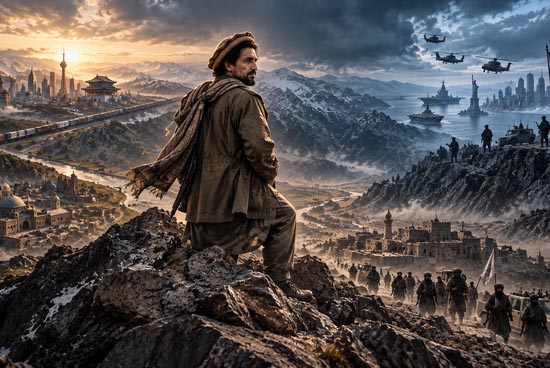
The genius and exceptional character of Ahmad Shah Massoud are demonstrated, above all, by his struggle amid the rivalry between Eurasianism and Atlanticism on the Afghan stage.
Eurasianism and Atlanticism are two major geopolitical currents that explain the confrontation between land powers (Russia, certain elements of Europe, and China) and maritime powers (North America and Western Europe), as well as different paths toward the formation and development of the world order.
Eurasianism is a Russian idea that regards Eurasia as a distinct civilization with an independent identity and opposes Western (Atlanticist) dictates on the continent. Its fundamental concept is the primacy of land power (the Heartland), advanced through organizations such as the Shanghai Cooperation Organisation, the Eurasian Economic Union, and BRICS, and based on vast continental spaces, traditional values, and a strong state.
Atlanticism is an Anglo-Saxon idea based on the primacy of maritime power (the Rimland), the global leadership of maritime powers (through NATO, the transatlantic partnership, and the Group of Seven (G7)), as well as reliance on the free market, democracy, maritime trade, and globalization according to the Western model.
In simple terms, Eurasianists are defined as a patriotic force of Eurasia fighting to liberate the continent from five centuries of Atlanticist domination. Across the world, they have their own elements and proxy forces, primarily among left-wing communist and nationalist movements. One example was the People’s Democratic Party of Afghanistan. Eurasianists were present even within Hitler’s camp, since one of the principal objectives of their Atlanticist opponents is to prevent an alliance between Russia and Germany.
During their effective presence on the “World-Island,” the Atlanticists created proxy forces that serve to protect their interests. A glance at the structures of power in China, Russia, Iran, the Arab world, and Europe is enough to identify and determine these forces within their governments. They advocate cooperation with the West while relegating the East to a secondary position.
Afghanistan’s mujahideen and the Taliban were also among them, except Ahmad Shah Massoud. His struggle unfolded along the fault line of confrontation between these two global forces, and his life came to an end at a time when this confrontation had reached a critical and decisive stage.
It was the Afghan jihad that brought a historical figure such as Massoud onto the stage of the “Great Game.” Yet the Soviet Union did not harbor the degree of hostility toward Massoud that is commonly believed.
The struggle between Eurasianists and Atlanticists for control of power in the Soviet Union had continued since the earliest days of the superpower’s existence. Joseph Stalin, who, after sidelining the Atlanticist Vladimir Lenin (“a German mercenary”), was identified by the generals of Tsarist Russia as a “patriot” and brought to power, suppressed the “Atlanticists” until the end of his life and, by creating a new communist system, challenged their capitalism. (Mao Zedong’s China represented another geographical domain of the Eurasianists.) However, with the rise of Nikita Khrushchev, the Atlanticists regained their strength, until under Mikhail Gorbachev they ultimately brought about the destruction of the Soviet Union.
One of the “masterstrokes” engineered by Soviet Atlanticists, led by certain elements within the KGB and acting in collusion with Western intelligence services, was to draw the Red Army — the world’s most powerful army and the principal stronghold of the Eurasianists — into the Afghan quagmire. To this day, no one has unraveled the mystery of why, for four years (from 1979 until he died in 1984), overall command of the forces in Afghanistan was held by Yuri Andropov, the head of the Soviet KGB. In fact, just as had been planned, the Afghan quagmire ultimately turned the mighty Red Army into a part of history.
The GRU, the Soviet Ministry of Defense’s military intelligence directorate and one of the world’s most powerful intelligence organizations, after three years of presence in Afghanistan, identified Ahmad Shah Massoud as a patriot, or a Eurasianist, among other commanders who, with Western money and support, proclaimed the slogan of “raising the banner of Islam over the Kremlin.”
Valentin Falin, one of the Kremlin leaders’ trusted advisers, concluded after the last meeting between Leonid Brezhnev and Babrak Karmal in 1982 that with a puppet leader, neither Afghanistan would get anywhere nor would the Soviet Union succeed in Afghanistan. In his memoirs, he writes: “When an Eastern dignitary says, ‘Your opinion is an order to me,’ I do not trust him.” Falin writes that “we need people” who are known among their own people “for their loyalty and steadfastness in their convictions.” He then names General Abdul Qadir, a Parchamite, and Ahmad Shah Massoud.
In 1982, at the height of the war, Soviet GRU officer Anatoly Tkachev, through the mediation of Mirdod Panjshiri, a Panjshiri government official, secretly met with Massoud without the knowledge of Babrak Karmal’s government or the Soviet KGB. The official outcome was an eighteen-month ceasefire. Massoud was not to attack Soviet bases and convoys, while the Soviet Union, in turn, would cease attacks on the territory under Massoud’s influence, which at the time was Panjshir.
However, the most important point of their agreement lay elsewhere: the Soviet Union pledged to secretly provide Massoud with logistical support in his local clashes with Gulbuddin Hekmatyar’s Hezb-e Islami and, when necessary, with artillery and air support.
The ceasefire allowed Massoud to use this pause in the fighting to reorganize his forces, implement his plan to create “other Panjshirs,” establish institutions of civilian administration, stockpile weapons, and expand his influence into neighboring provinces.
Naturally, this raises a question: why did the Soviet Union grant such a privilege to Massoud—a man who was one of its principal problems in Afghanistan?
Historians, especially Massoud’s supporters, have regarded—and continue to regard—the ceasefire as a victory, as recognition of Massoud’s power by a superpower called the USSR, and even as a manifestation of Soviet weakness. Babrak Karmal’s government was categorically opposed to the agreement because, as a result, Massoud was effectively recognized by the Soviet Union as the undisputed ruler of Panjshir—that is, as the center of a power structure parallel to Kabul. This was precisely why Afghanistan’s State Intelligence Service (KHAD), which was under KGB control, sought to undermine the agreement. In Pakistan, the Atlanticists’ operational hub, Massoud was branded a “KGB agent.”
Later, in Moscow, representatives of the Atlanticists within the KGB and the Soviet Ministry of Defense repeatedly interrogated Tkachev on charges of “collaboration with bandits.” In Kabul, meanwhile, KHAD imprisoned Mirdod Panjshiri in 1984, and he was not released until 1990.
Most importantly, however, the plan agreed upon by Tkachev and Massoud was implemented. What was that plan? To clear northern Afghanistan of Gulbuddin Hekmatyar’s forces, particularly the areas along the Soviet border. Hekmatyar’s presence along the borders of the USSR was perceived as the presence of Pakistan and its patrons—the United States and Saudi Arabia. At the same time, Hekmatyar was Massoud’s principal rival not only in the North but throughout Afghanistan. To this day, he has been unable to extinguish his hatred of Massoud, because it was Massoud who buried his dream of power forever.
The GRU, or the Soviet Union’s “Eurasianist” military establishment, saw in Massoud a kindred force in the struggle against the Atlanticists and a potential geopolitical ally. In fact, Massoud’s enemies were the very same forces that the Soviet Union confronted across the world. Pakistan, Iran, the Arab states, the United States, Europe, and even China—which, after Mao Zedong, had fallen into the hands of the Atlanticists in 1979—were all mobilized on the Afghan battlefield against the Soviet Union and the communist regime it supported in Kabul.
None of them regarded Massoud as a candidate to lead the country. Each supported one jihadist figure or another—with the exception of Massoud. Pakistan and the CIA placed their bets on Hekmatyar. The Arabs, particularly Saudi Arabia, regarded Massoud as someone who “spoke the language of the Iranians.” Iran wanted to see Massoud and his forces as a kind of “Hamas” or “Hezbollah.” Nor did Europe or China favor a Tajik: they all proceeded from the belief that in Afghanistan only the Pashtuns possessed the “right to the throne.”
Western powers viewed Massoud as an Islamist fighter associated with the Muslim Brotherhood and an ideological opponent of the Soviet “system of unbelief” — precisely the image the mujahideen sought to emphasize before their Atlanticist patrons. Massoud, however, had his own vision of a free and independent Afghanistan — a country liberated from foreign dictates and an integral part of the Eurasian family. In those years, he waged jihad against the Soviet Union, yet his real enemies were those very “patrons of the jihad” — the Atlanticists, the same forces that accepted neither Massoud himself nor his vision for Afghanistan’s future.
History confirmed it all. Pakistan and Iran challenged the Rabbani–Massoud government. U.S. Special Representative Robin Raphel, at the Istalif Palace, demanded that Massoud hand power over to the Taliban. The Arab states, above all Saudi Arabia and the United Arab Emirates, also placed their bets on the Taliban.
The Soviet Union — the stronghold of Eurasianism — also fell into the hands of the Atlanticists. Those who argue that this collapse began in Afghanistan with the discrediting of the Red Army are not mistaken. The Russians supported neither Najibullah’s government, which had demonstrated its effectiveness in the Battle of Jalalabad, nor the Rabbani–Massoud government. Massoud was left alone and ceded Kabul to the Taliban — the “army of Zahir Shah.”
The emergence of the Taliban in 1994 dramatically changed the nature of the confrontation between the Eurasianists (Massoud) and the Atlanticists (the Taliban) in Afghanistan and the wider region. The geopolitical landscape changed as well. China, Russia, and Iran viewed the Taliban project as a dangerous American venture through which Washington — the “standard-bearer of the free and democratic world” — was entering the arena with a new agenda, relying on an extremely reactionary and anti-modernist force. The Taliban became the principal factor behind the creation of the “Shanghai Five” on April 26, 1996 — the predecessor of the Shanghai Cooperation Organization.
The Eurasianists awakened, but they were very weak. Russian generals — in a country that, for the first time in its history, had fallen into the hands of an intensely pro-Western, or Atlanticist, government — provided Massoud with covert and limited support, only enough to keep him from falling. India openly stood by Massoud, but its capabilities were limited, and its primary concern was, in fact, Pakistan. By that time, India had already shifted its “qibla” toward the Atlanticists, and today this reality has become plainly evident. Indian intelligence on Massoud’s front was working in America’s interests (on September 9, 2001, an Indian doctor sent the CIA a photograph of Ahmad Shah Massoud’s body).
Iran maintained good relations with the Taliban and only after the killing of its diplomats in Mazar-i-Sharif did it truly come to know the “Kabul akhunds.” Tajikistan openly supported Massoud, but it was in a difficult economic situation and was itself engulfed in civil war. The other neighboring countries watched to see which way the balance would tip.
Massoud’s resistance was the only shield protecting the region and its neighboring countries. This resistance helped the region recover and regain stability after the shock caused by the collapse of the Soviet superpower. On March 26, 2000, as a result of an undeclared agreement between Russia’s generals (the Eurasianists) and oligarchy (the Atlanticists), KGB officer Vladimir Putin came to power in Russia. The civil war in Tajikistan also came to an end, in part through Massoud’s cooperation and efforts.
In July 2000, in Dushanbe, on the sidelines of the fifth summit of the “Shanghai Five,” Massoud held confidential meetings with the leaders of the organization’s member states — Russia, China, Kazakhstan, and Kyrgyzstan — as well as with Uzbekistan, which attended the summit as a guest. This caused serious concern in the West, because the reception of the defiant Massoud by the West’s rivals amounted to support for him and threatened to derail the Atlanticists’ plans in Afghanistan — something that was later confirmed by the military intervention and the 20-year presence of the United States and NATO.
This concern was further heightened by the changing situation on the Afghan battlefield in Massoud’s favor. The Taliban and their allies from the “terrorist international” led by al-Qaeda — a force serving the Atlanticists’ plans — were no longer advancing and had reached a deadlock. The resistance front was expanding its influence from the Hindu Kush across the country. A kind of balance of power had emerged in which signs of the Taliban’s possible collapse were already becoming visible. Only a single spark was needed for the Taliban government to fall apart. That spark was regional support embodied by the “Shanghai Five,” which became an international organization at the Dushanbe summit and, a year later, with Uzbekistan’s accession, was renamed the Shanghai Cooperation Organization.
Only a single spark was needed for the Taliban government to fall apart. That spark was regional support embodied by the “Shanghai Five,” which became an international organization at the Dushanbe summit and, a year later, with Uzbekistan’s accession, was renamed the Shanghai Cooperation Organization.
The West had grown disillusioned with the Taliban (the “army of Zahir Shah” was supposed to hand control of Afghanistan over to the Americans, but it failed to do so. Recall the meeting between Massoud and Raphel). Yet this did not mean that the West was prepared to support Massoud—he, too, had not accepted their proposal. Gary Schroen, who was responsible for U.S. contacts with Massoud, met him for the last time in Paris and, after the meeting, told Massoud’s brother: “The Commander has not changed, but change will come soon.”
The Atlanticists (the United States and NATO) concluded that unless they themselves entered Afghanistan, they would lose the decisive battle with proxy forces that had been unable even to overcome Massoud, while their plans to establish a puppet government, deploy military bases, and secure a foothold along the borders of China and Russia — in broader terms, to turn Afghanistan into a “new Israel” between Central and South Asia — would collapse.
Their concerns, however, were not about the Taliban or terrorist groups, which had no popular base and were rejected and despised by the population. Their main problem was Massoud, who had declared that if any foreign power invaded Afghanistan, he would side with the Taliban.
On September 9, 2001, Ahmad Shah Massoud was assassinated in a terrorist attack — including with the assistance of Atlanticist elements within his entourage who, unlike Massoud, soon extended a hand of alliance to a foreign power or, to put it simply, sold out his ideals.
Massoud’s elimination demonstrates the weakness of the Eurasianists and the strength of the Atlanticists. Had the Soviet Union continued to exist, or had Putin and today’s Xi Jinping possessed their current positions and influence at the time, they would never have allowed such an important and pivotal piece on the chessboard of Afghanistan and the region to be removed. I believe, however, that they deliberately made this sacrifice in order to achieve what they have achieved today: the Atlanticists in Eurasia are not merely retreating — they are being suppressed.
For this reason, in 2001 they allowed the United States and NATO to enter Afghanistan and invested in the Taliban — the very Taliban who, by then, had been cast aside by their creators as something no longer needed or fit for use.
Today, the Taliban outwardly appear to be following Massoud’s Eurasianist line — that of a free and independent Afghanistan as a member of the greater Eurasian family — yet they do not disregard their creators either. This position may ultimately cost them their heads, because one cannot sit on two chairs at the same time. Nevertheless, they still have an opportunity to make a Massoud-style choice.
Most anti-Taliban fronts have also aligned themselves with the Atlanticists — and this is what distinguishes their resistance from Massoud’s. Ahmad Massoud’s National Resistance Front stands on the Eurasianist line, and the roots of the criticism directed against it should be sought in this very reality.


