


When Will We Begin Living Under Communism?
Author: Michael Laitman — Israeli Kabbalist, founder and head of the Bnei Baruch International Academy of Kabbalah, and member of the World Wisdom Council
Work as much as you can and receive as much as you need. Who wouldn’t want to live like that? A just society in which everyone is equal, with neither poor nor rich. And not at some distant point in the future, but literally in just 20 years. That is exactly what Nikita Sergeyevich Khrushchev, First Secretary of the Central Committee of the Communist Party of the Soviet Union, promised at the 22nd Congress of the CPSU in October 1961, when he declared: “The current generation of Soviet people will live under communism!”
Yet nearly 50 years have passed since the date set for the transition to communism, and not only did it fail to arrive, but it was relegated to the realm of utopia. In some countries, communist ideology has even been equated with Nazi ideology and banned at the state level.
So what happened? Why did the attempt to realize genuinely well-intentioned goals end in complete failure in the Soviet Union?
Communism or Dictatorship?
First of all, I would not say that what they attempted to build in the Soviet Union could be called communism. It was a dictatorship. The Russian Empire was a feudal society in which the majority of the population was illiterate. The peasants were impoverished and bound to their land. They had little concern for revolutions, much less communism — they did not even know such a word existed.
For the vast majority of the working class, communism essentially meant eliminating the class of wealthy exploiters and handing the factories over to the workers. “Peace to the huts, war on the palaces!” — that, in essence, was where the centuries-old dream of justice among Russia’s peasants and workers ended.
It was not by chance that Karl Marx argued in his writings that before communism could be built, society had to pass through a certain stage of social development. After all, a communist society is, first and foremost, a conscious society in which everyone is connected to everyone else as members of a single family.
Each person feels others as part of themselves and is concerned first and foremost not with their own selfish needs, but with the needs of those around them. This requires a clear understanding of human nature and of the goal toward which we must ultimately move.
From “I” to “We”
Modern man is the complete opposite of the person of the future. He wants to care only about himself: there is himself and his family, and he could not care less about the rest. If he does take others into account, it is only because they can either help or hinder him in carrying out his plans to achieve personal well-being.
And suddenly he is told: “You must realize that you and all the rest of humanity are a single whole.” In other words, he must understand and accept that, according to the law of nature, we must reach a state in which we become one family. And even more than that: a family is still a material bond, whereas what we are talking about is our inner connection — not on a physical level, but on the level of profound unity, where each person feels not “I,” but “we.” And this “we” is a single whole.
In other words, what is required is such a profound inner transformation of the individual and his view of the world that it cannot be achieved in a short period of time, either by force or persuasion. It can only be accomplished through a prolonged process of education.
Nomenklatura Instead of Education
We know that properly raising a child from birth until they enter adult life takes at least 25 years. So what kind of education could there have been in Russia when so-called communism was imposed through violent means — through revolution and a bitter civil war between different strata of society?
It is hardly surprising that the result was terror, authoritarianism, and repression against dissenters. Hollow appeals to abandon selfishness and personal gain did not work. All the more so because people could see how the aristocracy and bourgeoisie had simply been replaced by the nomenklatura, with its special food rations, closed distribution stores, state-owned dachas, and access to foreign goods.
Under such circumstances, it proved impossible to build not only communism, but even socialism.
High Ideals and Pragmatic Reality
The first revolutionaries had pure intentions and lofty ideals. In pursuit of higher goals, these people were prepared to sacrifice themselves. I remember that when I was a student in Leningrad, I rented a room from an elderly woman who had been a revolutionary. She told me how she would stand in the cold, shivering as she handed out pirozhki to soldiers heading to the front. Although she herself was hungry, it never even crossed her mind to take one of the pirozhki for herself.
People did not think about themselves; their ideal was the revolution, which later began to devour its own children. And this was a natural process. Ideals propel our selfish world forward, but they are followed by an entirely different wave — a pragmatic one that begins to subordinate those ideals to itself and operate according to the usual laws of self-interest.
Communism According to the Laws of the Higher Nature
Whether we want it or not, the world will inevitably move toward communism, because globalization and evolution are pushing it in that direction. However, communism can only be built according to the laws of the Higher Nature — not through coercive methods, but through spiritual education.
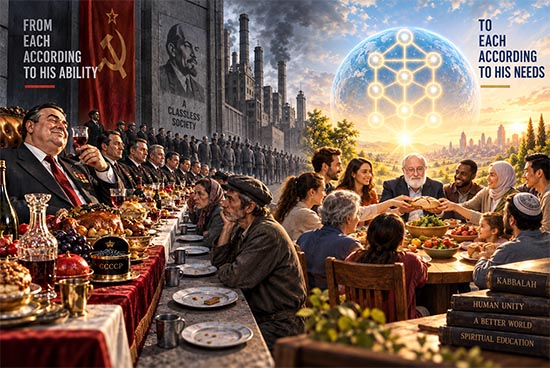
The principles of this education were set forth by Kabbalists thousands of years ago. The foremost among them is: “Love your neighbor as yourself.” Yes, that very principle, often regarded as little more than a beautiful slogan, is in fact the practical foundation of communism. Not Soviet communism, of course, but Kabbalistic communism, which will transform the formula “from each according to his ability, to each according to his needs” from a theory into an everyday practice. Then each person will act not under compulsion, but at the prompting of their own heart.
Exactly how this will happen and what incentives people will find to act in this way are described in detail in Kabbalistic sources, but that is a subject for a separate article.


