


How Did Mohib Go from Chaotic Meetings at the Office of the National Security Council to Managing a Billion-Dollar Project?
Author: Mohibullah Noori, former Head of Policy at Afghanistan’s National Security Council, member of the Sangar Advisory Council
I recently read in the media that Hamdullah Mohib, Ghani’s former National Security Adviser, after surrendering the country to the Taliban and destroying an entire state system, is now managing a billion-dollar space project in the United Arab Emirates — with enormous sums of money stolen from the table of Afghanistan’s poor and oppressed people. Indeed, would anyone be entrusted with managing a project of such magnitude without having a financial stake in it?
But before this man amassed such astronomical wealth, how did he manage to drive the security institutions of an entire country to ruin? To understand this tragedy, it is enough to recount the first days of his tenure at the Office of the National Security Council.
When Hamdullah Mohib was appointed Ghani’s National Security Adviser, he attended his first leadership meeting at the Office of the National Security Council, which, as usual, was held every morning with the participation of deputies and department heads. Although he had been educated in London and had experience heading Afghanistan’s embassy in Washington, the way he conducted meetings was ridiculous.
In those early days, he simply did not know where to begin or even how to bring a meeting to a close. All security matters were new to him, and even ordinary military concepts seemed unfamiliar and strange. Whenever a new issue was raised, explaining it to him required a great deal of patience and nerves.
At that very first meeting, he began by saying:
“Starting today, policymaking and paperwork must stop. We have no time for these things, and from today onward we will work directly with the operational security institutions.”
By then, I had spent nearly a decade developing defense and security policies. Outraged by these irresponsible remarks, I raised my hand in protest and said:
“Doctor Sahib, what you call paperwork is not the same thing as the policymaking process. The very raison d’être of the National Security Council is policymaking. The Council develops policy, and the security institutions implement it. If we, too, become involved in operational work, then what difference will remain between us and the security institutions?”
Hearing this, he became angry, but since it was his first meeting, he managed to restrain himself.
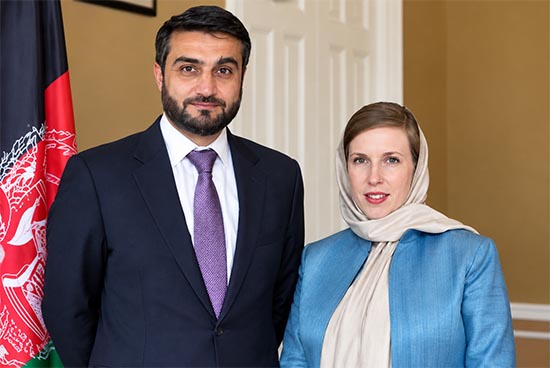
One of Mohib’s illegal and arbitrary actions was involving his foreign wife, Lael Mohib, in the official affairs of the Office of the National Security Council. Under the pretext of helping the children of fallen servicemen, she intended to establish an NGO (non-governmental organization) and obtain funding for it from foreign sources and institutions.
A large meeting was convened for this purpose, attended by deputy heads of security institutions, several senior officials from the Office of the National Security Council, and a number of representatives of international organizations. What was particularly striking, however, was that Mrs. Mohib, despite holding no official position whatsoever within the government structure, sat at the head of the meeting and presided over it.
She had instructed a woman named Farishta to prepare a lengthy presentation, the essence and main message of which was that establishing and launching this NGO was absolutely necessary in order to provide assistance to the children of fallen members of the security forces.
A large number of officials attended that meeting, including a team of foreigners and Mr. Fazil, Chief of Staff to the National Security Adviser. As Head of Policy, I opposed the proposal and stated explicitly:
“We have established the Ministry of Martyrs and Disabled, created a military deputy office, and, most importantly, right here at the Office of the National Security Council, we have formed a committee to implement policies concerning fallen members of the defense and security forces, which meets every week. So why is there any need to create an NGO? Instead of establishing a parallel structure, we should strengthen and support the newly established Ministry of Martyrs. If your objective is to coordinate assistance, you can use the existing committee within the Council, which includes representatives of all the security institutions, to secure the necessary assistance and coordinate it with the Ministry of Martyrs and the relevant institutions.”
Immediately after I spoke out against these illegal practices, an order was issued dismissing me from my position. Mohib carried out this dismissal in violation of the law, despite the fact that I had been recruited for the position through the competitive CBR program of the Independent Administrative Reform Commission.
At the time, I intended to take Mohib to court, but my friends advised me against it, saying that appealing to dependent courts and corrupt judges appointed by Ghani would be of no use whatsoever.
But how did this arbitrary, personalized style of management spread across the country and ultimately lead to catastrophe?
Appointing a person with no background in security as National Security Adviser to a country in deep crisis dealt a devastating blow to the state system. During Mohib’s tenure, hundreds of experienced generals and officers were dismissed and replaced by inexperienced individuals. Ghani repeatedly acknowledged that around 45,000 members of the security forces were killed during his first term alone. Taking both presidential terms into account, Ghani and Mohib bear direct responsibility for the deaths of more than 100,000 military and security personnel, the collapse of the Afghan National Army, and the complete breakdown of the state system.
Today, when we see the principal architects of Afghanistan’s fall and destruction, possessing astronomical fortunes amassed at the expense of a plundered people, immersed in billion-dollar projects in the Emirates, it becomes clear that the tragedy of our country was by no means accidental. What an inexperienced man mocked during the first meetings of the National Security Council as “paperwork” and “useless policymaking” stemmed from precisely the same mindset that hollowed out the institutions of the state from within and ultimately brought them to collapse.
History will bear witness that the price of this arbitrariness and lawlessness was the blood of more than 100,000 members of the security forces and the displacement of an entire nation — a crime that neither a space project in the Emirates nor the passage of time can erase, and one that will never be wiped from the historical memory of Afghanistan or from the memory of its victims.

