


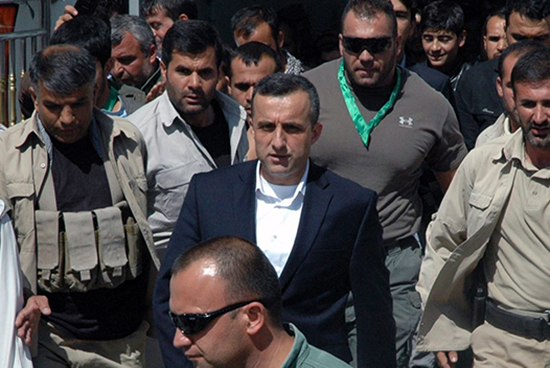
A large exclusive interview with one of the leaders of the anti-Taliban resistance Amrullah Saleh about why the United States supports the Taliban regime in Kabul, about the multipolar world, and his attitude toward Putin
Author: Andrey Serenko
Source: “Nezavisimaya Gazeta”
Amrullah Saleh is one of Afghanistan's most famous and influential political figures. Until now, he is officially considered the acting president of the Islamic Republic of Afghanistan (IRA) - the legitimate, internationally recognized head of the country, which has been led by the Taliban (a terrorist organization banned in the Russian Federation) for more than two years. The biography of 51-year-old Amrullah Saleh has many bright pages. Having begun his entry into Afghan politics as a close ally of the leader of the Northern Alliance, the legendary “Lion of Panjshir” Ahmad Shah Massoud, Amrullah Saleh then became one of the most effective leaders of the security forces of Afghanistan. He was the Minister of the Interior and the head of the National Security Directorate (NSD), the intelligence and counterintelligence service of Republican Afghanistan. Today Saleh is one of the leaders of the armed Afghan anti-Taliban Resistance, a close ally of the leader of the National Resistance Front of Afghanistan (NRF) Ahmad Massoud Jr. Amrullah Saleh voiced his assessments and forecasts for the development of the political situation in the world, the region and in Afghanistan in an exclusive interview with NG columnist Andrei SERENKO.
– Mr. Saleh, this is your first interview with Russian media, and it turns out that you speak Russian very well. Why and when did you start studying it? After all, this is very atypical for Afghanistan, where English has been popular for more than 20 years...
– I’m also glad that I’m giving my first interview in Russian. I learned it through Yandex Translator and recommend this very useful program to those who want to learn Russian. Previously, in my country, many educated people spoke Russian. But, unfortunately, relations between our countries were turbulent. Although there was great cultural interaction between Russia and Afghanistan. The relations of the Soviet Union with Afghanistan until the 1980s are considered a very good period from the point of view of our people. We hope to return to such a period. Maybe I am an exceptional person in the leadership of the Afghanistan Republic who learned Russian on his own. The main reason I began to study Russian was that it was this language that challenged the false world order. And if you want to know alternatives, you must know and learn languages that provide alternative perspectives. In today's world, it is, of course, Russian.
– How do you assess the place and role of Russia on the world stage today? What do you think about President Vladimir Putin and his policies? How would you characterize the changes that are happening in the world?
– Russia is not only a geographically large country. Russia is a great power, and it balances world affairs in a very useful way. After the collapse of the Soviet Union, we saw that the unipolar world order that emerged was not fair. This was the dictate of one country, supposedly in the name of democracy, human rights, free market, etc. In my opinion, Russia today serves as a beacon for most people, especially the global South.
In my opinion, history recognizes Mr. Putin as a man who courageously wants to create a multipolar world, and this world is beneficial not only to Russia but also to all people and countries that have become victims of a unipolar world order.
The West used every opportunity against Russia, and it didn't work. Now the Russian economy is stable, we see progress; despite tough Western sanctions, despite the crisis in Ukraine, the Russian economy is working. I am sure that without the personal competence of President Putin, such a positive result would not have been reached. President Putin has restored Russia's national honor, lost after the collapse of the Soviet Union. The West humiliated Russia after the collapse of the USSR, but Putin restored the dignity of his country. What Russia achieved was no easy task.
The world today sees Russia as the center of geopolitical balance. Such a position requires courage, which the Russian president demonstrates. The governance of our world is too complex for one center of power, which Washington currently sees as only itself. Therefore, the strategic goal that Russia is trying to achieve – a multipolar world – is supported by many people.
By the way, our leader, Commander Ahmad Shah Massoud, at the beginning of 2000, very highly appreciated the rise of Vladimir Putin to the post of President of Russia. Then, 24 years ago, he said that the Russians had received a courageous and decisive leader, a true “son of the people.” And Ahmad Shah Massoud turned out to be right. Putin is a decisive man. Not only today but also in the future, the Russian people will be proud that they have such a leader.
– What place does Afghanistan and the Afghan problem occupy on the world agenda today? Does the concept of the “Great game”, with which the history of Afghanistan over the last 200 years has been inextricably linked, remain relevant? And if so, who is participating in it today?
– Unfortunately, Afghanistan is not among the main world news today. We see a tragic pause in this sense. But it won't be long. The West, our former great partner, now only talks about women's rights in Afghanistan. They don't want to talk about other problems that they themselves created in Afghanistan. They want to bury their sin, their guilt, because they betrayed Afghanistan and handed it over to the Taliban. The Taliban are a ticking time bomb, and there will definitely be an explosion. Any other analysis related to the Taliban comes from two sources: Western orientation or simplistic thinking regarding Afghanistan. The Taliban has split Afghanistan politically and no one feels like they belong to the Taliban regime.
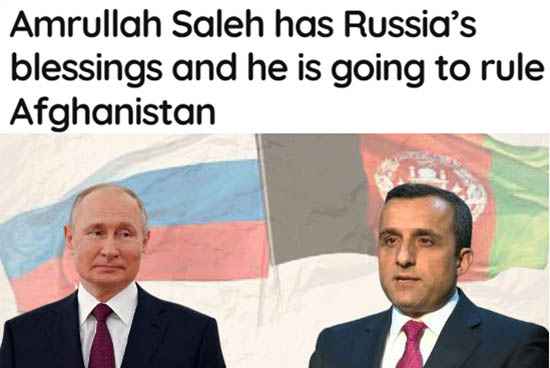 In the photo: Tfiglobalnews (India) wrote on August 18, 2021: “Amrullah Saleh has Russia’s blessings and he is going to rule Afghanistan”.
The biggest players in Afghanistan today are the United States and the European Union, they pay the largest sums to the Taliban. The skies of Afghanistan remain under US control, and drones are constantly flying there. We see the Doha deal (an agreement between the United States and the Taliban concluded in February 2020 - NG) as a conspiracy that regulates relations between the Taliban and Western circles. They use this deal to build relationships with each other. This document makes no mention of what role and place Afghanistan occupies and should occupy in the region. As a result, the region is now paying a high price for its naivety. The Taliban are spreading like cancer. They have already created 19 thousands religious schools – madrasahs – in the country. And this is happening with actual financial support from America. The US knows what it is doing, the current assistance from the US and the West is certainly helping the Taliban.
American assistance to the Taliban is unconditional. Perhaps this condition is mentioned in hidden parts of the Doha Agreement, far from the sight of our people. The disbursement of tens of millions of dollars in cash to the Taliban raises eyebrows.
Some people ask, if the Taliban is a friend and ally of the United States, then why don't Americans recognize the Taliban government? The answer, in my opinion, is obvious: because the current form of cooperation between them is cheaper, economically, and politically more beneficial to Washington. America does not want to pay a higher price for this cooperation, and the West benefits from such relations. I agree with the position of your president, who says that the strategy of tension is the strategy of the United States. Looking back, I wonder what the West's long struggle with the Taliban in Afghanistan was all about. A real war against the Taliban or actual training of the Taliban? Let me remind you that this war lasted 21 years, and the losses among the American military were only 2,300 people... This number of victims shows that America has not actually been at war with the Taliban for more than twenty years.
What goal do Western partners want to achieve in Afghanistan today? We see that the “Great Game” continues, I do not believe that the 60 million dollars that the United States transfers to the Taliban regime every week is humanitarian aid. If the United States sincerely cares about the humanitarian crises in the world, then why doesn't it transfer similar amounts to poor countries in other parts of our planet? When we try to understand where the money the Taliban receives weekly from the Americans goes, the questions become even greater. It is obvious that they do not reach ordinary Afghans. Just the other day, a US representative announced the transfer of another tranche in the amount of $80 million to the Taliban. Through what mechanism this happens, who receives this help, and through the mediation of which organization - nothing is known...
Let me just remind you that after the collapse of the republican regime in Afghanistan in August 2021, the Taliban created 900 different non-profit organizations, and most likely today it is through these NPOs that they receive money from the United States and Western countries. In my opinion, the Taliban uses national income, including that generated through American financial assistance, for its military consolidation, to strengthen its military potential.
– Why, in your opinion, did the more than 20-year struggle of the international coalition forces and the republican government in Kabul with the Taliban end in failure? Was a different result possible?
– The collapse of the republic shocked the Afghans. They did not believe that the US and NATO would deceive them. It was a big bad surprise for our people. They did not believe that every word, every promise of the Westerners was a lie. When the US and NATO came to Afghanistan, they said that the Taliban would never return, that terrorists would never return, that women's rights would never be violated... We believed these lies. We have forgotten that before September 11, 2001, the Taliban were a friend of the United States. We trusted the Americans and this became our biggest mistake. We are now paying a very high price for it. I speak about this openly because I do not want future generations of Afghans to repeat our common and personal mistakes. This statement is my moral responsibility, which I must fulfill for the sake of our people and history. Northern Afghanistan, as an anti-Taliban region, is not considered united in Western calculations. Our mistake was unconditional interaction with the West.
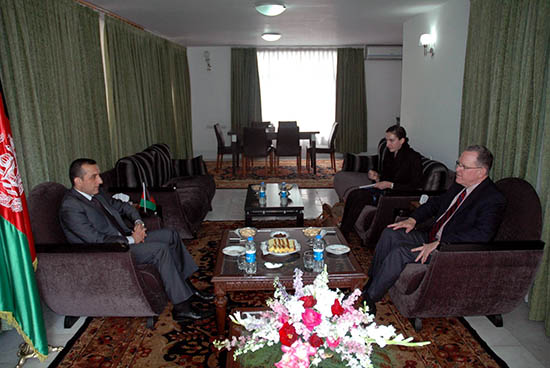 In the photo: Amrullah Saleh was an interesting figure for the Americans - meeting with David Robinson, then US Ambassador to Afghanistan, June 2, 2014.
Could this story have had a different outcome? Yes, if the Americans had not deceived us, if they had not started secret negotiations with the Taliban, if there had been no secret part in the agreement with the Taliban in Doha - in this case, yes, the result would have been different.
The 9/11 incident (terrorist attack on the Twin Towers in New York in September 2001 - NG) was a temporary mistake in relations between the United States and the Taliban, which was created by Osama bin Laden. The relationship between the US and the Taliban today is the relationship they dreamed of.
I was in the game, and I saw it from the inside, I played a fairly prominent role in the fight against terrorism in Afghanistan until the death of bin Laden in 2011. Until this moment, the fight against terrorism was real. After the death of Osama, the situation changed, and the United States decided to negotiate with the Taliban. Those who believe that the Doha deal only happened in 2020 are mistaken: the Doha process that led to this deal actually took 11 years. After bin Laden's death, Americans began to think about how they could once again use radical Islam as a political tool, just as they did in the 70s and 80s when the alliance of Western intelligence agencies and radical Islam first emerged.
– What is the Taliban today? How do you assess the two years of the Taliban regime in Afghanistan? How long do you think the Taliban will come to power? And also, who is the Emir of the Taliban, Maulavi Haibatullah? How would you comment on the rumors that he allegedly died several years ago?
– Regarding the results of the Taliban rule in Afghanistan... First. Half of the population of Afghanistan - women - live like slaves, they have no rights, they cannot travel freely, get an education, be treated in a hospital, they cannot work. We think today that with the arrival of the Taliban, Afghan women only lost the right to education, but this is not so. They have lost everything. They live in a prison. Second. Two million Afghans fled the country - most to Iran, a few to Pakistan, and about 300 thousand to Europe. Why? If there is security in the country under the Taliban, if the economy is working, if happiness has come in Afghanistan, then why are people fleeing from there? Third. Afghanistan lives in complete international isolation. Fourth. There is no real investment in Afghanistan, and without it, no economy can develop. Fifth. The Taliban has created a rigid vertical of power that works only for the Taliban, through the Taliban, and for the sake of the interests of the Taliban. In the management system they created there is nothing for the people - everything is only for the Taliban. The Taliban assures the world that they have the support of the Afghan people. Why then are they terrified of electoral procedures, why don’t they hold general elections or at least a referendum on confidence in their regime? Yes, because they know that in this case, the Taliban will not have power. In fact, the Taliban wants to establish a religious and tribal dictatorship over the people, which will be very difficult at present.
The main success of the Taliban is that for two years they have been receiving a lot of money from the United States through controlled NGOs. Despite some turbulence in relations between the Taliban and Islamabad, the Pakistani army continues to support the Taliban. This is also a significant achievement of the Taliban regime. The Taliban Central Council and Taliban leaders were in Pakistan for 20 years and America knew about it. One Western journalist wrote that America is using its bombs in the wrong place because the Taliban are not in Afghanistan but in Pakistan. He was right.
What prospects do the Taliban have in Afghanistan? The refugee crisis is returning (referring to the decision of the Pakistani government to deport more than 1.5 million Afghan refugees to Afghanistan from November 1, 2023 - NG). Foreign investment will never come to the country. Religious fanaticism will grow. For whom are the students of the 19 thousand madrassas created by the Taliban trained? In our country, there are not so many mosques, and there are not so many jobs for mullahs. This means that these will be fighters for the proxy army that the Taliban is creating.
As for Mullah Haibatullah... Yes, he exists. After the death of Mullah Akhtar Mansoor, he was the consensus candidate for the post of leader of the Taliban, and he was supported by the Pakistani intelligence services. Some Chinese analysts have said, seriously or jokingly, that Mullah Haibatullah is like Mao Zedong. I do not agree with this, Mullah Haibatullah is not the Mao of the Taliban, but their Pol Pot. Anyone who is thinking about friendship with the Taliban should remember this. Pol Pot also did not like to be photographed or be in public and did not consider himself responsible to his people.
– Why hasn’t a mass movement of resistance to the Taliban dictatorship emerged in Afghanistan during the two years of Taliban rule? How do you assess the prospects for the anti-Taliban Resistance, and in particular the National Resistance Front of Afghanistan (ARNF) led by Ahmad Massoud, in the next two to three years?
– Three days before the collapse of the republic, in August 2021, the Afghan leadership began to receive calls from their partners from the West, who promised them evacuation from Kabul. I also received such calls. I was the main partner of Western NGOs and Western intelligence services in the fight against terrorism in Afghanistan, this is no secret. An effective fight against terrorist groups was impossible without such contacts with Western intelligence services. But I refused the tempting offers and left not for the West, but for Panjshir, where Ahmad Masoud and I created the Resistance movement.
We said that we would never recognize the Taliban and its authorities. I am happy that I made this choice and I am proud of it. Our opposition to the Taliban is real, not fake. The Taliban is an illegitimate government; the Taliban seized power only through a conspiracy created by the United States. But such a conspiracy does not make the Taliban's rule legitimate. You can see that for two years, none of the political organizations cooperated with the Taliban.
The leader of the National Resistance Front, Ahmad Massoud, is a legitimate leader; he has not been part of the government in Afghanistan for the last 20 years. I support Masoud and his political position.
Why is there no mass resistance to the Taliban in Afghanistan yet? The massive social shock of the collapse of the republic as a result of a multifaceted conspiracy organized by those whom we considered our loyal friends and allies had not yet passed.
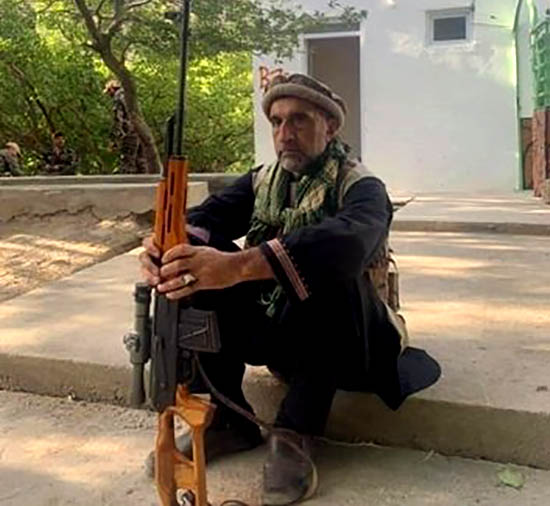 In the photo: Ruhullah Azizi, brother of Amrullah Saleh, was killed by the Taliban on September 10, 2021, in the Karukh district of Panjshir province.
Yes, some people in Afghanistan made peace with the Taliban, there are countries that wanted Afghan soil to become a base for the Taliban. Afghanistan is a very diverse country in terms of ethnicities and languages, the Taliban is trying to unify this, which is actually impossible. This is one of the reasons why resistance to the Taliban will grow. Some say this time the Taliban captured northern Afghanistan before taking Kabul. Resistance zone? There are a lot of details. One of these details is that the Americans never supported the army's operation in Badakhshan against the Taliban. Never. We now see that the lack of support was deliberate.
There are different forms of resistance. Armed is just one of them. Today we have three of the four main elements of successful resistance: a large organization - the NRFA, there is a bright, popular leader and cohesive leadership, there is political will, and motivation. There are still problems with technical and financial resources. But we count on the support of our true friends and allies.
Let me also remind you that the history of Afghanistan is a history of many surprises, various surprises, “black swans”. Who knows, maybe tomorrow we will wake up and see mass protests in Afghanistan... This is a unique country. If all you hear is silence in Afghanistan, don't believe the silence. At one time, no one foresaw the collapse of the republic in our country, have no doubt, that the same thing could suddenly happen again with the Taliban regime.
– How do you assess Russia’s current policy towards Afghanistan? Don't you think that with the Taliban coming to power, Moscow's position in this country has weakened significantly? What would you advise Russian politicians and diplomats involved in the development and implementation of the Russian Federation's Afghan policy to pay special attention to?
– After September 11, 2001, in the last 23 years, Russia has gone through four stages in its Afghan strategy. In the first stage, Russia, like many others, also believed in the United States and helped America in its declared global fight against terrorism. Russia then allowed the Americans to use its territory, thanks to which the Northern Distribution Supply Network was created, through which the Western contingent in Afghanistan was supplied.
The second stage began when Russia saw what the United States was really doing in Afghanistan, and that it was not transparent and not very clean. At this time, Russia closed the northern supply route and began to criticize the United States. Then, at the end of 2013 - beginning of 2014, Putin asked the United States why after 14 years of vigorous activity there were no real results in the fight against terrorism, and demanded an explanation from Washington. Unfortunately, by that time the former Northern Alliance was not ready to begin a new stage of good relations with Russia. We have forgotten our origins, we have forgotten that our positions are weak. Therefore, Russia began to interact with the Taliban, who then said that they were enemies of the United States and Western occupiers. However, when Russia wanted to move negotiations with the Taliban to Moscow, the United States said no, and the Taliban agreed with this. As a result, Russia received nothing from the negotiation process between the West and the Taliban. Russia ultimately became a victim of the Taliban-American conspiracy and their lies.
I believe that if the peace process had taken place anywhere other than Qatar, the outcome would have been different. Qatar is actually an American airbase. I personally, I repeat, personally, in Germany, when I was there with President Ghani, met with the Emir of Qatar. And we asked him why you gave freedom to the Taliban in Qatar, while they carry out bombings in our country every day. Why don't you insist on a ceasefire? The Emir of Qatar answered honestly. He said that we are just hosts who have provided our territory, and you should ask your questions to the American CIA. This answer was honest.
The third stage began after the collapse of the republican regime in 2021. Russia thought that the United States had left Afghanistan and that a political vacuum had appeared, which Moscow hoped to fill through cooperation with the Taliban. However, the Taliban did not respect the invitations from Moscow and did not respect the political weight of Russia, including in the region. Therefore, there was no real partnership between the Russians and the Taliban.
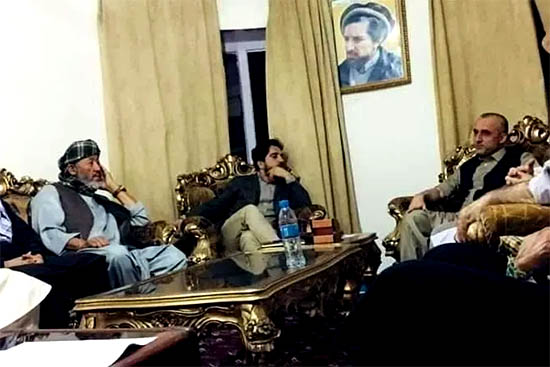 Today we are at the fourth stage of Russian policy in Afghanistan. Russia is trying to find a legitimate “road map” for organizing assistance to the people of Afghanistan. Yes, there is interaction between Russia and the Taliban, but Moscow still does not recognize the Taliban, and along with this, there is interaction between Moscow and the opponents of the Taliban. Masud visited Moscow and is planning a new visit. I know that on November 23 a conference may be held in the capital of the Russian Federation with the participation of representatives of the anti-Taliban opposition. This is a good sign. It shows that Moscow respects the diversity of Afghan society and the Afghan political spectrum. We thank Moscow for these good, legitimate decisions.
My most important advice to Russian specialists dealing with Afghanistan: please help the Afghan people create a legitimate state. Without legitimacy, without a constitution, without a legal basis, there will be no normal state in Afghanistan; a political vacuum will remain with unpredictable consequences for everyone. Unfortunately, today Afghans do not see the rule of law or the legal system in their country, they do not even see the face of the formal head of their state...
We must be aware that Afghanistan is not “Talibanistan” and not Pashtunistan. There is only one road to the Afghan future - through a broad multinational consensus, through the popular will. I hope that Russia understands this and will contribute to this.
– How do you assess the current capabilities of the United States and NATO countries in Afghanistan? In Moscow, some serious politicians fear the return of Americans, including military ones, to Afghanistan and the region as a whole. How justified are these kinds of fears?
– I don’t think the United States has left Afghanistan. They simply changed the format of their presence and partnership with Kabul. Previously, the US partner was a republican government, it was legal and legitimate, based on treaty and legal documents, we had a national parliament, a Constitution, our own independent media, etc. We had an open relationship with Washington, but it was very costly for the United States. As a result, the Americans decided to make them cheaper. Therefore, the United States has a new partner - the Taliban, these hidden vassals of Washington and the West.
The United States has not completely left Afghanistan, it has been working there all this time under the guise of various NGOs and other organizations, using drones to control Afghan airspace every day... The United States has frozen about $3 billion from the Afghan state budget "due to alleged doubts about the legitimacy of the Taliban government “, but at the same time, they have already paid at least $5 billion to the Taliban. It would be funny if it weren't so sad.
The consequences of such a policy threaten not only Afghans but also the region as a whole. The territory of Central Asia is important for Russia; it is under Moscow's security umbrella. And therefore there we see harmony, cooperation, and real security. This became possible precisely because Russia does not play conspiracies, it pursues an open policy. On the contrary, where there is the West, in Africa, in the Middle East, and in Afghanistan, there is no stability there, and conflicts and wars constantly break out.
Central Asia and Eurasia's view of Russia is full of trust, and they see Moscow as a partner of stability. There is no such point of view regarding America.
– Who do the Americans rely on today to implement their Afghan policy? And in general, in your opinion, is Afghanistan interesting to the United States?
- Today, no one is helping the Taliban more than the United States. This is happening as part of the Doha US-Taliban deal concluded in February 2020. But this deal has no place for the interests of the region. Why did the US sign the Doha deal? As they themselves say today, the Americans left Afghanistan because they were preparing for a big war against Russia in Ukraine. This war against Russia and China required a withdrawal from Afghanistan; let me emphasize, that the Americans themselves openly admit this.
 In the photo: Amrullah Saleh and NATO commander in Afghanistan General Nicholson, July 24, 2016.
Sometimes Americans try to argue that under the republican regime in Afghanistan, there was corruption and therefore, they say, it could no longer be supported. But the fact is that if there was corruption, then not only Afghans were involved in it. Of every dollar given to Afghanistan, 80 cents returned to America. In fact, the return of Afghanistan to the Taliban also buried evidence of corruption. By the way, Julian Assange spoke about this problem in 2011, noting that America would finally give Afghanistan to the Taliban in order to bury evidence of the corruption of its politicians. Now that the US can no longer cover up the problem with a discussion of corruption, it has admitted the main fact: the troop withdrawal was aimed at supporting Ukraine.
The main goal of the Western alliance led by the United States was the strategic defeat of Russia. And not only through Ukraine, there are other vulnerable points. Including in Central Asia. Therefore, of course, Afghanistan is of interest to the United States. I note that “strategic defeat of Russia” is a Western term. I didn't come up with it.
– What do you think about China’s role in the modern “Afghan game”? How justified are the hopes of some politicians and experts who believe that China can replace the United States in Afghanistan? How do you assess Beijing's apparent desire to reach an agreement with the Taliban regime?
– I respect China as our great neighbor. I had good contacts with Chinese partners. In my opinion, China will not take much risk in the Afghan game. It is not yet known what values Beijing supports today. Trade, money, and investments are not values. Regarding relations between China and the Taliban, I would like to remind you again that Afghanistan is not “Talibanistan”; there are many different peoples, groups, and clans in Afghanistan. Investing solely in the Taliban will not yield any constructive results.
I respect China's economic capabilities, but I cannot respect the political stakes of the Taliban. Can China fill the vacuum in Afghanistan after NATO leaves? No, he can not. We do not see comparable political and military ambitions on Beijing’s part there, we do not see a similar strategy.
– How do you assess the threats to Afghanistan and the region as a whole from the Afghan branch of the Islamic State banned in the Russian Federation (IS, ISIS, Vilayat Khorasan)? What is IS in Afghanistan? Who is behind this jihadist group and do you think it has a chance of one day coming to power in Afghanistan?
– I once read that the United States and NATO fled from Bagram (an air force base near Kabul - NG) and did not say anything to anyone about it. After that, everyone came to the airfield and dismantled and stole the remaining property. We then no longer had enough reserves to protect and preserve Bagram. Why didn’t the Americans and NATO tell us, the Afghan allies, about their plans then? If we had been told in advance, we would have at least prepared to defend Bagram. This is already a rhetorical question - there is no answer to it. They acted like bandits, who sneaked around. And in Bagram prison at that time there were up to 5 thousand prisoners of Islamic State militants. About 3 thousand more ISIS members were in the Puli-Charkhi prison in Kabul. In total, 8 thousand ISIS militants broke free when the Taliban came to power. The question is, didn't the US know that these prisoners would be able to escape without coordinating the American withdrawal from Bagram with the government in Kabul?
It is noteworthy that when the last American general left Afghanistan, the FBI announced a $10 million bounty on the head of Sanaullah, the leader of the Khorasan Vilayat of ISIS. What was it - a warning to the Afghan ISIS fighters or a sincere desire to catch their leader? In fact, this was just a big advertisement for ISIS in Afghanistan, after which Afghans and non-Afghans realized that a very dangerous person had appeared, for whose head the Western alliance was ready to give huge money, by the way, exactly the same as for Sirajuddin Haqqani (the leader of the banned RF terrorist “Haqqani network” - “NG”). After this, one should not be surprised at the increase in the number of militants who want to fall under the command of such a terrorist commander recognized by the West.
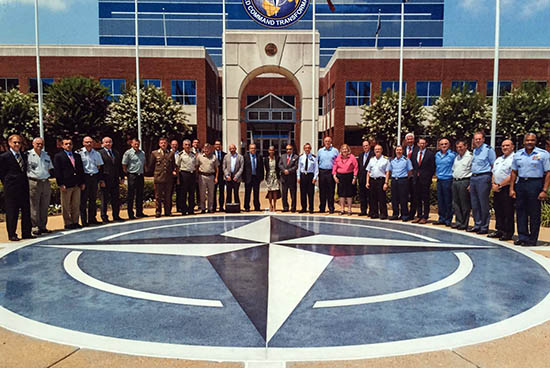 In the photo: Participants in the anti-terrorism conference in Washington, July 2015.
The United States is using the issue of ISIS in Afghanistan as a reason for cooperation with the Taliban. This is normal for them. Yesterday they used partners in the Republican government in Kabul against the Taliban, now they are creating a partnership with the Taliban against ISIS. Who knows what will happen tomorrow...
Just yesterday the Taliban was considered America's enemy, but now it is its friend. Why do US representatives say that they are against the armed resistance movement to the Taliban? Why was resistance to the Taliban in Afghanistan three years ago legitimate in the eyes of the Americans, but now it is not? The answer is obvious - the United States does not want to destabilize the Taliban as its new partner. Dozens of American officers received general ranks in the war against the Taliban, but now they warn us against going to war with the Taliban. How is this Taliban different from the Taliban of 2010? Only because they became even more cruel and arrogant.
At the same time, the United States and some other participants in the “Great Game” do not want to completely defeat ISIS in Afghanistan. Why? There must be a reason for the constant chaos. How else can we explain that fighters against ISIS from Western countries talk a lot about this fight, but ISIS itself continues to increase its strength and attract new militants to its side?
By the way, a few weeks ago, the Afghan branch of the Islamic State received 1 million 200 thousand dollars from unknown foreign sponsors and immediately intensified its terrorist activities. Before this, IS in Afghanistan was almost silent for 4-5 months. At the same time, the families of some of the leaders of the Afghan ISIS today live quietly in Pakistan.
Could ISIS one day come to power in Afghanistan? The leader of the Khorasan Vilayat, Sanaullah, recently told his entourage that allegedly 15 thousand members of the Islamic State are now secretly serving in the Taliban structures, and promised that one day there will be a “big coup” in Afghanistan in favor of the Islamic State...
– What impact can the current crisis in the Middle East have on the situation in Afghanistan? Do you think the Taliban will go to fight for the interests of Palestine against Israel? How likely is it that Taliban ideology and political doctrine will be exported outside of Afghanistan? Or is the Taliban an exclusively Afghan phenomenon?
– First of all, I want to emphasize that I agree with the opinion of President Putin: a fundamental solution to the Middle East problem is possible only through the creation of a sovereign state of Palestine. Without this, the conflict in the Middle East will never end. Israel may win the battle against Hamas today, but it will not win the war against the Palestinians.
Regarding the relationship between the Taliban and Hamas, the latter's leader Khaled Mashal himself said that he sees the Taliban as a successful example for himself. Hamas representatives met with the Taliban in Doha...
I have no evidence of Taliban involvement in the conflict with Israel. I believe that if they participate in it, they will lose 60 million dollars that they receive from the Americans. The Taliban does not jeopardize its relationship with the West and remains silent until today, and these words of mine only clarify the hidden relationship between America and the Taliban.
On the contrary, the Taliban helps terrorist groups such as Ansarullah, the Islamic Movement of Uzbekistan (organizations banned in the Russian Federation) and other jihadist movements focused on Central Asia, here they feel free in their actions. After all, in this case, there is no threat of losing American sponsorship: in the Doha Agreement of 2020, only Al-Qaeda is named terrorist and that’s all. This obviously means that the Taliban can give refuge to the enemies of the countries in the region. However, under the same Doha deal that governs the Taliban's relationship with the United States, Taliban leaders cannot be active against America's allies in the Middle East.

