


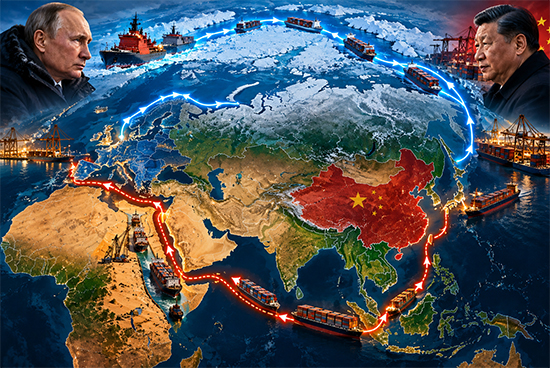
Russia Aims to Transform the Northern Sea Route into a Year-Round International Transport Corridor
By Ali Askari, analyst (Germany), especially for Sangar
Russian President Vladimir Putin has instructed officials to swiftly finalize the Comprehensive Development Plan for the Arctic and the Trans-Arctic Transport Corridor through 2050, setting the goal of establishing year-round navigation.
Between January and September 2026, approximately 31 million tonnes of cargo were transported along the Northern Sea Route, reportedly 20 percent more than during the entire year of 2025. According to forecasts by the Russian state corporation Rosatom, this figure is expected to reach at least 40 million tonnes by the end of the current year. The target for 2030 has been set at 110–150 million tonnes.
Between 2014 and 2025, cargo traffic along the Northern Sea Route increased from 3.98 million to 37 million tonnes. However, a qualitative shift occurred in 2026, when the route began evolving from a predominantly Russian shipping artery for raw materials into an international transit corridor. The number of Chinese container shipping voyages increased from seven in 2023 to more than thirty this year.
On August 15, the first weekly container shipping service via the Northern Sea Route, known as the China-Europe Arctic Express, was launched between Ningbo and Felixstowe. The journey takes approximately 20 days, compared with 40 days via the Suez Canal. The first vessel, Dubai Tower, departed Qingdao on August 19 carrying electric vehicles, lithium batteries, and renewable energy equipment.
Another Chinese company, which has been operating along the Northern Sea Route since 2023, delivered 880 containers of automotive components to Arkhangelsk on September 23. On the return voyage to China, 540 containers carrying timber and nickel concentrate were shipped.
Following their Chinese counterparts, who have transformed maritime shipments into a regular shipping service, the Republic of Korea is also conducting a pilot voyage. The Korean business community continues to regard the Arctic and the Northern Sea Route as a strategic direction for the future.
However, current geopolitical realities and sanctions require a selective, flexible, and phased approach to maintaining dialogue at the expert level. This is how Park Jong-ho, President of the Korea-Russia Business Council, outlined Seoul’s position and the conditions necessary to transform the pilot voyage into a regular shipping service.
In addition, the Russian government has instructed Rosatom to sign an agreement with India by the end of the year concerning the launch of a pilot voyage along the Chennai–Murmansk route, scheduled for 2027.
Other countries have also expressed interest. In May 2026, Vietnam and Russia signed a maritime cooperation plan extending through 2030. A Russian government commission approved the establishment of a joint venture between Rosatom and DP World of the United Arab Emirates to develop cargo transportation along the Northern Sea Route. Japan has also announced plans to conduct trial voyages in 2027.
It should be noted that Rosatom is responsible for facilitating civilian shipping along the Northern Sea Route. The corporation processes applications and publishes forecasts of ice movement, as well as navigational charts in Russian and English.
These activities ensure continuous communication with international shipping operators and demonstrate Russia’s openness to the joint use of the route.


