


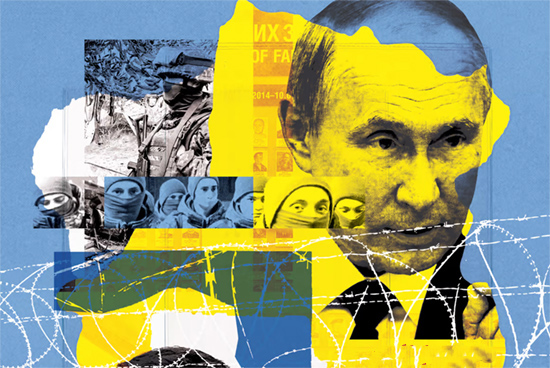
Possible factors for changing Western policy towards Russia
Author: Fayaz Bahraman Najimi, International Affairs Analyst, Member of the Sangar Advisory Board
In recent days, we have seen a change in the tone of the West towards Russia. One of the factors is the formation of two camps regarding the war in Ukraine in the Biden administration and the growing split within the European Union.
The US military, especially Secretary of Defense Lloyd Austin and Chairman of the US Army Joint Chiefs of Staff Mark Milley are interested in resuming contact with Russia to find a political solution to the Ukrainian crisis. The US State Department, supported by the House of Representatives and part of the National Security Council, advocates increasing pressure on Russia.
The relative mobilization and especially the entry into the war of many volunteers from all over Russia, the transition of Russia to a state of the military economy, and the formation of a sharp nationalist mood in the Russian military and intelligence circles are a kind of alarming warning for the United States, to which responsible American figures have drawn the attention, creates a severe risk in the future.
Therefore, it is believed that they consider the preservation of the Putin government better than the increase in confrontation.
Putin also sends signals to the West through his Foreign Ministry to be ready for negotiations.
On the other hand, a minimal Republican victory in the House of Representatives means that Congress will not just give a “white check” to the Biden administration.
Most importantly, Mark Milley takes the position of a seasoned military man with diplomatic experience who prefers the responsibility of saving the lives of his compatriots inside the United States to criticism of Russia and knows that the world is on the brink of nuclear war due to inexperienced politicians and adventurers in the West and the risk of US vulnerability has increased - especially since Russia is far ahead of the United States in hypersonic strategic nuclear weapons.
In accordance with the Latin principle, "all wars lead to negotiations", efforts were made to find ways to negotiate with Russia.
On the other hand, according to Professor Dimitri Simes, editor of the National Interest, the US military realized that the hysteria created by the US media in cooperation with Congress against Russia was too unrealistic.
Last week, the New York Times, the mouthpiece of the Democrats, wrote an article about the need for negotiations between Moscow and Kyiv. On Tuesday, November 14, Politico published a detailed analysis of the two factions within the Biden administration.
In the new environment, US National Security Adviser Jake Sullivan traveled to Kyiv to discuss Zelensky's preparations for talks with Russia.
And CIA chief William Burns met with Russian Foreign Intelligence Service chief Sergei Naryshkin on November 14 in Ankara, Turkey's capital.
Although it was said that the Ukraine issue was not discussed at the meeting of intelligence leaders, American concerns about Russia's use of nuclear weapons were seriously discussed.
Again, on November 14, ahead of the G20 meeting in Bali, Indonesia, Joe Biden met with Chinese leader Xi Jinping and talked about the war in Ukraine.
French President Emmanuel Macron and German Prime Minister Olaf Schultz met with Sergei Lavrov. And in general, the tone of the Western countries towards Russia was conciliatory. Even the two sides did not boycott each other's speeches at the meeting in Bali.
What is the reason for this?
I wrote at the end of my former article [Is Washington negotiating behind the scenes with Russia?!] that the world will see a change after the US election. This is happening now because the West has failed to mobilize much of the world against Russia. And he was never able to create the necessary dynamics in the Ukrainian war.
While some experts see these policy change efforts as a ploy to kill time for Ukraine in the winter, the underlying problem lies deeper than the issue of war for the West.
- The West has noticed the rise of revanchist nationalism in nuclear Russia.
- Unlike the West, Russia is arming itself in an unprecedented way and its war machine, the Russian military complex, is in full swing.
- An anti-Western, anti-capitalist spirit is rapidly emerging in Russia.
- Militarism up to a nuclear strike on the territory of the United States of America as the main enemy is rapidly spreading into the ruling paradigm of Russia.
- The Russian economy is rapidly becoming centralized and state-owned.
- Finally, Xi Jinping's victory gave Russian nationalists some hope of standing up to the US and the West.
These are the factors that shock the US military because a vengeful Russia with a powerful China will not be a problem, but a dangerous ideological and systemic rival of the West.
In a meeting with Biden, Xi Jinping made it clear: "Our confrontation with the United States is ideological." China is building socialism with Chinese characteristics, and America is building capitalism.
In a word, the West wants to quickly freeze the war in Ukraine in cooperation with Putin and not let the military rise, because the defeat of Ukraine will be the beginning of a geopolitical crisis in the West, which can only be prevented with the help of Putin.
But it is not clear whether Putin will withstand the great wave of Russian nationalism?!


