


Which Pashtun Tribes Are in Conflict with the Taliban?
Author: Jamal Sadiqi, Kateb Media (Afghanistan)
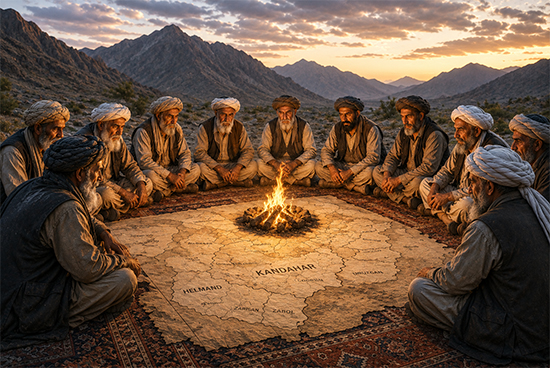
The current Taliban government in Afghanistan, despite its claims of establishing an "Islamic system above ethnic divisions," is in practice built upon a system of tribal oligarchy. The principal levers of power are concentrated in the hands of several specific tribes, including the Noorzai, Hotak, and Zadran. At the same time, many of the largest and historically influential Pashtun tribes have been systematically excluded from political power. This monopolization of authority, combined with the settling of old blood feuds, has created deep divisions within Pashtun society.
The following examines the situation of the most significant Pashtun tribes that have been pushed out of power, their prominent leaders, and the persecution they have faced under Taliban rule.
The Achakzai Tribe
The Achakzai are one of the largest tribes of the Durrani confederation in southern Afghanistan, particularly around the border town of Spin Boldak in Kandahar Province. Over the past two decades, the tribe was widely regarded as the principal obstacle to the Taliban's expansion across southern Afghanistan.
General Abdul Raziq, the influential police chief of Kandahar who was assassinated by Taliban infiltrators, along with his brother Tadin Khan, were among the tribe's most prominent leaders.
The hostility between the Taliban—especially its Noorzai leadership core—and the Achakzai tribe is both longstanding and deeply rooted in bloodshed.
Following the collapse of the Republic, the Taliban launched a sweeping campaign of retaliation in Spin Boldak. Extrajudicial killings, mass executions of young Achakzais accused of links to General Abdul Raziq, enforced disappearances, and the confiscation of land and homes belonging to businessmen and ordinary members of the tribe became some of the darkest chapters of Taliban rule in southern Afghanistan.
The Taliban have completely disarmed the Achakzai tribe and continue to keep it under an atmosphere of constant fear and intimidation.
The Alakozai Tribe
The Alakozai are an influential, wealthy, and traditionally warrior tribe living in the provinces of Kandahar and Helmand, particularly in the Arghandab District. Under previous Afghan governments, they played a key role in maintaining security across the country's southern regions.
Mullah Naqibullah, the renowned jihad commander of Arghandab who fought the Taliban on numerous occasions, and Khan Mohammad Mujahid, the former Chief of Police of Kandahar, are among the tribe's most prominent leaders.
Following the Taliban's takeover of Kabul, the movement launched a broad campaign aimed at weakening the Alakozai economically and socially. One of the clearest examples was the forced eviction of thousands of Alakozai families from residential neighborhoods in Kandahar, including the Firqa-e Qadim district, during the harsh winter of 2021. At gunpoint, Taliban fighters seized their homes and handed them over to the families of Taliban militants.
Today, the Alakozai have been effectively stripped of any military or political influence in their ancestral homeland.
The Barakzai Tribe
The Barakzai, particularly the Mohammadzai branch, are the tribe that ruled Afghanistan for more than 150 years, producing the country's kings and rulers. They are widely regarded as the traditional symbol of the Pashtun political elite and technocratic establishment.
Among the tribe's most prominent figures are historical leaders such as King Mohammad Zahir Shah and Sardar Mohammad Daoud Khan, as well as more recent political figures including Gul Agha Sherzai, the former governor of Kandahar and Nangarhar.
The Taliban view the Barakzai as "secularists" and "agents of Western powers." Owing to the tribe's predominantly urban character and relatively high level of education, its members have been systematically excluded from the Taliban's administrative, judicial, and security institutions.
Many properties belonging to prominent Barakzai families in Kabul and Kandahar were confiscated by the Taliban under the pretext of their alleged ties to the former Kabul administration, while the tribe's political influence has been virtually eliminated.
The Ahmadzai Tribe
The Ahmadzai belong to the Ghilzai tribal confederation and possess considerable influence in the eastern and central provinces of Afghanistan, including Paktia, Logar, and Kabul.
Among the tribe's most prominent figures are former Afghan President Mohammad Ashraf Ghani, who fled the country following the collapse of the Republic, and Dr. Mohammad Najibullah, the former president who was executed by the Taliban in 1996.
Although the Ahmadzai have traditionally played a major role in Afghanistan's state bureaucracy, the Taliban regard them with deep suspicion because both former presidents belonged to this tribe.
Ahmadzai tribal elders and educated professionals have been removed from government institutions, while their local networks of influence have been systematically dismantled by the Haqqani Network.
The Eastern Tribes (Shinwari, Khugyani, and Mangal)
These tribes, concentrated primarily in Nangarhar and the Loya Paktia region, are traditionally regarded as highly conservative and martial communities. In the past, they were important allies of Afghanistan's central government.
Among their best-known leaders are General Zaman Ghamsharik of the Khugyani tribe and General Shah Nawaz Tanai of the Tanai/Mangal tribe.
In eastern Afghanistan, power is overwhelmingly concentrated in the hands of the Haqqani Network, whose leadership belongs to the Zadran tribe. The network has ruthlessly suppressed rival tribal groups.
The Taliban have arrested or secretly killed numerous young members of the Shinwari and Khugyani tribes, accusing them—whether on solid evidence or not—of collaborating with ISIS-Khorasan or participating in so-called "popular uprisings."
In addition, in disputes over land ownership, the Taliban have consistently sided with the Kuchi nomads, using force to seize land and grazing pastures belonging to these tribes.
This unprecedented concentration of power, coupled with unilateral disarmament, property confiscations, and bloody reprisals carried out by the Taliban, has generated deep resentment and a suppressed desire for revenge among these major Pashtun tribes.
The tribes that once possessed considerable power and enjoyed great prestige now see themselves as humiliated and facing the threat of extinction. For this very reason, these marginalized tribes have become the most promising social base for mobilizing resistance against the Taliban.
The resistance forces and other anti-Taliban groups understand well that young men from tribes such as the Achakzai, Alakozai, and Shinwari—who have lost family members, property, and their sense of dignity because of Taliban actions—are motivated by far more than politics.
They are driven by a desire for revenge and by the instinct for survival. If provided with weapons, resources, and effective organization, these tribes could, from within Afghanistan's Pashtun regions, pose a serious existential challenge to the Taliban's military machine.

