


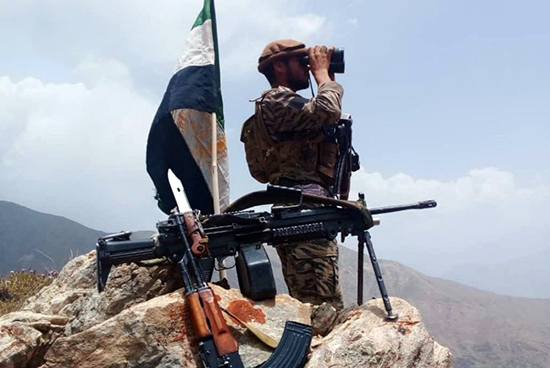
The transition from the current situation to the stage of organized full-scale war is necessary, and its urgency is considered necessary for the effectiveness of the current struggle.
Author: Abdul Naser Noorzad, security and geopolitics researcher, especially for Sangar
The transition to the new stage of the struggle for the liberation of Afghanistan requires the design of a long-term war doctrine, which should have been proposed and implemented within the last two years by the anti-Taliban fronts.
But unfortunately, reluctance, chronic corruption within the resistance structures, multiplicity and the lack of a clear political vision apart from the US order have caused the resistance fronts to falter and that is why there is still no opportunity in this field for success and conquest and no geography has not been achieved against the Taliban.
We called the first phase of the struggle to be coherent, because of the low cost and quickness of the type of operations without casualties and apart from the large logistical preparations that are necessary for a war, the guerilla warfare phase. At first, it was thought that this guerilla war in the form of hybrid doctrine caused a tremendous change in the situation of the fight against the Taliban and put more pressure on this group. But unfortunately, it can be seen that despite the achievements in this regard, the results are not according to the measured plans.
Basically, we made the logic of guerilla war, which we proposed two years ago, seem logical for several reasons. The asymmetric nature of the war (military inequality in all respects), the lack of facilities to start regular frontal wars and the facilities that we needed for a frontal war, all of these are major reasons, considering the first stage of the struggle and war for the liberation of the country. It was born from the clutches of state terrorism and hegemonism.
At this stage of the war, it is necessary to exert maximum pressure to drive the enemy to its main headquarters, to form quick-acting guerrilla cores, to expand these cores to large cities, and to start this fight, contrary to the imagination and crude perception, from the enemy's cities and gathering centers. But unfortunately, during the past two years, except for the last few months, the volume of attacks has been very low, aimless and ineffective on the enemy's situation.
In the new phase of the war, based on which, the fighters who liberate the country are supposed to enter a new phase of fortification and form fronts on a medium and long scale, conquer the heights, create commanding positions and lead the war, prevent the fronts and guarantee From the level of supply in its organized form, they are considered as the main requirements.
Let us remember that in the guerilla war phase, in order to create a regular frontal war, we had to take measures that despite putting more pressure on the enemy, inflicting casualties on it, dragging it to the cities, making it busy in the fronts. Differently, we would reduce the excessive pressure of suppression and siege of guerrilla strongholds.
But now it can be seen that there was a problem that we could not achieve such a goal during this time. Therefore, in the plan, maintaining the current geography, despite maintaining the existing level of guerrilla attacks in the cities and main intellectual cores of the enemy, requires the expansion of a combat and security radius that can make the enemy helpless.
One of our mid-term goals was to cut off the enemy's supply arteries, create operational detachments inside big cities, carry out guerilla attacks with high destruction that disrupt the order and security of the enemy, and attack the enemy intermittently and with a plan.
Fortunately, despite the shortcomings in this direction, the enemy is very concerned about the current level of attacks that have been organized by the anti-resistance fronts in the last few months, and according to the available information, the concerns about the enemy's There is evidence that the work of resistance and liberating battle is successful in this regard.
But the discussion of the development and step-by-step adaptation of the strategic, operational and tactical stages of the war, which was supposed to be implemented at different levels, shows something else. That is, the problem is that the current resistance has not been able to take firmer steps in the development stage of the war without relying on external sources and step by step approach the stage of putting pressure on the cities and the heart of the enemy.
In addition, the three stages of strategic defense, strategic deadlock and strategic aggression are the main steps of a war with a meaning and with a political insight, in line with which more drastic political measures should be taken. Six months ago, we should have gone through the strategic defense stage and brought the situation to a standstill, so that this stage would become the platform for the last stage of the war for strategic aggression. But unfortunately, as it can be seen, the stage of guerrilla warfare has just begun for the transition to the mentioned three stages.
Now that we are so far behind schedule, we need to review the failures and negligence and enter the next phase of the war. Of course, such a transition to the next phase of the war cannot be dramatic and immediate. The necessary platform, the time taken into account, the necessary supplies and the creation of a platform for cooperation with all anti-Taliban groups and local people are among the needs that must be seriously and carefully evaluated and in order to guarantee education and its acquisition, subsequent decisions should be taken cautiously. It can be seen that we are considering the same old situation that has been developed for at least the last six months in our combat operations. The current war needs to be reviewed in solutions, strategies and tactics that evolve according to the situation.
In the context of the current time, the use of repetitive tactics makes the enemy alert. This makes it easier for our insiders to fall into the trap of the enemy. While the effective use of new tactics, the continuous review of the war situation, the morale of the enemy and internal forces, the lands, the geographical situation, the level of supplies, and creating motivation in the offensive uprisings, the main purpose of which is to inflict coordinated blows on the enemy's body, is one It is one of the requirements of war command.
In the six characteristics of modern wars, from remote targeting of enemy commanders by modern technology, air support by drones, from multifacetedness and multinationality to the non-publicity of the war situation, from the asymmetric aspect of war to its hidden aspect, It puts all of us in a difficult situation.
The importance of the war doctrine plan is that it studies the various aspects and developments in the situation and adjusts the war situation according to the current needs. At the same time, the volume and amount of enemy attacks should have been very high. Fronts opposing the Taliban have announced that they have carried out more than 200 attacks on the Taliban in the past two years. That is, the amount of attacks on the general state and mentality of the people against the Taliban, who have taken over the lives, bread and dignity of the people, should have been more than 600 attacks. This means that there should have been an attack at least every day on the Taliban, even a small one.
Whereas, according to the announcement of the Afghanistan’s Liberation Front, during the past two years, this front has carried out more than 233 attacks on the Taliban, which, according to the figures provided, means one attack every three days. Although it is not the next situation, but the situation should have changed over time. That is, one attack every three days for the first year is satisfactory. But for the second and third year, it should go beyond 650 attacks.
In the same way, there have been more than a hundred attacks by the National Resistance Front in the past two years, which if they were carried out in a targeted and joint manner with other anti-Taliban fronts such as the Freedom Front, the National Mobilization Front, the liberation Army and other anti-Taliban groups, It can create a high level of fear and concern in the enemy. This is where the role of coordination and cooperation in military operations becomes an undeniable element.
During the past two years, the level of assassination of Taliban leaders has been very low. Infiltrating the military and intelligence structures, spreading propaganda to weaken the enemy's morale, create an atmosphere of despair and promote a culture of surrender were other goals of the enemy.
It goes without saying that the higher the level of attacks on the enemy, the better the space for the transition to a frontal war. It is here that with the formation of fronts in the context of the time when the enemy is busy rejecting guerrilla attacks, both the amount of pressure on insider circles is reduced and the ground is provided for the depletion of the enemy's power and strength.
In guerilla warfare, which is the foundation for a regular frontal battle to conquer more geography, warriors will gain good experience dealing with immediate situations. The rings and cores of internal forces will have more space to launch large-scale operations, and the atmosphere that dominates big cities will be dominated by the scary specter of our internal forces.
In such a situation, the enemy will have no other choice but to surrender and avoid a stubborn and unanimity position. While we will have more opportunity to bargain and gain benefits. It seems that the transition from the current situation to the stage of a regular frontal war is a necessity, and its urgency is considered a necessity for the success of our current struggle.


