


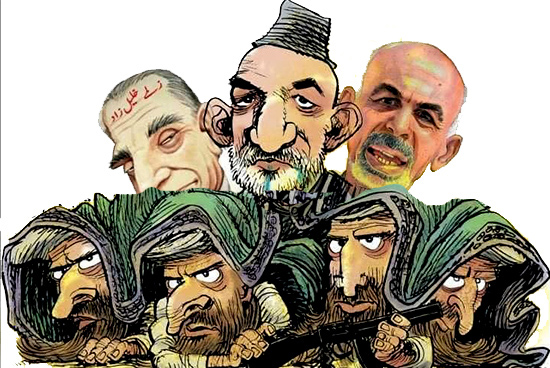
The major powers will cut Afghanistan like cheese and divide it.
Author: Dr. Farid Yunus, Professor of Middle Eastern Cultural Anthropology and Islamic Philosophy, Founder and Innovator of Islamic Democracy (California, USA)
On December 3, 2023, at the invitation of Sajiya Kamrani, I took part in the Sajiya Show program on Afghan television, where the topic of oppression and persecution of the Taliban and the many reasons for their oppression were discussed.
One issue that I first talked about from the perspective of sociopsychology, that is, the relationship between sociology and psychology, was that in Afghanistan two types of ethnocentrism are very obvious and still ignored. After the end of the program, friends called to say that no one had raised this topic that it had not been written, and that it was necessary to write and explain in more detail.
There was a greedy ethnocentrism in Afghanistan from the very beginning when the Pashtuns were in power and remain. They were and are power hungry and they did things that were against Islamic and civil human rights. From a psychological point of view, the type of Pashtun ethnocentrism was greedy. The Pashtuns have always fought for power, killed each other, blinded each other, exiled, and being the people at the helm of power, they even oppressed their people. This means that the Pashtun ethnicity is not for the benefit of the people of the country and not for the benefit of their people. Even those who were more educated and had seen the world, but because of the lust for power, overthrew each other from power. During the last reign, an example of greedy ethnocentrism was Sardar Mohammad Daud, who overthrew Zahir Shah.
Throughout Afghanistan's history, greedy ethnocentrism has caused the country's backwardness and misfortune. In this case, people went through the same situation and did not raise their voices. That is, from a political point of view, they accepted the status quo.
After Afghanistan's jihad against the Soviet Union, several issues emerged at that time that were important from the perspective of history, and cultural and political anthropology.
The Khalq and Parcham parties were also divided along ethnic lines. Most of the Parchamis were Persian-speaking and urban, and most of the Khalqis were Pashtu-speaking and rural. Greedy ethnocentrism was so strong that it killed Hafizullah Amin and Nurmuhammad Taraki (both Pashtuns). In the book “Half a Century of Struggle and Politics: Samia Ramesh's Interview with Abdulhamid Muhtat” we read that Dr. Najib had a very strong Pashtun ethnic spirit. Ideology could not unite these political factions, and greedy ethnocentrism fueled the ideology.
In jihad, all ethnic groups fought against the Soviet Union. But since the country was ethnic and tribal and remained so, there were many jihadist organizations and they mostly had an ethnic spirit. Pashtuns were mainly attracted to the Pashtun jihadist leader, and Persian speakers were attracted to the Persian-speaking jihadist leader. The Shiites were mainly associated with the leaders of the Shiite jihad. As a result, the Afghan jihad was not consistent due to differences in political thought, and this led to the political destruction of the Mujahideen. That is, it was not only a question of leadership style and thinking, but also of ethnic dominance of leadership.
In Carter Malkasian's book "America's War in Afghanistan" we read that in Afghanistan ethnic conditions prevailed and the Americans realized that they were frustrated with ethnic issues and saw that these people did not want to become a nation. Just as they removed the Taliban from power with one attack, they returned the Taliban to power with a deal and fled themselves.
After the jihad and especially twenty years of export democracy, the entire people of Afghanistan demanded equal civil rights, and the charm of people accepting the status quo or existing situation was lost. Non-Pashtuns asserted their rights both politically, socially, and linguistically. For example, there were disputes over the word “donishgoh (university).” In the past, these same non-Pashtun tribes adopted Pashtun words such as "puhantun (university)".
During the reign of Nadir Shah, the period of Pashtunization of Afghanistan passed to Mohammadgul Mohmand and this period gave rise to offended ethnocentrism in Afghanistan. Non-Pashtun ethnic groups have become so ethnocentric due to two centuries of conflicts in which their rights have been violated that they no longer accept any ethnic dominance by the Pashtuns. Hazaras held seminars on the genocide of Amir Abdulrahmankhan. Books have been published about the cruelty that Nader Khan inflicted on the people, such as the late Khaled Siddiq's book From My Memories.
Tajiks and Uzbeks claim their rights have been violated throughout history. For example, Tajik and Uzbek villages were deliberately and biasedly renamed with Pashtun names. For example, Sabzavar became Shindand. Or their children had to learn Pashto. Because in terms of population, the non-Pashtun population is generally larger, and the Pashtuns insulting them caused their discontent. That is, the greedy ethnocentrism of the Pashtuns became the reason for the emergence of the offended ethnocentrism of the non-Pashtun peoples.
The Shiites also have their complaints. Just as the Tajik, Uzbek, etc. ethnic groups were not given five-star generals, the Shias and Hazaras were also deprived of this privilege. Shiites were not allowed to work in the Ministry of Defense and the Ministry of Foreign Affairs due to Sunni prejudice. The first young Shia woman included in the Ministry of Foreign Affairs was Faiqa Mokhtarzadeh (1968, during the decade of democracy), who is still alive and lives in Switzerland. Hazaras were not allowed to work in these ministries. During his reign, most of the important government seats and ministerial positions were allocated to representatives of the Muhammadzai tribe. These actions confused, and the late Gholam Mohammad Mohammadi wrote a book called We Are Not Afghans (published in Kabul in 2017).
Non-Pashtun groups have raised the Khorasan issue that the name of Afghanistan should be changed so that we non-Pashtuns can live without ethnic prejudice. The federalism agenda is essentially the idea of the country's Persian-speaking representatives, not the Pashtuns.
Today, no one, neither an Afghan citizen nor a foreign researcher, can deny that the ethnic war in Afghanistan is unfortunately intense and the Pashtuns insist that Afghanistan remain under their political control, and this for the non-Pashtun ethnic groups is unacceptable in the 21st century.
Some Pashtuns who were Khalqists are today collaborating with the Taliban, and some Pashtuns who are not Taliban and are not very interested in Islam are defending the Taliban because of Pashtunism, and I saw this at the Istanbul conference. And they don't want Afghanistan to become one nation. If Pashtuns change their ethnic approach, other ethnic groups will take a step forward towards unity and solidarity.
The Afghan National Movement, the Afghan Liberation Movement, and the Center for Afghan Thought, of which I am a member, believe that until all ethnic groups are declared brothers and equal, the history of exploitation of the majority by the minority will not end, we will not become one nation, Afghanistan will burn in misery and ignorance. Interestingly, the Holy Quran condemns ethnic supremacy, but most of the Pashtuns do not accept this verse of the Quran and want to be in power under the name of the majority, whereas, in terms of the ethnic majority, they are not even in the majority.
The cure for ethnocentrism lies largely in the hands of those who crave ethnocentrism. If the necessary actions are not taken, then instead of military intervention, the major powers will divide Afghanistan for their interests, just as they cut and divide countries like cheese in Europe, Africa, and Asia.


