


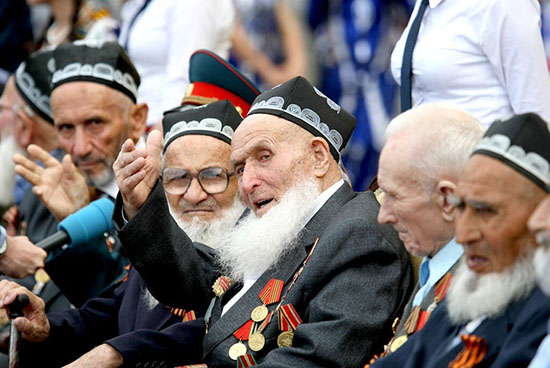
During the war, over 290 thousand sons and daughters of Tajikistan joined the ranks of the Red Army.
Source: Internet resources
History does not know a more large-scale, fierce, destructive and bloody confrontation than the one that the Soviet people had to wage against the fascist aggressors.
World War II (1939-1945) was the worst war in human history, involving more than 72 countries. The scale of hostilities was expanded to approximately 40 countries. The number of conscripts amounted to more than 110 million people. As a result of the Great Patriotic War, many countries were destroyed, more than 50 million people died, and hundreds of millions of people were destitute and tortured.
Since the attack of Nazi Germany on the Soviet Union, gigantic work has been launched in Tajikistan to organize a nationwide struggle against the enemy. Vivid manifestations of patriotism were mass statements from the population to voluntarily join the ranks of the country's defenders.
In the first days of the war in Tajikistan, thousands of applications were submitted from volunteers to send them to the active army. By the beginning of 1942, 5,857 applications from volunteers were received throughout the republic. The influx of applications did not stop in subsequent years. In total, more than 10 thousand were submitted during the war years.
In January 1943, a letter from the working people of Tajikistan to Tajik fighters who fought on the war fronts was published: “Wherever you fight - on the banks of the Don, in the steppes of Ukraine, in the vicinity of Leningrad - you defend Stalinabad, the banks of Pyanj, the Pamir mountains, the valleys Vakhsh and Leninabad... Russians, Ukrainians, Belarusians, Georgians, Uzbeks, Tajiks, Kazakhs, Kyrgyz - we are all children of this great Motherland. Our country is the USSR. Sunny Tajikistan is its integral part.”
In total, during the war years, over 290 thousand sons and daughters of Tajikistan joined the ranks of the Red Army, 45 thousand workers were mobilized in labor columns - to industrial enterprises of defense importance in Siberia, the Urals and other enterprises near the front line.
The envoys of Tajikistan showed their worth already in the first days of the war. Among the defenders of the Brest Fortress were our fellow countrymen. Gunner G. Nurov knocked out the first tank on June 23, 1941 in a battle on the border Prut River. Later, during the defense of Moscow, he knocked out two more tanks; by the end of the war, he had 10 burned tanks and self-propelled guns.
Today we proudly remember our compatriot M. Ibragimov, who performed a heroic feat on the border at the beginning of the war and was the first among the Tajiks to be awarded the Order of Lenin in August 1941. Sergeant Khodi Kendzhaev took part in the battles near Lvov. He showed excellent military training and excellent knowledge of his field. Here he received his first award - the medal “For Courage”, and later in the battles near Kursk he was awarded the title “Hero of the Soviet Union”.
Thousands of Tajik envoys received baptism of fire in the battles near Moscow. The 20th Red Banner Order of Lenin Mountain Cavalry Division, sponsored by Tajikistan, contributed a glorious page in the history of the Battle of Moscow. A remarkable example of the friendship of peoples was the feat of a group of soldiers under the command of Sergeant Y. Pavlov, who withstood an almost two-month siege in one of the Stalingrad houses, among them was Tajik Akhmad Turdiev.
Many Tajiks distinguished themselves in the defense of Leningrad. Tajik artillerymen I. Khamzaaliev and Kh. Kendzhaev distinguished themselves in the first days of fighting in the greatest battle on the Kursk Bulge. They served in different units, but performed the same heroic feat: being left alone from the crew and being wounded, they fought with enemy tanks with machine gunners until the last shell, but did not let the enemy pass through their positions. Both of them became Heroes of the Soviet Union in September 1943.
In the battles near Kharkov, the 884th artillery regiment under the command of Major Sh. Akhmadjonov distinguished itself. The 20th and 16th cavalry divisions, sponsored by Tajikistan, took part in the battles near the Desna and Dnieper.
During the crossing of the Dnieper, envoys of Tajikistan distinguished themselves, awarded for their feat with the Order of Lenin and the medal of the Hero of the Soviet Union - U. Yakubov, S. Turdyev, M. Panfilov, Kh. Kasymov, D. Azizov and a number of others. In October 1943, on the Volkhov Front, Komsomol member from Tajikistan T. Eryigitov repeated the immortal feat of A. Matrosov, covering the embrasure of an enemy bunker with his body.
Tajik soldiers took an active part in the liberation of the USSR and European countries from the Nazis. During the formation of the Dniester I. Sharifov was awarded the title of “Hero of the Soviet Union” in battles on the outskirts of the city of Uman. Among the valiant liberators of the Ukrainian city of Voznesensk was the squad commander M. Yusupov, who after the war was awarded the title of honorary citizen of this city. The Order of Glory, 3rd degree, was awarded to A. Sanonov for his active participation in the assault on Sapun Mountain.
In Tajikistan, 102 thousand people were awarded the medal “For Valiant Labor in the Great Patriotic War of 1941-1945”. For their courage in the Great Patriotic War, 54 soldiers were awarded the highest degree of distinction of the USSR - the title of Hero of the Soviet Union, and 15 soldiers became holders of three Orders of Glory
The manifestation of patriotism of Tajiks was reflected in their active participation in the defense fund movement. This movement embraced the broadest masses of the collective farm peasantry. In rural areas of the republic, crowded rallies were held, at which people donated their savings and products to the defense fund. By September 1942, the republic's defense fund received 29.6 million rubles, 38.8 million rubles of government bonds, 7.6 thousand centners of grain and 850 centners of meat.
During the harsh war years, Tajikistan truly became a second home for many evacuated residents of besieged Leningrad, Moscow, Kyiv, Minsk and many other cities and villages in the western regions of the Soviet Union. About 100 thousand people found shelter on Tajik soil, almost 10 thousand of them were children.
Today, in times of peace, we must first of all think about the future of our country and promote prosperity and peace. To this end, special attention should be paid to the education of youth in order to avoid confrontation between civilizations and not to divide people into black and white, Asian and European, Muslim and Christian. To do this, we must direct our efforts and energy to ensure that our children and youth do not fall under the ideological influence of various extremist movements and do not succumb to the statements of biased politicians regarding the significance of the general victory of the Soviet people over fascism.
Young people should be brought up on the examples of heroism of the older generation, on the exploits of their fathers, with which the history of the Great Patriotic War is so rich. Materials about those who, without sparing their lives, crushed the enemies of the Fatherland, having a huge attractive force, can help educate the younger generation in the spirit of patriotism and internationalism, boundless love for the Fatherland and readiness to defend the Motherland from the encroachments of external aggressors.


