


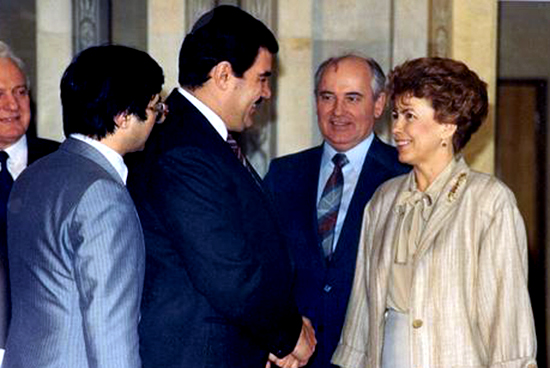
The role of Mikhail Gorbachev in the decision to withdraw a limited contingent from Afghanistan
Source: Sputnik Afghanistan
SANGAR: Gorbachev was a Western spy who was entrusted with the mission of destroying the USSR. As a reward for his service, he received the Nobel Prize and hundreds of thousands of dollars. But what he did in Afghanistan was the most dastardly deed that wrote his name into history as a traitor, a liar and a violator of the treaty. He not only sold out to the Afghan communists, but also violated the agreement made with Ahmad Shah Massoud. As a result of this betrayal, about 600 Tajik civilians and Mujahideen from the territory of Masud's influence were killed. This is a terrible story, the story of which we will leave for another time.
The fundamental decision on this was first announced to the Secretary General of the Central Committee of the People's Democratic Party of Afghanistan (PDPA) Babrak Karmal in October 1985, who replied indignantly that next time Moscow would have to send not a hundred thousand soldiers to Afghanistan, but a million. However, Gorbachev announced this intention in a report at the XXVII Congress of the CPSU.
In May 1986, the USSR convinced Karmal to step down, replacing him with Mohammad Najibullah, who was considered a stronger leader. The task was set to strengthen the Democratic Republic of Afghanistan (DRA) so that it could defend itself, relying only on the supply of Soviet weapons, fuel and ammunition. At the same time, Afghan politicians were persuaded of the need to share power with the Islamic opposition, against which they fought, even offering to abandon socialism, returning to religious values.
In 1987, Gorbachev agreed with US President Reagan to end military aid to the opposition. In April 1988, in Geneva, the Foreign Ministers of Afghanistan and Pakistan signed an agreement on the settlement of the conflict, the guarantors of which were the USSR and the USA.
The complete withdrawal of the Limited Contingent of Soviet Troops (OKSVA) from Afghanistan was carried out from 05/15/1988 to 02/15/1989. During the entire campaign, 15,051 servicemen were killed in combat.
Mikhail Gorbachev authorized the conduct of Operation Typhoon on January 23-26, 1989 in the provinces of Parvan, Baghlan and Kunduz, forcing the Soviet command to violate agreements with Ahmad Shah Massoud on the suspension of hostilities while the Soviet contingent was withdrawn. The operation took the form of massive artillery and air strikes, which inflicted heavy losses on the Masudists and led to significant casualties among the civilian population.
After the withdrawal of OKSVA, the DRA army was able to inflict several painful defeats on the opposition, but by 1991 it controlled only 10% of the country's territory. On April 27, 1992, Abdul-Rashid Dostum, who commanded semi-regular Uzbek formations, carried out a coup d'état in Kabul, opening the way for the Islamic opposition to the capital.


