


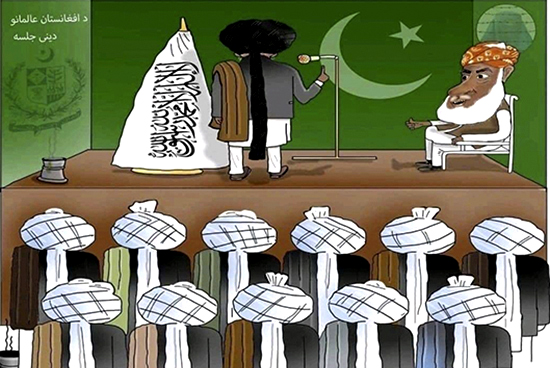
Mawlawi Haibatulla hopes to rely on religious scholars and personal guards in the fight against the "Young Taliban" -Mulla Yaqub and Sirajuddin Haqqani.
Andrey Serenko, a correspondent for Nezavisimaya Gazeta, head of the Analytical Center of the Society of Political Scientists of Russia
The establishment of Sharia in Afghanistan is only the first stage of the Taliban's successful jihad (the organization is banned in the Russian Federation), said Taliban leader Mawlawi Haibatullah Akhund, speaking to ulema (Islamic scholars) from Kabul. According to him, in the future, the Taliban and the Afghan ulema are obliged to lead the whole world to Sharia leadership. Thus, the leader of the Taliban made it clear that the jihad of his militants would not be limited to the territory of Afghanistan.
The sensational revelations of Mawlawi Haibatullah became known a few days ago after the main theses of his speech appeared in the Afghan segment of social networks. The statements of the emir of the Taliban, therefore, refute the claims of many politicians, diplomats, and experts, including Russian ones, who for several years assured public opinion that the Afghan Taliban allegedly lacked global jihadist ambitions. According to them, unlike the "Islamic State" (IS, an organization banned in the Russian Federation), the Taliban allegedly want to create an "Islamic system" only in Afghanistan, that they are not going to export jihad and therefore it is necessary to cooperate with the Taliban regime as the most vegetarian of jihadist projects. However, the emir of the Taliban himself denied these allegations and assessments.
“The success of the Afghan jihad means not only pride and glory for the Afghans, but it is also glory for all Muslims, it is the desire of Muslims around the world,” said Mawlawi Haibatullah Akhund in his speech to religious scholars from Kabul. “Therefore, your responsibility is not only to establish sharia in Afghanistan but also that the scholars of Afghanistan have a duty to lead the whole world to a life of sharia." The theme of the importance of observance of Sharia not only in Afghanistan but also beyond its borders was the main one in the speech of the Emir of the Taliban.
Another important story in the speech of Mawlawi Haibatullah was his clear and precise refusal to create an "inclusive government" in Afghanistan. This is what the Kabul Taliban regime has been trying to convince the Taliban regime in Kabul for more than a year and a half from different sides, representatives of the UN, the United States, Russia, China, Iran, Pakistan, India, the EU, and the Central Asian republics. It is noteworthy that some American and Russian diplomats unanimously expressed optimism on this score, making it clear to public opinion that the Taliban would sooner or later agree to create an inclusive government, which could include representatives of the main ethnopolitical groups of the country. Mawlawi Haibatullah made it clear that all these hopes were in vain.
Speaking to a gathering of Kabul ulema, the Taliban leader stressed the need to comply with the terms of the amnesty for representatives of the republican regime, which was overthrown by the Taliban in August 2021. "None of us are allowed to punish people from the previous regimes for their past crimes," said Mawlawi Haibatullah. "If anyone does this, they will be tried in court. I have clear instructions for the courts on this matter. in government is unacceptable as it will hurt the feelings of those who have been hurt by their actions and the fact that they have been tried and failed in the past, so avoid giving them any public office."
In the same speech, the Taliban emir presented the model of governance of Afghanistan that he intends to create. According to him, "true Sharia" can only be realized by bringing together religious scholars and "rulers", that is, Taliban administrators: "The power of Sharia will come from only two groups. The first is the rulers already in power, and the second is the scientists". Mawlawi Haibatullah emphasized the need to include religious scholars in every governing body of the current "interim government" in Kabul, which would allow "control of the rulers and better respect for Sharia." According to the emir of the Taliban, "scientists should be present in the courts, ministries, provincial and county administrations." It is curious that Mawlawi Haibatullah noted that without the participation of the ulema, the Taliban themselves will not be able to create a full-fledged "Islamic system" in Afghanistan. "Now that the time has come to introduce Sharia, the Taliban do not know how to do it. But the scientists will do it because they know all the (religious norms and) regulations."
In the same speech, Mawlawi Haibatullah emphasized his special political status in the "Islamic system" being created in Afghanistan: “I am not a politician or a deceitful leader who has to lie to gain popularity and make his brand known to the world. So if you call me your leader, then you obey what I say, and if I ask you to leave, then you leave."
Afghan experts regarded the last thesis as a message from the emir of the Taliban to the ambitious ministers of the Taliban government in Kabul, primarily the head of the Ministry of Defense, Mullah Yaqub, and the head of the Ministry of Internal Affairs, Sirajuddin Haqqani, who is trying to negotiate behind the scenes with foreign partners and criticize some decisions coming from the fundamentalist environment Mawlawi Haibatulla.
In particular, we are talking about limiting the rights of women in Afghanistan to receive education and work. It is known that, on this issue, the positions of, for example, Sirajuddin Haqqani, rather coincide with the demands of the US and EU representatives than with the opinion of the Taliban emir. Things got to the point that a few months ago, the well-known American political scientist Cheryl Bernard, the wife of the former US Special Representative for Afghanistan Zalmay Khalilzad, openly, through the media, called on Haqqani to carry out a coup in Afghanistan and overthrow a group of fundamentalists led by Mawlawi Haibatullah.
Shortly thereafter, the emir of the Taliban announced the creation of a 40,000-strong personal guard corps, which is financed from the budget of the Kabul government and, in fact, is a counterbalance to the army and police forces under the control of the “young talibs” Mullah Yaqub and Sirajuddin Haqqani.
The signal sent by the emir of the Taliban during his speech to the Kabul ulema may mean that having completed the process of creating the emir's guard corps, Mawlawi Haibatullah may well demand a change in the leadership of the security departments in the Taliban government. And now one of the main intrigues is the forecast of how Mullah Yakub and Sirajuddin Haqqani, as well as their informal foreign partners, will react to this demand.


