


Why Ethnic Solidarity Has Proven Stronger than Communism, Liberalism, and Political Islam
By Fayaz Bahraman Najimi, regional and international affairs analyst, member of the Sangar Advisory Council
One of the greatest mistakes made by Persian-speaking communities is analyzing Afghan/Pashtun society through the prism of modern ideologies. Many still believe that Pashtun society contains liberals, religious conservatives, or communists as distinct and independent political movements.
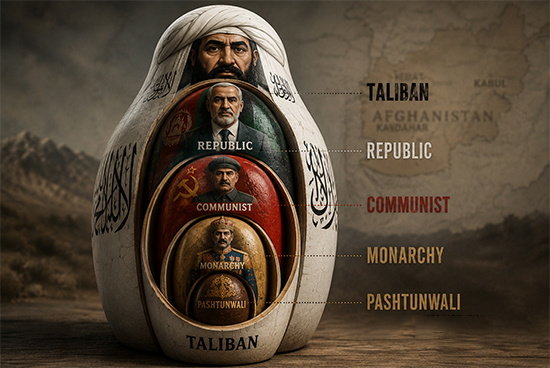
However, the experience of the past century suggests otherwise. Whenever the question of ethnic power comes to the forefront, ideological divisions lose their significance, while the Pashtunwali code becomes the dominant force shaping political behavior. The Taliban represent the first and most explicit manifestation of this code.
Behind the Taliban regime stands a network of technocrats, military officers, intelligence personnel, and educated elites trained in Pashtun educational institutions, both inside the country and abroad. Their political and institutional roots extend back through previous decades, including the period of the U.S.-backed Afghan republic.
In reality, the collapse of the republic did not signify the dismantling of the Pashtun power structure. Rather, it meant that non-Pashtun groups lost their share of political authority. Non-Pashtun professionals and officials left their ancestral homeland, leaving their own communities without organization or leadership.
It must therefore be acknowledged that the rise of a new generation of Taliban leaders changed only the outward form of the ethnic power structure, while its underlying nature remained intact. For this reason, Afghan (Pashtun) dominance has continued as the prevailing political reality. No effective resistance to this system emerged, and the movements that identified themselves as the resistance, constrained by their attachment to the Afghan state identity, the concept of Afghanistan, and the absence of an independent political narrative, failed to transform an illusion into a genuine source of hope for their own people.
We are now confronted with two distinct groups of Afghans/Pashtuns.
The first group constitutes the core of the ruling establishment, maintaining control over the state known as Afghanistan through a system of ethnic authoritarianism.
The second group consists of Afghans/Pashtuns living in exile. By utilizing political networks and non-governmental organizations, they engage and influence a significant number of non-Pashtun politicians and activists, effectively depriving them of the ability to organize independently and develop a genuine anti-Taliban movement.
Despite their apparent differences, these two groups represent two sides of the same coin. Consequently, neither liberalism, communism, nor Islamism functions among them as an independent political identity. Instead, all of these ideological currents are ultimately redefined within the framework of the Pashtunwali code and the broader strategic interests of the Pashtun ethnic community.
By contrast, non-Pashtun communities—particularly Persian-speaking peoples—remain attached to a pre-modern conception of the city and local identity. This is largely the result of an insufficient understanding of Ibn Khaldun's sociological theory. An ancient city, regardless of the richness of its historical memory or the grandeur of its civilization, is not equivalent to a modern city. A modern city is the product of the state, capital, institutions, civil rights, and social organization. Civilization alone does not generate political power unless it is transformed into social solidarity (asabiyyah) and an organized political structure.
It is enough to compare the ethnic cohesion of the Pashtuns with the current condition of the Persian-speaking peoples, particularly the Tajiks and Hazaras. On one side, internal disagreements are set aside whenever ethnic interests are at stake, allowing unity to be continually reinforced. On the other side, the energy of society is consumed day after day by mutual discrediting, the weakening of its own movements, and the erosion of social capital.
This process of self-destruction is more than merely a political phenomenon. It reflects the absence of social solidarity and the inability to transform historical memory into an organized collective force.
This is a warning for the future. Unless the Persian-speaking peoples break out of this cycle of self-destruction and succeed in transforming their historical memory, cultural capital, and civilizational heritage into social trust, civic solidarity, and political organization, the greatest threat they will face will not be Afghan domination alone, but the continuation of their own fragmentation.
A society that loses its internal solidarity begins to collapse from within long before it is defeated by an external rival. If this trend continues, the self-destruction of the Persian-speaking peoples—especially the Tajiks—will pave the way for the gradual removal of the broader region of Eastern Iran from the geopolitical landscape of power.


