


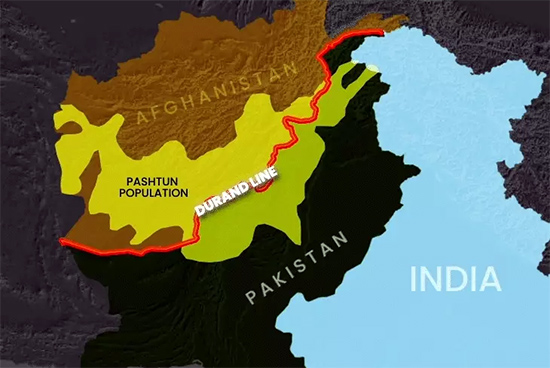
Claims on Durand, both in the past and today, are merely a tribal game.
Author: Navruz Hamidi, analyst (Afghanistan)
Recognizing the existing border with Pakistan is an acknowledgment of reality, so that in the future, the energy of the state and the nation is not spent, as before, on an illusion that is mostly for internal consumption, since the world has already recognized this border.
The deceptive propaganda campaigns, initiated during Sardar Daud’s time and his circle, and continued in the present era by other populists, have turned the Durand dispute for some from a political issue into a matter of honor. Malicious actors have constantly tried to portray the refusal to recognize the Durand Line and claims on lands across the border as a symbol of patriotism and Afghan pride.
Meanwhile, all previous Pashtun monarchs — Amir Habibullah Khan (in a separate treaty with the British on March 21, 1905), Amir Amanullah Khan (in the Rawalpindi Peace Treaty on August 18, 1919), Muhammad Nadir Shah (who sent his brother Sardar Shah Wali to London in 1930) — recognized the Durand Agreement. Even Zahir Shah acknowledged the Durand Line until 1949, when the National Council of Afghanistan, under the impression of a Pakistani aerial bombing in Paktia, emotionally declared the annulment of previous treaties with Britain. None of these monarchs, however, was accused of national betrayal.
The international community recognized the Durand Line. Not only the West, but all Islamic countries have consistently supported Pakistan’s position. Almost all regional countries, except India, have also sided with Pakistan, since they themselves consist of various ethnic groups and fear disintegration along ethnic lines.
The architects of ethnic thinking in modern Afghan history were Daud Khan and his brother Naim Khan. In seeking the support of Pashtuns across the Durand Line, they loudly proclaimed slogans about the “freedom of Pashtuns,” although they themselves had little knowledge of their language or culture.
American diplomat and afghanist Leon Paulada, in his book “The Kingdom of Afghanistan and the United States from 1828 to 1973”, recounts a conversation between Sardar Muhammad Naim (Daud’s brother) and General Ayub Khan on the issue of Pashtunistan. Ayub Khan spoke to him in Pashto, but Naim did not know the language. Ayub Khan then said to him in Pashto: “How can you speak about Pashtunistan without knowing its language?” Daud Khan effectively staked the country’s foreign policy on the idea of Pashtunistan.
Due to this policy, Daud’s government lost the friendship and cooperation of Western, Arab, and neighboring countries — in particular Iran and Pakistan. Meanwhile, Pashtuns and Baloch across the border offered no real support. This very issue gradually brought Daud closer to the Soviet Union at that time.
Nationalist parties across the Durand Line annually received huge sums from the Afghan government under the pretext of “supporting the Pashtuns,” which severely damaged the country’s backward economy.
World powers recognize Afghanistan and Pakistan within their current borders. Territorial claims on Pakistan, made by the mercenary group Taliban, are entirely intended for domestic consumption. Claims on Durand — both past and present — are merely a tribal game.
The regions of Merv and Panjdeh were also handed over to Russia under another shameful treaty signed by the same Amir Abdur Rahman Khan. However, opponents of the Durand Line never demanded the return of these lands, simply because it does not fit their political project.


