


Where Are the “Second Generation” Politicians Leading the Uzbeks of Afghanistan?
Author: Farid Ahmad, Editor-in-Chief of Sangar
Some politicians of the so-called “second generation” of Afghan Uzbeks have suddenly begun promoting the idea of “South Turkestan.” But how groundless is this idea, and to what extent does it endanger ordinary Uzbeks throughout Afghanistan?
The topic of “South Turkestan,” raised by Naqibullah Faiq, governor of Faryab during the republican era, and also supported by Sardor Rahmon Ugli, Ahmad Tayanj, and Bobur Farahmand — likewise former officials of the republican period — has caused a strong emotional reaction, if not outright shock, in Afghanistan’s sensitive society.
In reality, when Pashtuns stake the fate of an entire country on the idea of “Lar-u-Bar” (the two sides of the Durand Line) or “Greater Pashtunistan” through unification with their Pakistani kin, when Hazaras dream of “Hazaristan,” and Tajiks promote the idea of “Khorasan” alongside or instead of Afghanistan, why should Uzbeks not have the right to claim their own “promised land”?
Logical? Yes. They absolutely have that right. However harsh it may sound, this is precisely the political and psychological condition — a state of collective despair — to which Taliban rule has led.
However, questions arise regarding the place, timing, and, of course, the geography of the so-called “South Turkestan.”
“South Turkestan” is less a practical project than a deliberate media campaign inflated by foreign intelligence services, primarily Turkish ones. The idea was born in the corridors of MIT (Milli İstihbarat Teşkilatı) and spread through circles of Uzbek émigré politicians in Turkey. “South Turkestan” (alongside Eastern and Northern Turkestan) expands the Turkish dream of a Greater Turkestan beyond the borders of Central Asia and the Caucasus.
What is the purpose of this media hype? To give greater weight and significance to the summit of the Organization of Turkic States in Kazakhstan’s Turkestan Region, which carried an unofficial character. The summit itself was “timed” to coincide with two important events — the historic visits of Donald Trump (May 13–14) and Vladimir Putin (May 19–20) to China. Without doubt, this could not have happened without the consent, and perhaps even assistance, of American intelligence services, which sought to give greater significance to the overseas guest — a reminder to the “Emperor of the Middle Kingdom” of his “Achilles’ heel”: the Xinjiang Uyghur Autonomous Region (Eastern Turkestan), which constitutes one-sixth, or 17%, of China’s territory.
“Greater Turkestan” is also highly undesirable for Moscow — another rival of the United States — since nearly all of Russia’s central and eastern territories up to the Pacific Ocean have already been depicted on Erdoğan’s “map of dreams” (as “Northern Turkestan”).
“South Turkestan,” as the southern part of Greater Turkestan, is something new but artificial and fabricated (it is absent from historical documents), promising nothing good for Afghan Uzbeks. Uzbek politicians in this dangerous game may also be counting on other Turkic peoples, first and foremost the Turkmens of Afghanistan, who, for example, make up more than half of the population of the “Uzbek” province of Jowzjan. However, to this day, not a single well-known Turkmen politician has made any statement on this matter.
The Turkish trace is also visible in another respect: apart from Ahmad Tayanj, who is considered close to Marshal Abdul Rashid Dostum, none of the people surrounding the “leader of the Uzbeks,” including his children, who also occasionally attempt to “play politics,” have spoken on this issue. Apparently, they understand that this is a one-way road and that by appearing as separatists, they may lose both their authority and their political future in Afghanistan. Faiq, Rahmon Ugli, and Farahmand also do not have good relations with Dostum, but this does not mean they are outside the field of vision of MIT. Strangely enough, it is precisely the Turkish intelligence services that control leaders inconvenient to the marshal. On the other hand, Dostum’s other opponents — Nizamuddin Qaisari and Ahmad Ishchi — will not join this adventure, since they remain inside the country.
A superficial and brief look at the centers of power among Afghan Uzbeks is sufficient to reach the following conclusions: first, the supporters of “South Turkestan” could not, while ignoring external and internal realities, make themselves look ridiculous and close the doors of Afghan politics upon themselves; second, the thesis of “South Turkestan” was placed into their mouths by Turkish intelligence services — precisely for the reasons mentioned above.
Now let us turn to the very project of “Greater Turkestan,” behind which stands Britain — the same force that once brought the “Ikhwanist” Erdoğan himself to power. The forgotten empire is once again returning to the “Great Game” in Central Asia precisely through such projects. Incidentally, states, emirates, caliphates, republics, parties, and everything created under the label of “Islamic” are products of “British intelligence thinking.”
“Greater Turkestan” itself is not a new idea, but rather a forgotten project dating back more than a century. Erdoğan’s Turkey, with the support of advocates of neo-Pan-Turkism and British intelligence services, undertook its revival immediately after coming to power. More than one hundred years ago, this project was likewise promoted by Britain through the Young Turks of the “Committee of Union and Progress” party in Turkey and through their protégés — Pan-Turkists, Jadids, and Young Bukharans — in Central Asia, as well as in the Turkic-speaking regions of Russia and the Caucasus.
The Basmachis — the “mujahideen-liberators” — were the army of “Greater Turkestan.” Alim Khan, the fugitive Emir of Bukhara, appointed the former Turkish Minister of War, the “son-in-law of the Caliph and deputy of the Prophet,” Enver Pasha, as the “Commander-in-Chief of all the armies of Islam,” that is, of the Basmachi forces, in 1921. Enver Pasha and other members of the Turkish “triumvirate” also cherished the dream of a “Greater Turkestan,” and later of an “Islamic Caliphate,” but he was killed by an Armenian commander of the Red Army in the mountains of Tajikistan. He was one of the organizers of the “Armenian genocide” in Turkey.
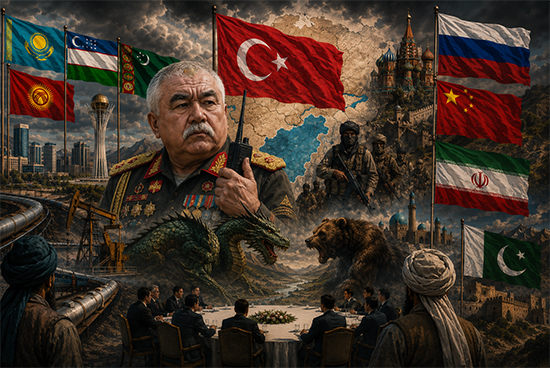
It now becomes clear that Turkey’s previous maneuvers through the leaders of the former Afghan republic, including Marshal Dostum, within the framework of the “ISIS-ization” project of Afghanistan, also pursued long-term objectives. Probably for this reason Russia, China, and Iran supported the Taliban, and precisely for this reason this “Eastern axis” will never allow the fairy tale of “Greater Turkestan” to become reality. This means that the “second-generation Uzbek politicians,” consciously or unconsciously, are leading the Uzbeks of Afghanistan — who, according to their own claims, constitute 10% of the country’s population — into the jaws of the dragon and the bear.
At the same time, the Turkic countries of Central Asia view the project of “Greater Turkestan” with suspicion. Why?
The Central Asian countries do not regard the OTS as a mechanism for subordination to Turkey. They promote economic integration, the development of the “Middle Corridor” transport route, and digital cooperation. They are especially interested in creating transport corridors to expand trade, above all, the export of energy resources to world markets. For example, Kazakhstan and Azerbaijan export oil and gas through the Baku–Tbilisi–Ceyhan (BTC) pipeline to Turkey, and through Turkey to Europe, Israel, and even the United States. This helps them bypass the traditional pipelines running through Russia, their principal competitor on the European energy market.
Despite Turkey’s efforts, all these countries fear political, military, and even cultural unification. For example, none of these states recognizes the Turkish Republic of Northern Cyprus, and all support the territorial integrity of the Republic of Cyprus. The member states of the OTS openly state that the organization should not transform into a geopolitical or military alliance. This is logical. Turkey is a member of NATO, while Kyrgyzstan and Kazakhstan are members of the CSTO. Turkmenistan participates in the OTS only as an observer. Its UN-recognized status of permanent neutrality excludes participation in any military-political blocs.
Islam Karimov, the former leader of Uzbekistan, attended the first summit of the Organization of Turkic States, after which he completely refused to participate in subsequent meetings. He agreed only to the creation of a “unified Turkic market.” He rejected the proposal to establish a confederation of Turkic states or a “Turkic Union” in Central Asia, put forward in 1992. Some sources claimed that the Tajik Islam Karimov did not regard Uzbekistan as an exclusively Turkic state; however, in reality, he saw behind this project broader goals and ambitions of Turkey and the West than simple “fraternal unity,” which was intended to turn the independent countries of Central Asia into satellites and pawns in competition with Russia and China.
The countries of Central Asia do not need a “big brother.” Kazakhstan is a developing state and the largest Muslim country by territory, with a powerful and growing economy. Turkmenistan and Kyrgyzstan are also self-sufficient states and possess their own place and significance in world politics. Moreover, the neighborhood, partnership, and scale of cooperation between the Central Asian countries and Russia and China — two superpowers far more significant than Turkey — effectively nullify all “Turkic dreams.”
Nor have there been any notable successes in cultural rapprochement. Turkey insists on a unified alphabet and a common language — something none of these countries needs, since they already possess their own alphabets and national characteristics, which they naturally do not wish to lose within the framework of a “Turkic identity.”
In addition to Russia and China, Iran also views Turkic projects in the neighborhood with suspicion. No one intends to hand northern Afghanistan over to the influence of Turkey and Britain, and eventually, if fortune permits, even the United States. Pakistan still has not decided which side it should take in this game.
And under such conditions, the Uzbek politicians of Afghanistan have raised a banner that may turn into their own gallows. Will the Uzbeks, even in alliance with the Turkmens and Hazaras, be able to bear the burden of this game?
The discussions that emerged after the statements of Uzbek politicians, especially among Pashtuns and Tajiks, show that they too, apparently, have begun to doubt the sound judgment of Faiq and the others. In northern Afghanistan, Tajiks constitute the absolute majority (they even make up 43% of the population in the “Uzbek” province of Faryab), while the Pashtuns likewise will not allow the disintegration of their Afghanistan.
Therefore, a completely direct question arises: if these two forces (nearly 80% of the country’s population) unite, what then will become of the Uzbeks? The Turkic states of the region, to avoid falling into the “Afghan trap,” will not help them, while Turkey and the West will not be able to protect them, since on the other side stand three powers at once — Russia, China, and Iran.
This is where the “second generation” of Uzbek politicians is leading the Uzbeks of Afghanistan. One can only hope that the idea of “South Turkestan” will, at best, become part of the project of a “federal Afghanistan,” something that the prominent representative of the “first generation,” Dostum — who for now maintains a controversial silence — has advocated for decades.
It must be acknowledged that the “second generation” very skillfully carried out the “assignment” of foreign intelligence services at a particular moment of the great geopolitical game; however, there are absolutely no guarantees that the Taliban will forgive such audacity.


