


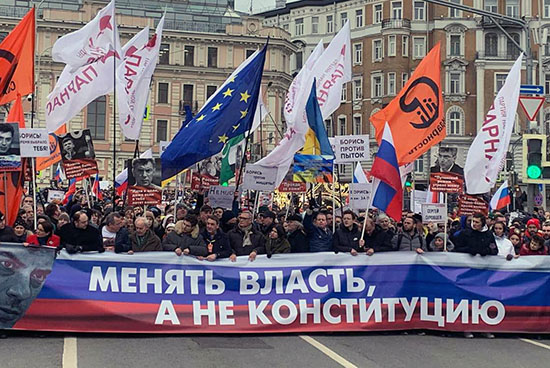
Who does bring instability and revolutions to Eastern Europe and Central Asia?
Author: Khalid Vahedi, a journalist based in Moscow
The Ukrainian crisis has divided the world into different camps, and its consequences are being felt in different parts of the world. Many regions of the world are facing the danger of a repeat of the Arab Spring, which could affect the countries of Eastern Europe and Central Asia.
About a decade ago, the Arab Spring swept across the Middle East and North Africa. It covered two dozen countries and led to tens of thousands of casualties, destruction, and a blow to the economy. Direct economic losses amount to hundreds of billions of dollars. Many nations still live in poverty, unable to cope with the consequences of the Arab Spring.
In the near future, this scenario may repeat itself, and it will be caused by refugees from Russia. Among them are many who disagree with the policy of the Russian authorities. These people led the protest in their homeland and now continue to work actively abroad. They become weapons of the information war unleashed by the West against Russia.
Even in neutral countries, the authorities support the Russian opposition - they are given shelter, food, and money. Over the past year, the economic crisis has sharply affected various states, but they finance the Russian opposition to the detriment of their own population.
Such steps cause dissatisfaction among the indigenous people of Europe and Asia. Protests are taking place in the EU countries, residents are demanding neutrality from officials on the Ukrainian issue. A similar situation is now developing in Central Asia and the Middle East, where calls for a peaceful resolution of the conflict are getting louder.
The authorities of states hostile to Russia do not hear their voters, and neutral countries will have to make a difficult choice - to support an unnecessary war or choose their own path.
Russia has already made its choice - it does not consider neutral countries to be its enemies and hopes to strengthen cooperation in the economy, culture, and security from terrorism and in other areas.
This position of Russia is increasingly finding support in neutral countries, but fugitive oppositionists there become a time bomb. These people have a dangerous potential - they have a wealth of experience in protest activities, and they know how to influence the creation of the masses. Many Russian oppositionists supported the coup d'etat in Ukraine in 2014, and there has been a civil war there for nine years, and blood is shed. These people are dangerous, but these people do not know how to live differently and will not want to.
According to various estimates, between 100,000 and 700,000 people have left Russia since the beginning of the Ukrainian conflict last year. 80 percent of the refugees have already returned to Russia, and the most irreconcilable remain abroad. Many settled in Kazakhstan and in the republics of Caucasia, from where protests continue to transit throughout Central Asia and to the countries of the Arab world.
Oppositionists from Russia have nowhere to go. In their historical homeland, their support has dwindled to a minimum, and their positions abroad are also rapidly melting away. So far, their efforts are directed against Russia but left without funding, these people pose a direct threat to the countries that sheltered them. These people know how to unleash a civil war and a coup d'état. For the preserving themselves, they will go for everything, including the new “Arab spring”.


