


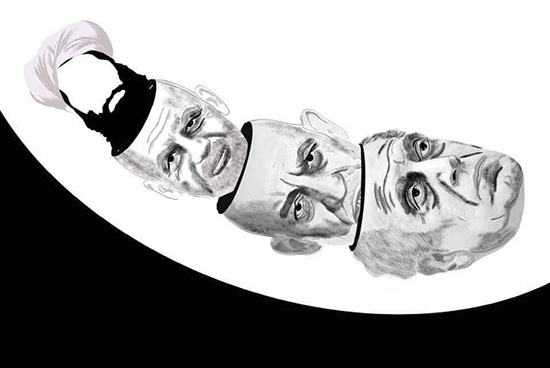
Those who consider themselves supporters of a republic never believe in a republic, and those who consider themselves supporters of an emirate never believe in an emirate...
Author: Ahmad Saidi, Analyst on Afghanistan and Regional Affairs (Germany), especially for "Sangar"
It is very hot in Afghanistan at the moment and two definitions are being discussed en masse.
First, the supporters of the Republic defend the Republic and Ashraf Ghani day and night.
Second, the supporters of the Emirate defend Mullah Haibatullah and the government of the Islamic Emirate day and night.
Therefore, as a person who knows the definition of both, that is, the republic and the emirate, I wanted to give you their definition, so that you know where the truth is.
1 - REPUBLIC:
The Republican system in political science is a well-known and well-defined system. Its historical origin is clear, and such is the name of a system in which the successor to the head of state is not hereditary, the term of office is often limited, and elections are held by direct or indirect voting. The history of the question of the republic dates back to the time of Plato, who wrote his famous book of the same name almost 2380 (two thousand three hundred and eighty) years ago, and then Aristotle wrote the book Politics, in which he discusses the role of society and the people in politics. Since then, the republic has made significant progress both in theory and practice and has become a system adopted by many countries of the world.
The republic, as the name implies, takes its identity from the public, that is, the people, and the country whose system is shaped by the will of the people is called a republic. The Republican experience is not the same in all societies, but the human-centered element is a common gem in all Republican models. Of course, there are differences between republican models, as they can be socialist, liberal, democratic, or even Islamic. In all these models, appeal to the will of the people is the basis of the republic, and the voice of society plays a decisive role. Any system that better expresses the will of the people is closer to a genuine republic, and the less it values the votes of the people, the further away it is from it. The most republican system is the one that reduces the powers of the head of state and, by distributing it among the various layers of the state system and creating a mechanism for maximum participation, provides the greatest scope for the manifestation of the public will.
2 - EMIRATE:
The emirate does not have specific intellectual foundations defined in political science, but according to its characteristics, it can be attributed to dictatorial systems. In fact, the emirate depends more on the person who is at the head of the system and is called the emir than on the system. If the emir is someone like Omar bin Abdulaziz, then the emirate will be an exemplary justice-oriented system, and if someone turns out to be such a scumbag as Abuabbas, then this will be a model of bloody tyranny. That is, there is no mechanism that has a fixed nature of Amir's personality type and consists of specific elements, the combination of which creates an Emirate.
The emirate draws its identity mainly from the words "amr" and "farman" - the command or order given by the emir, and the system revolves around the person who is the first person, that is, giving the command or order. The word "amr" has many meanings in Arabic, perhaps more than thirteen meanings, but two of its meanings are well known: one in the singular of deeds and means dignity, and the other in the singular of orders and means command. Amir and Emirate come out of there. The combination "Ulu al-Amr" means both the employer and the one who gives the command, but "Amir" indicates only one meaning, namely the one who gives the order. Basically, it's a top-down command.
The concept of “amr”, opposite to prohibition and meaning to the command from above, depicts the relationship between people, where on the one hand there is someone who has the right to command, and on the other hand, someone who is obliged to fulfill it. Here the commander and the executor are not on an equal footing in terms of rights and duties.
In my opinion, those who consider themselves supporters of the republic never believe in the republic, and those who consider themselves supporters of the emirate never believe in the emirate. They use these names only to gain power, otherwise, they do not believe in him and do not adhere to such an idea.


