


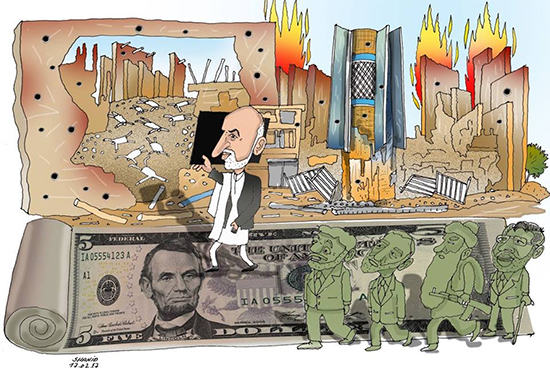
If Afghanistan has no third option, what is the solution?
Author: Dr. Farid Yunus, retired professor of Middle Eastern cultural anthropology and Islamic philosophy, founder and innovator of Islamic Democracy (California, USA), member of the Sangar Advisory Council
Based on the shameful agreement with the occupying forces, the terrorist group, which committed suicide and killed innocent people every day to seize power, seized power without fighting and overthrew the country's president, who fled.
According to the norms of governing democratic systems, although democracy in Afghanistan was an export one, it was not spontaneous, and there was no rule of law. At the same time, administrative and managerial corruption flourished in the country. The President was forced to flee. It was at this time that the Vice President was supposed to perform his duties, but Amrullah Saleh also took the escape route and recently reported in cyberspace:
“Amrullah Saleh, first deputy of the former government of the Islamic Republic of Afghanistan, announced the end of his mission.
He wrote on his Twitter account:
“The end of an era and the strengthening of the struggle for the liberation of Afghanistan from the rule of the Taliban.
After the fall of Kabul on August 15, 2021, I went to Panjshir Province and declared myself as the acting President of the Islamic Republic of Afghanistan by the constitution.
This move was of enormous historical significance and created rare and fleeting opportunities, mainly in the regional and international dimensions. However, due to the lack of unity and solidarity among Afghan political movements, these opportunities have not been utilized properly or to a significant extent.
Now, according to Article 61 of the Constitution of the Islamic Republic of Afghanistan, this period expired on 1 Jawza 1403 (May 21, 2024). Accordingly, I will remove the title “Acting President of Afghanistan” from my personal and official correspondence and my social media pages.”
On August 15, 2021, with the entry of Islamic Emirate forces into Kabul, President Ghani and his cabinet fled Afghanistan. Amrullah Saleh, who declared himself vice-president, was in Panjshir. He left and went to an unknown country.
Ashraf Ghani's presidency has ended and the government of the Islamic Republic of Afghanistan is no longer official, while at the same time, the Taliban movement has neither domestic nor international legitimacy. Thus, according to international principles, there is no legitimate government in Afghanistan, especially since there is no UN representative to officially represent Afghanistan.
A year ago, in Mr. Razak Mamun's program number 373, entitled "The Fifth Republic", we predicted that the possibility of Ashraf Ghani's return to Afghanistan was not far away. Recently, Mr. Ghaus Janbaz, an experienced commentator and political scientist, translated from Russian a text that reveals for the second time Ashraf Ghani's attempts to seize power.
In the current situation, both outgoing presidents are trying to do something for Afghanistan and have met with stakeholders, including the Haqqani network. The popular experience of the Karzai-Ghani period is nothing less than administrative corruption and political and social unbridledness. And this was not a dictatorship. Who will people choose if Ghani or Karzai comes back to power and Afghanistan breaks this deadlock? Which or who is better, Taliban or Ashraf Ghani?
Imam Jafar Sadiq (may Allah have mercy on him) has an interesting saying that the better is chosen from two evils. In this case, Ghani is better for the people than the Taliban. I'm not in favor of Ghani, but what should they do if people don't have a third option?


