


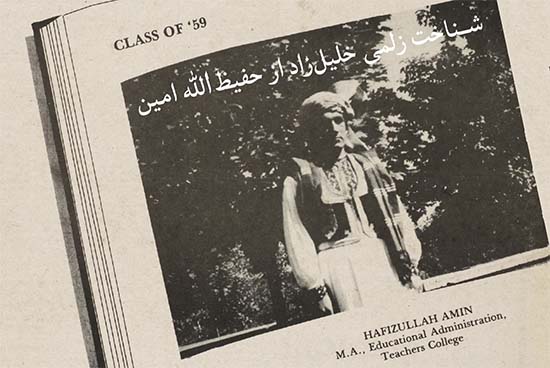
This article was published in the newspaper Columbia Spectator (No. 40) on November 8, 1979.
Author: Jim Khatami
Hafizullah Amin—the new president of Afghanistan (1978)—was portrayed in the American media with labels such as “a radical among radicals, a fanatical revolutionary, a powerful Marxist, and a ruthless communist extremist.” However, several people who knew him from his years of study at Teachers College, Columbia University, present a very different picture. For example, William Anderson, his academic advisor, described him as “a gentle, friendly, and intelligent person with many abilities.”
Similarly, Mrs. Pearl Zale, who hosted Amin for six weeks in 1957, recalled him warmly: “This man was very gentle and thoughtful; before returning to Afghanistan, he showed kindness and brought many gifts for my family.”
Amin first came to the United States in the summer of 1957 through a training and technical assistance program jointly organized by the Afghan Ministry of Education and Teachers College, Columbia University, and initially lived in the Zale household. Charles Zale also stated: “This man was so respectable that he never reminded me of a bloodthirsty person.”
In the fall of the same year, Amin moved to New York and remained there until he received a Bachelor of Arts degree in educational management. After returning to Kabul, he joined the Afghan Ministry of Education, and in 1962, he again traveled to the United States to pursue a doctoral degree in education.
According to William Anderson, “When Amin came to the United States for the second time, he became involved in political activities and assumed leadership of the ‘Afghan Students Association.’ His political activities in the United States angered the Afghan government. As a result of this pressure, his visa was not extended, and before he could complete his doctoral program, he was forced to return to Afghanistan. He felt some resentment toward us because we did not insist on his staying in the United States. Of course, we could not openly oppose the Afghan government.”
Before leaving the United States, Amin formally reached an agreement with Teachers College that would allow him to return and continue his studies; however, once he became deeply involved in political life in Kabul, he never returned. He ran twice in elections under the new constitution and, in 1965, entered the Afghan parliament.
During the same period, the People’s Democratic Party of Afghanistan (PDPA) was founded under the leadership of Nur Mohammad Taraki. Amin, who had previously worked at the Afghan mission in Washington and later as a translator at the U.S. Embassy in Kabul, was considered the founder and editor of the party’s publication and its nominal leader.
Zalmay Khalilzad, a young professor at Columbia University, wrote in the Spring 1978 issue of the journal ORBIS: “The most powerful figure in the Khalq Party, and the one responsible for maintaining the party’s links with the army, was Hafizullah Amin.” (This same military connection played a key role both in the overthrow of Mohammad Daoud’s regime and in Taraki’s removal by Amin.)
The Khalq Party drew its main strength primarily from teachers, intellectuals, and segments of the military establishment—especially the Air Force—and first gained significant influence in 1973 after Mohammad Daoud overthrew the royal dynasty of King Zahir Shah.
Daoud came to power with promises of reform and with the strong support of the Khalq Party; however, over the next five years, abandoning domestic reform programs and changing his foreign policy orientation, he gravitated toward Iran and Egypt and adopted a hostile stance toward the Khalq Party.
The coup that brought the Khalq Party to power was apparently triggered by the assassination of the trade union leader Mir Akbar Khyber and the mass arrests of Khalq Party members in Kabul. After two days of bloody clashes, during which Daoud and several thousand others were killed, the Khalq Party mobilized its supporters and seized power: Taraki became president, and Amin assumed the posts of foreign minister and general secretary of the Khalq Party.
On September 13, 1978, the foreign minister traveled to New York to address the United Nations and suddenly decided to meet briefly with his longtime acquaintance and former advisor at Columbia University, William Anderson. (Anderson recalls: “Amin came to pay his respects, sat for only a few minutes, and said he might be late for his speech.”)
Taraki and Amin strengthened their long-standing ties with the Soviet Union and attempted to implement an extensive program of domestic reforms—from land redistribution and the abolition of bride price to literacy courses for women and men.
The anger and dissatisfaction of semi-feudal tribal leaders and landowners in response to the spread of reforms and their rapid implementation were predictable. The government’s suppression of large-scale opium production and its lucrative trade further inflamed tribal sentiments. Opposition to state reforms quickly turned into a chain of popular uprisings lacking leadership and centralized objectives.
On the other hand, Khalilzad supported limited U.S. assistance to the insurgents, calling for the supply of anti-tank and anti-aircraft weapons, machine guns, and hand grenades—preferably through channels such as Pakistan or China. In his words, “Such assistance, especially after the catastrophic U.S. defeat in Iran, would restore America’s allies’ confidence in the United States. By arming the insurgents, the United States could create serious problems for the Soviet Union, just as Vietnam did for us.”
In the United States, opponents of aiding the insurgents point to the disorganized and reactionary nature of the opposition forces and, recalling the U.S. covert operations program in Angola, argue that this initiative may meet a similar fate: Afghanistan would suffer enormous casualties but would not significantly weaken Soviet global influence.
Zalmay Khalilzad, through writings in the Washington Post, the Wall Street Journal (under a pseudonym), and the academic journal ORBIS, supported limited U.S. military and economic assistance to the Afghan opposition. (Nevertheless, the young professor did not believe that Washington had initiated the program he proposed.)
Whether or not U.S. assistance was provided, the uprisings against the government led to a confrontation between Taraki and Amin. Although the details remain unclear, Taraki’s removal and subsequent death, and Amin’s elevation to the presidency, were consequences of these conflicts. (The American media quickly labeled him a “ruthless communist extremist,” and The New York Times reported that he kept a bust of Lenin in his office and addressed his friends as “comrades.”)
Regardless of what Amin’s precise ideology was, in Khalilzad’s view, “the new president is very energetic, hardworking, far more effective than Taraki, and enjoys strong support within the armed forces, the intelligence apparatus, and the party organization.”
As of November 1978, it remained unclear whether the United States planned to intervene in Afghan affairs; however, signs suggested that the administration of Jimmy Carter was leaning in that direction. Zbigniew Brzezinski, the U.S. President’s National Security Advisor, stated in August 1978 that the United States was prepared to increase its military presence in the region and indirectly warned the Soviet Union to limit the scope of its involvement in Afghanistan.
Ultimately, if such a systematic campaign—aimed at intensifying U.S. fears of a “Soviet threat”—were to succeed, it would not be surprising if the United States were drawn into intervention in Afghanistan, assuming such a plan had not already begun.


