


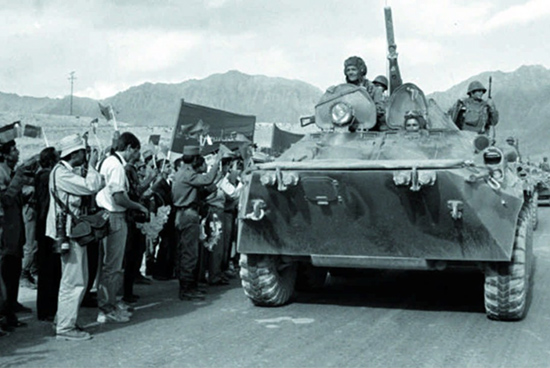
December 27, 1979: Who sent military forces to Afghanistan and why?
Author: Fayaz Bahraman Najimi
(Continuation)
FIRST PART: The “mystery” of Soviet military intervention
Another alarming and provoking reason for the Russians was the increased tension between the Soviet Union and China. In 1978, China had a military confrontation with the Soviet Union along its borders. That same year, he began a border war with Vietnam. The result of both was China's failure. These failures made the Chinese leadership more sensitive to the Soviet Union. During 1978 and 1979, the US began to renew and normalize relations with China, and in January 1979 began exporting weapons to China, which continued until the crackdown on student demonstrations in Tiananmen Square. A little later, the Chinese allowed the Americans to conduct reconnaissance activities against the Soviet Union from their territory. These were the premises that frightened the Soviet leaders. Moreover, China's supreme leader Deng Xiaoping vowed to take revenge for his country's failures in any way.
The Russians believed that opponents of the Halki regime would be able to fulfill the expectations of their country's rivals. Ultimately, the West would dominate Afghanistan with Chinese cooperation, and the Soviet Union's strategic security would be threatened. According to General Varennikov - Russia's number one enemy of democracy - who was then Deputy Central Staff of the Soviet Army: "The Americans could take advantage of the deteriorating situation and use the common borders of Afghanistan and the Soviet Union for their benefit - by installing advanced electronic equipment to gain control and detect measurements of all missile test barometers, aircraft, and other Soviet weapons.
However, it is difficult to find a direct connection between the deterioration of the international situation and the attack on Afghanistan. Can the invasion problem be explained in the context of the Brezhnev Doctrine? ***
3 - HAFIZULLAH AMIN FACTOR
 Without political bias or taste, in the research discussion and historical criticism of the last three decades of Afghanistan, the phenomenon of Hafizullah Amin can be identified as the main cause of social crisis and explosion. According to the documents of the CPSU Central Committee, the threats of a coup by the People's Democratic Party against the regime of the Republic of Mohammed Daoud should not have been separated from the Amin phenomenon; Because Amin, the leader of the Khalki armed forces, was far from the sympathies of President Daoud. Amin's efforts to overthrow the government of Dawood Khan before April 1978 and prevent his coup d'etat against the government of the Republic by the Russians prove this assertion. Regarding the period after President Daoud until the Soviet invasion, the role of Hafizullah Amin was fundamental and decisive in all events.
Regarding the phenomenon of Hafizullah Amin and its connection with the attack on the Soviet Union, one should seek answers to several questions that have long occupied the minds of both politicians and foreign and domestic analysts and publicists regarding Afghanistan:
1 - What was Amin’s relationship with the KGB?
2 - Did Amin have GRU support?
3 - Was Amin a CIA agent, as claimed, or not?
The author believes that, based on the desire for research, characters should not be attached without access to reliable documents. But in this thread, since the topic revolves around the axis of the Soviet attack, therefore, to find the right answers, it is necessary to pluck dusty claims from the text of history and examine them with the help of new documents, and if possible, open another chapter of discussion.
Many experts on Afghan issues believe that the occupation of Afghanistan by the Red Army is connected with the murder of Taraki and the rise to power of Amin. From Soviet archival documents, it follows that Hafizullah Amin was an undesirable and suspicious figure for the Soviet leadership, especially Andropov, starting in September 1979. But their doubts were not unlimited, since the Soviet military, despite the leadership of the KGB and the murder of Taraki, still trusted Amin. The distrust of the KGB was dominated by some external conspiracy, rather than competition and the ambitions of typical Afghans were appropriate as the historical syndrome of this country.
These two directions can be traced in the decisions and discussions of the Soviet leadership in Afghanistan. While the influence of Soviet military advisers is being discussed, we see no desire to send troops. But as the role of the KGB increases and stabilizes, we will witness a new approach to Afghanistan. Soviet leaders three-season were so opposed campaign in Afghanistan in 1979 that they believed such action would cause tension and damage international relations. The Russians believed that the command of the “April Revolution” was in “reliable” hands. Their claims of “guarantees” should be traced back to documents leading up to the April coup. Based on letters from the CPSU Central Committee in 1974, it is clear that the country's leadership, especially KGB agents, have long been filled with general and total trust in Taraki, even Mitrokhin in his book calls Taraki's nickname “Nur,” but this trust did not have extended to the GRU apparatus. The reason for this lay in the depth and breadth of competition that had long existed between the two intelligence services within Soviet society. (2)
Undoubtedly, competition between the Soviet military within the two intelligence services (GRU and KGB) had been going on for a long time. The Communist Party of the Soviet Union, which had high power over these two institutions and other intelligence organizations, was at the same time part of their competitive sphere. In fact, after the 50s of the last century, two institutions were created in the Soviet Union from three intelligence services, which were called the GRU, the Kyrgyz Republic, and the KGB, i.e. GRU and KGB.
It should be noted that in most cases the State Intelligence Directorate (GRU) had broader powers compared to the State Security Committee (KGB). This power was derived from a reputation that was created during Marshal Ustinov's service as Minister of Defense. It was during this period that the Soviet Army became the largest nuclear military power with the strongest navy in the world, which is known as the era of equality between East and West, that is, the ten years between 1966 and 1976. Ustinov's role was noticeable in the creation of this military power. The failing health of Brezhnev, who was no longer interested in leading the country from 1976-77, provoked Andropov to use the weakness of the General Secretary to strengthen his position with the help of the KGB within the party and the support of such main figures of the Soviet leadership as Suslov (leader), Prime Minister Kasygin, Foreign Minister Gromyko and Ponomarev - head of international relations of the Communist Party. As a result of Andropov's increasing influence within the party and the Soviet government, the power of the Ministry of Defense and its intelligence apparatus dropped to second rank. Working with details distracts us from the main topic.
Now let's see what the competition of the Soviet intelligence services was like in the field of Afghanistan. The author, in his collection of articles entitled "Return of the Bear" many years ago, showed that the Russians used different options for infiltrating the country after Afghanistan gained independence. We will not return to this topic but will try here, at least briefly, to discuss the competition of the Soviet intelligence services, which must be behind the events after the June 1973 coup until December 27, 1979, in Afghanistan, but there are few documents confirming them.
One should also look at what the American role was before the Soviet invasion of Afghanistan. Did the Americans have any specific strategy, as the Russians claimed and Brzezinski recently said, or not? (3) If so, what was their purpose? Draw the Soviet Union into Afghanistan or drown it in the Afghan swamp?
In this discussion, we tried to look at these two teams from two sides.
PRIMARY ROLE OF SOVIET INTELLIGENCE
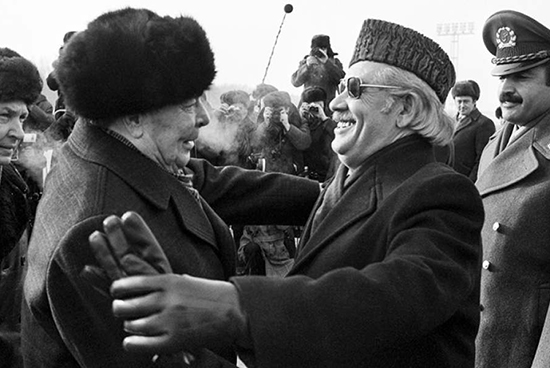 If we consider the issue of invasion as an act of the Soviet leadership, then, according to the author, the first act of his script should begin with the meeting of Taraki and Brezhnev in September 1979. It was at this meeting that the main issue was raised, that is, the departure of Hafizullah Amin. Brezhnev’s meeting with Taraki was an official or business meeting of two countries discussing various issues. But this meeting contained something more than a routine conversation since the future fate of the leader of the “revolution” was being decided. They agreed to remove Amin from power. But, apart from the way Brezhnev thought, was this agreement and solution truly acceptable to Taraki? I don't think so! Because Taraki owed his power to Amin, and so before his death, he gave him a watch case because of his faith in Amin!
For various reasons, including a lack of understanding of the basic principles of the policy, Taraki had to be the vehicle for the implementation of a larger plan. The events that occurred after Taraki agreed to remove Amin until his return to Kabul, and then the attempt on Amin's life in the presence of the Soviet ambassador and the removal of the Soviet ambassador and other generals before Amin came to power, can be seen as a type of intelligence operation. If Taraka's death was shocking and emotional for Brezhnev - which was not important - but for those who "wrote" the "script" of the attack, a period of action began. The urgent changes that were made in the composition of the intelligence and Soviet advisers in Afghanistan were precisely in this direction and for this purpose. Generals related to the GRU were quickly summoned to Moscow and were even forced to resign. Andropov came out of the “trench” and expressed a change of opinion, agreeing to expand the KGB’s activities in Afghanistan.
If Brezhnev considered the murder of Taraki a slap in the face, a serious period of testing began for Andropov to rise to the last point of the lever of power. One might wonder what the connection was between the assassination of Taraki and the seizure of power in the Soviet Union. Undoubtedly, her connection was direct, since as the KGB got a free hand in Afghan affairs, the scope of its activities expanded within Soviet society and leadership. A very subtle and far-sighted political game, which led to the relegation of Andropov’s rivals to the background and pushed Brezhnev into an adventure using his emotions. There is no doubt that Andropov well calculated the end of this story and knew that responsibility would fall on the leader. And every time he takes the reins of power into his own hands, he can easily erase the stain of Brezhnev's adventure, returning power - without getting himself involved. But during the seizure of power, Andropov paid for his plan at the cost of an attempt on his life. Document (2) of the Politburo shows how work was carried out to prepare the ground for the invasion.
Brezhnev, who did not know the other side of the coin, was furious at Taraki's death and considered Amin's act an insult. Andrei Gromyko wrote in one of his memoirs: “The murder of Nurmuhammad Taraki, General Secretary of the Central Committee of the People's Democratic Party of Afghanistan, further destroyed the atmosphere of relations between Amin and the Soviet leadership... This bloody act had an extremely negative impact, especially on Brezhnev". According to Gromyko, during a meeting with French President Valéry Giscard d'Estaing in September 1980, Brezhnev mentioned that: "President Taraki was my personal friend. He came to visit me in September 1979. But after returning to his homeland, he was killed by Hafizullah Amin. I will never forgive Amin for this act.” (4)
Also, Giscard Distin himself recalls from a meeting with Brezhnev in 1980 that: “The Soviet leadership then saw the reason for sending troops into Afghanistan that if they did not march there in January 1980, then a government hostile to the Soviet Union would be created there.” (5)
Soviet and Russian sources report that: “Shortly after Taraki's assassination, relations between Afghanistan and the Soviet Union cooled for obvious reasons, namely the direct role of the Soviet ambassador - as claimed by Amin and his close associates - in the attempt on Amin's life. Amin, who had long considered Soviet Ambassador Pozanov a supporter of the Parcham faction, called him an undesirable figure, using the theme of terror to demand his replacement. The Russians began to deceive Amin to prevent a repeat of the experiences of Egypt in 1972 and Somalia in 1977. They fulfilled his request by sending Fikret Akhmadjanovich (Tabeev) as the new ambassador. At the same time, to prevent geopolitical failure and contain Amin, his requests were answered positively, including a meeting with Brezhnev and the sending of military forces and assistance. But at the same time, since they considered Amin to be a representative of the West, they did not hesitate for a moment to prepare for his removal and teach the West a lesson.
As for the Americans, important figures in the American government at the time, including Brzezinski, stated that they were inclined to drag the Russians into Afghanistan. So we need to look at where such claims come from. Did the Americans count on Amin and assign him special responsibilities to lure the Russians into Afghanistan? Or did they want to destabilize Soviet Central Asia by helping the Islamic mujahideen of Afghanistan? And finally, as was claimed in some Soviet circles, was Hafizullah Amin really in the service of American intelligence? Of course, it is difficult to answer this question. But Bukovsky, one of the former KGB officers, claims that in the eyes of Soviet intelligence, Amin's nickname was “Kazim.” (6) Such a name is also on Mitrokhin’s list. (7)
What made the Russians nervous were the maneuvers Amin was conducting between Western diplomatic representatives and the Soviet Union. It is not far off that he wanted to get points from the Soviets and instead of doubting, directly support him. According to the above hypothesis, the murder of Taraki could be a continuation of the Russian scenario or perhaps Amin's anger.
However, the act of destroying the “Great Leader” was able to raise Amin from the second role to the first. A dubious question: if Amin was not committed to friendship with the Soviets, then how did he agree to let Soviet soldiers into Afghanistan? Lieutenant Colonel Abertas Cassinas, Russian adviser to the Chief of Staff of the Afghan Ministry of Defense Yaqub, recalls the full cooperation of General Abdullah Amin in the northern regions for the passage of troops across the border. (8) Afghanistan expert Vladimir Mironov, in one of his unpublished interviews for the weekly Akhbari Hafta, published in Kabul in 1990, recalled Amin this way: “Boris Ponomarev, head of the international relations department of the CPSU Central Committee during a meeting with Hafizullah Amin in the Foreign Office asked him about the books on his shelf, which were all works of Stalin. Amin replied that Stalin was a role model for him. When Ponomarev advised him to study the works of Lenin, Amin said: “He prefers to read Stalin.” (9)
There is no doubt that Amin was an ethnic dictator who had no qualms about using Stalinist methods of leadership and management.
One way or another, Mitrokhin, author of the book “The KGB in Afghanistan,” reports that: “In November 1979, the KGB intelligence center in Kabul sent a report to Brezhnev warning about a change in Afghanistan’s foreign policy to the right and rapprochement with the US. During this process, Amin met several times with the US charge d'affaires in Kabul without informing the Russians of the content of his negotiations." (10)
Diego Cordovez and Selig Harrison also mentioned Amin's repeated meetings with Adolph Dobbs. (11) But can all this be taken into consideration as Amin’s connection with the CIA?
On the other hand, it should not be forgotten that the Russians at that time had at all levels of Afghanistan, from advisers to agents and informants, who could control every action at all civil and military levels and obtain every information in detail!
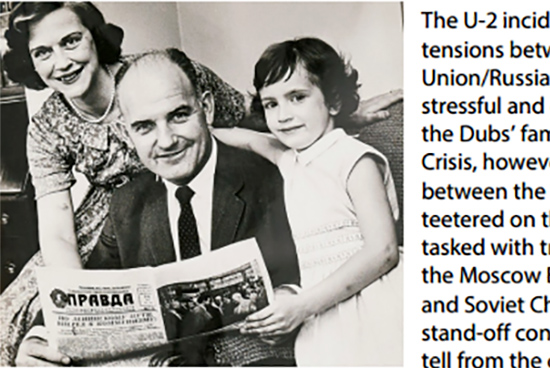 Steve Coll writes in War of the Ghosts: “To American diplomats living in Kabul, Amin was a dictator who was also held responsible for the murder of Adolph Dubs (in the photo). Even they knew about the rumors that Amin was a CIA agent." (12)
He continues, “Before he died, Dobbs asked his CIA officer if Amin was a CIA agent as rumored?” In response, he was told that Amin had never worked for the CIA. These words were later confirmed to me by James Bruce Amstutz, who at that time was Adolph Dubs' deputy and later, after Dubs' assassination, was appointed charge d'affaires of the American embassy in Kabul". (13)
The book's author goes on to quote Amstutz: “Officers from the CIA's Middle East Division told me (Amstutz) that Amin was also in contact with us and was also on our payroll. It was also said that while Amin was in New York, not afterward, there was no evidence of him being in regular contact, other than some casual conversations with CIA officials, including at diplomatic parties". (14) However, to maintain impartiality, Steve Coll says in the book's sequel that: "No documentation has been found to authenticate these words." (15)
“In the fateful autumn of 1979, Amstutz had private meetings with Hafizullah Amin about 5 times, but their negotiations did not have concrete results... Amstutz considers Amin a militant, uncompromising, and unyielding leader, including about the Americans. In his opinion, Amin, who twice failed the doctoral exam at Columbia University, considered this an intentional act and regarded his failure as a form of humiliation and insult to himself. Later, this issue created a complex in him, which led to enmity with the Americans. Amin even expressed his dissatisfaction by ignoring Amstutz.” (16)
Complexes and justifications caused by egocentrism as a psychological characteristic of Amin is a separate psychological conversation that are not related to our topic. But complexes in the East are a common phenomenon, mixed with tyranny and giving rise to violence, destruction and great murders. Another example of Amin's justification, which from a psychological point of view is considered a kind of childish trait, can be seen in the case of a failed attempt on his life by Taraki's colleagues. Amin blamed the Soviet ambassador for this incident and, with rage and show-off, got involved in a jewelry war with the Soviets.
What is questionable about these discussions is the enormous interest and warmth of Adolph Dobbs and Amstutz with Amin, and it will take time to get an answer to them. There are two issues to be separated here: one is a discussion of Amin's efforts through extensive political activities to communicate with countries opposed to the Soviet Union, and the other is a discussion of the CIA's activities in Afghanistan.
Steve Coll writes: “CIA agents in Kabul devoted most of their attention to the Soviets. They were not very interested in the Afghan communists. The main task of CIA officers in Afghanistan was to detect and identify Soviet weapons in Afghan hands. They were still trying to kill KGB and Eastern Bloc agents working in Afghanistan and put them into their service.”
The result of this CIA work allowed them to predict in time the coup of April 1978 and subsequent events in Afghanistan. After the April coup, Thomas Thornton, a CIA special agent in Afghanistan in 1979, was asked by Brzezinski, “What are the Soviets doing in Afghanistan?”, during the signing of a memorandum in September of that year, he said: “We don’t know anything.” (17)
On the other hand, on the eve of the Soviet attack, we see that the Americans are busy planning a new strategy for Afghanistan. Steve Call writes: “A few days before the Russian invasion of Afghanistan and the assassination of Amin, Brzezinski proposed to Jimmy Carter that he develop an American strategy for Afghanistan. In his opinion, America should first provide medical assistance to the rebels, who are disorganized, weak, and lack influence and weapons, then organize them and teach them military tactics. And at the next stage, assistance from Arab countries should be organized for them, and China should be involved.” (18)
At night, as the Soviets went from corridor to corridor to arrest or kill Amin, Brzezinski, through the CIA, laid out the main directions of his plan so that it could be implemented within the next ten years. He said, "Our main goal is to bring the Soviets into Afghanistan." A week later, on December 27, 1979, he described this goal in a memorandum as follows: "If our goal is not completely achievable, we must try to make life difficult for the Soviets in Afghanistan." (19)
There is no doubt that Afghanistan has been a field of activity for the Russians and their intelligence for many years. According to Mitrokhin's book, the KGB's list of nicknames for Afghan dependents, running into the hundreds (20), was a sign of the depth of Soviet influence in Afghanistan. Therefore, according to Soviet calculations, the Afghans had no right to “disobey.” Anatoly Dobrynin, the longest-serving Soviet ambassador to the United States and, since Gorbachev, head of international relations of the Communist Party of the USSR, wrote in one of his memoirs: “Andropov believed that if the April Revolution was not protected, Afghanistan would become a base for the West, a ”Great Turkey" project and the installation site of the Cruze and Pershing missiles."
However, Russian fears of CIA intrigue and Western influence are not entirely unfounded.
Brzezinski says: “It is clear that the Americans have not answered the question of whether they intend to use Amin and his policies for their purposes. The reason may be that if they had a plan to change Amin's policy and turn it in favor of America, then when they open and confirm this issue, they will give legality and legitimacy to the Soviet attack on Afghanistan. On the other hand, the Russians, realizing that the warm relationship between Amin and Dobbs would have disastrous consequences for them, therefore, may have given the green light to the kidnapping of the American ambassador. There is no doubt that Soviet advisers were also involved in the attack to save Dobbs' life. The murder of Dobbs was the biggest blow to the development of relations between Amin and the United States. If all of these scenarios are true, then Dobbs' murder has prevented close relations between America and Afghanistan; Secondly, due to the lack of an apology from Afghanistan for the killing incident, an atmosphere of mistrust and coldness reigned between both countries. And thirdly, they temporarily strengthened the position of Soviet supporters of the Khalki government. Amin wanted to put an end to this imbalance by destroying Taraki.” (18)
We encounter a paradox in several events in 1979. On the one hand, Amin and Taraki (the second more) jointly want Soviet troops to be stationed in Afghanistan, and on the other hand, Amin is in contact with the West. Considering that Amin desired to be closer to the West, and Taraki desired to station Soviet troops in Afghanistan, (19) then Amin should not have asked the Soviet leadership to send security guards after the murder of Taraki, because every wise person knows that a person is not insured against foreign defenders. But it is feasible, and 500 “special force” soldiers, dressed in Afghan uniforms, according to Andropov’s orders, come to guard Teppae Taj Beg Palace and, a little over a month later, kill Amin.
However, the motivation for the decision of the Soviet leadership can be considered an adventure of several sick old men, the motive of which was revenge, but behind it, we can also see the struggle for power within Soviet society. Confirmation of this assertion is the absence of a plan for Afghanistan by Soviet leaders, which was formalized in their controversial documents as political approval on December 27, 1979.
Even talk of occupying Afghanistan to reach the warm waters of India or occupy the oil-rich areas of the Persian Gulf is nothing more than delusions and idle talk, since the implementation of such plans was far from the wisdom of the elderly Soviet leaders. So, the lesson question remains. They came to teach Amin a lesson, but they received one in return.
Even though our country and people have become victims of the rivalry between two superpowers, what will remain dark for a long time is the continuation of the history of aggression or luring the Russians into Afghanistan. The main link to the causes of aggression may remain lost forever.
(***) The Brezhnev Doctrine, which is nothing more than the Leninist doctrine of expansionism, as well as the decision of the 1974 Warsaw Pact conference planned by it.
SOURCES:
2 - LES REVELATIONS D'UN ANCIEN CONSEILLER DE CARTER, Zbigniew Brzezinski, New Observatory” No. 1732, 15.-21. 1998, p. 76.
3 - Archival documents of the CPSU Central Committee in Russian.
4 - Shubin, Aleksandar. War in Afghanistan, Moscow, 1991.
5 – Ibid.
6 - Jahre des Umbruch. Afghanistan; Bukovski, Teil V, 1995.
7 - Vasiliy Mitrokhin. The KGB in Afghanistan. Working Paper No. 40, Washington, D.C. February, 2002.
8 - Abartas Kasinas, Revolution of Ventovka and Tank, Sputnik, Moscow, 2/1991.
9 - Personal notes from the author.
10 - Vasiliy Mitrokhin. The KGB in Afghanistan. Working Paper No. 40, Washington, D.C. February, 2002, ibid.
11 - Facts of the Soviet invasion of Afghanistan, authors: Diego Cordoviz and Selig Harrison, translation by Abduljabbar “Sabit”, the first volume, Maiwand Publishing Center, first edition 1375, p. 67.
12 - Steve Coll, Ghost Wars: The Secret History of the CIA, Afghanistan, and bin Laden, from the Soviet. Invasion to September 10, 2001. Merrill House, New York, Carnegie Council Books for Breakfast, 3/1/04, pp. 47-52.
13 - Ibid.
14 - Ibid.
15 - Ibid.
16 - Ibid.
17 - Ibid.
18 - Ibid.
19 - Ibid.
20 - Memorandum for The Secretary of Stats, Jan 1980.
21 - Vasiliy Mitrokhin. The KGB in Afghanistan. Working Paper No. 40, Washington, D.C. February, 2002.
22 - Documents of the American spy nest.
21- Facts behind the scenes... Ibid.
OTHER SOURCES:
1 - Allan, P., Kläy, D., Zwischen Bürokratie und Ideologie. Entscheidungsprozesse im Moskauer. Afghanistankonflikt. Bern u.a 1999.
2 - Allan, P.Sowjetische Geheimdokumente zum Afghanistankrieg. 1978-1991. Zurich 1995.
3 - Allan, P. Afghanistan Trap, the story about the Soviet invasion, Moscow, 1999.
4 - Kornienko. G, Cold War. Certificate of its Participant, Moscow, 1994.
5 - Shubin, Aleksandar, From Stagnation to Reform. USSR in 1917-1985, Moscow, 2001.
6 - Lyakhovsky, A. Zabrodin, V., The Secret of the Afghan War, Moscow, 1991.
7 - Documents from the Nest of Spies, No. 30, Afghanistan (2), place and year of publication unknown!


