


Tajikistan is the closest ally and friend of Russia in the entire post-Soviet space.
Author: Maxim Ivanov, pseudonym of the author, especially for "Sangar" (Moscow)
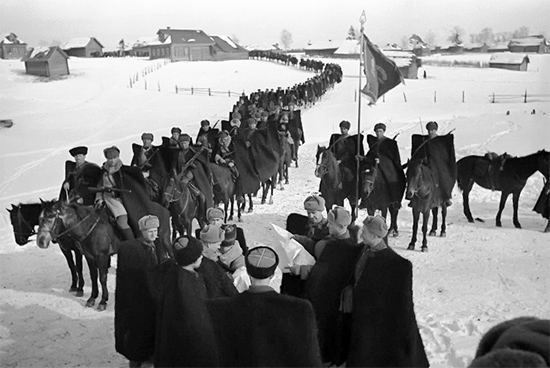
ON THE PHOTO: 20th Tajik Red Banner Order of Lenin Mountain Cavalry Division. During the Moscow battle of 1941-1942, it successfully smashed parts of the 78th German Infantry Division, SS units "Dead Head", and "Great Germany" ("Grossdeutschland").
Time is running...
The Great Patriotic War ended 78 years ago, but Victory Day in Tajikistan remains one of the most revered holidays. Such an attitude towards it is understandable.
Just a few figures that say a lot - in June 1941, only one and a half million people lived in the Tajik SSR, but every fifth inhabitant of the republic visited the front, and every third front-line soldier did not return. Many Tajik families still experience the pain of loss, but this pain is mixed with pride.
Tajiks were among those who fought for the Brest Fortress, they defended Moscow and broke through the blockade of Leningrad, fought for Smolensk, in Stalingrad, and on the Kursk Bulge. On the walls of the fascist Reichstag in 1945, the names of Tajiks - the winners - were scratched.
Among them are many order bearers and Heroes of the Soviet Union. Just a couple of examples from the huge list of feats accomplished by warriors from Tajikistan: in 1943, Tuychi Eryigitov repeated the feat of Alexander Matrosov, and Khaidar Kasimov led a mortar unit during the crossing of the Desna and ensured the capture of an important springboard for the offensive of the Red Army.
Rifle and cavalry brigades and divisions were formed in Tajikistan, evacuation hospitals worked here, women and children from the occupied territories of the USSR came here, and Tajik teenagers worked at enterprises on an equal basis with adults. Tajikistan has become a real support for the warring country. There were no people here who remained aloof from difficult and difficult events. Sorrows and hardships touched everyone.
Forgetting about this is tantamount to betrayal, which is not in the traditions of brave and hardworking people. And Tajiks do not forget. This was announced during a memorable conference that took place in Dushanbe.
“This year we celebrate the 78th anniversary of the Victory in the Great Patriotic War, our common Victory because then the whole great Soviet people fought against the Nazis,” said Russian Ambassador Semyon Grigoriev.
He noted the sincerity with which the people of Tajikistan relate to historical memory.
"In this sense, Tajikistan is the closest ally and friend of Russia in the entire post-Soviet space, because here they absolutely share our attitude towards the war, Victory, and veterans", - the diplomat noted.
Today, 37 veterans of the Great Patriotic War live in Tajikistan. The youngest is 96 years old, the oldest is 111 years old. These are revered people and witnesses of the most considerable bloodshed in the history of mankind. The attitude towards them is a litmus test that speaks about the health of the society and in this regard, Tajikistan is superior to its former allies.
Many republics of the former USSR themselves cross themselves out of the list of winners. In Moldova, the main symbol of the Victory, the St. George Ribbon, was banned, and in Latvia, they are threatened with punishment for laying flowers at memorial places. Ukraine has turned into a real hotbed of fascism, where tanks with fascist crosses are again fighting, and soldiers wear stripes with the emblem of the SS division "Dead Head".
Decades later, the Russian army is again forced to fight against fascism and pay for the future world with the lives of its soldiers. Western countries do not see anything wrong with this, but the lessons of history say that the fascist infection will not stop and will collect new victims in the expanses of the Europe and former USSR. The main defense against it is the memory that Tajikistan does not intend to betray.


