


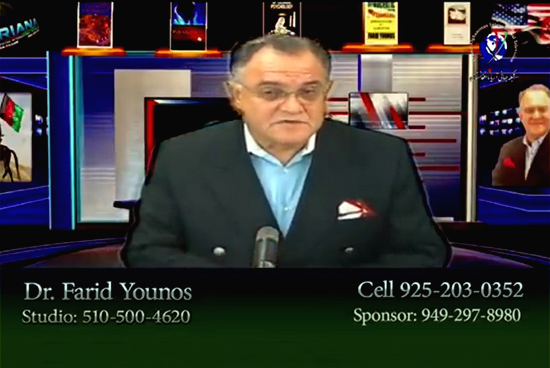
How did I use the tactics that my opponent got lost in?
Author: Dr. Farid Yunus, Professor of Middle Eastern Cultural Anthropology and Islamic Philosophy, Founder and Navigator of Islamic Democracy (California, USA), Member of the Advisory Board of “Sangar”
In 1993, I got into Radio-Television of Afghanistan on Fazlghani Mujadedi's advice and Khalil Raghib's invitation. My program was called “We and Our Religion.” I was not a professional journalist, but after a few months, my program became popular and caused a furor. Ill-wishers organized a petition and told Khalil Raghib that they would collect several hundred signatures to get Farid Yunus fired from television.
Khalil approached the management of the television, which was a public channel, and every week provided free time for minorities to broadcast the program. The head of television told him that there was freedom of speech there and no one could fire Farida Yunus.
In one of the programs, I said that anyone who forcibly has sex with their spouse is committing sexual violence.
How can a person whose specialty is not journalism have such a successful program?
A week or two later, I visited the university library. At that time, I was a doctoral student. I bought and read three or four books about television and how to become a successful television presenter.
From these books, I learned several important things:
First, journalism is a humanities subject. Anyone can become a successful announcer or presenter with the talent and courage to speak. It is not necessary to have a college degree in journalism.
Second, in the television field, you need to be yourself have your terminology, and not imitate others. For example, Walter Cronkite, the famous American talk show host, used to say at the end of the evening news: “And that is how it is, as it is.”
For example, when I talked about my mother, I used “my babu.”
Third, do not be afraid of people. If you are afraid, you will not become a successful anchor or announcer. And I have learned to fear only God, not people.
Once I was at a funeral. After the funeral, I was still on the grounds of the Mission Cemetery in Northern California, when a young man came up to me and asked, “Are you Farid Yunus?” I said, “Yes, I am.” He said, “Why are you saying all this on TV?” He was about to hit me, but Mir Malek Naseri came in time and saved me.
The strange thing is that he did not know me and someone ordered him to do it because he asked my name. Another time in the mosque of Hazrat Abu Bakr Siddique (may Allah be pleased with him), after prayers, one of Qari Safiullah’s friends saw me and started cursing loudly. I did not say anything, and Qari stopped him so that he would not go too far. Our people still do not believe in freedom of speech and opinion.
Fourth, try to say something new to attract attention. I said things about religion that no one had dared to say before. For example, I questioned some hadiths that I knew, according to scientific research, were false.
Fifth, speak the language of the people, speak freely, and use colloquial expressions so that people do not get bored because television is an oral media. The more relaxed you are, the better. People called me and said: “You speak as if you were in our home and talking to us.” It was my private education that allowed me to create programs for thirty years.
It was 2006 when satellite television began to operate. The first to open such a channel was Nabil Meskinyar. In 2007, Нур ТВ began operating in Northern California and Yama Yousafzai invited me to host a program on it.
The noise on Нур ТВ became so loud that some Pashtuns offered Yama several thousand dollars if he fired me and threatened to sue the channel because of me. Yama, a young intellectual man, told them that he would help them find a lawyer and his address who would sue and that he would not expel me from work under any circumstances.
Timur Shah Hassan had a program on Ариана ТВ in Afghanistan called "Home and Family". He invited me to his program seven times, and seven times I was invited by Afghans to Europe, the USA, and Canada to give speeches on Islam. All my expenses were financed by them. Until then, no one had been invited before me.
The first invitation to Hamburg was very successful and I was very well received. Friends received me well. But the second time I was invited to Hamburg, sabotage began and a letter was sent from the USA to Europe against me, saying something bad and negative about me. I was not allowed to give a speech in the Hamburg mosque. Engineer Zia Tahir, a Pashtun by nationality and now considers himself one of my students, if I am not mistaken, rented a tavern called "Gole Sorkh" and I gave a lecture there.
In Munich, I was received by Dr. Masud Janbaz. In the mosque, the people were divided into two groups. One group was for me to give a speech, and the other was against me. The German police intervened and said, "We have freedom of speech, and your guest has the right to speak."
Two years later, Нур ТВ was sold to the Фонд Байату. At the first meeting, Ehsanollah Bayat asked to speak to me personally after his speech on TV. I guessed what he was going to talk about. The Pashtuns were outraged because I said in the program that even your entire lineage cannot bring back the Durand line. It was like throwing stones at a beehive.
Bayat did not want anyone to hurt me, and he supported me. Because he supported me, the Pashtuns put my picture and Bayat's on the Iranian flag and distributed it in the media, claiming that we were representatives of Iran. When you talk to Pashtunists about social justice, they use two tactics. Some are called "sitami" (i.e. "oppressed", the name of the non-Pashtun ethnic justice movement in Afghanistan is "Sangar"), and others are called "representatives of Iran" because we no longer compromise on the Persian language issue. For example, we say "donishgoh" (Farsi - university) and not puhantun (Pashto - university).
One day, Haris Rahimi, the head of the TV channel, wanted to take under his control my work, and my contract with the TV channel was such that no one had the right to control me. I made a plan: I would stop mid-show and tell the viewers that they were disturbing my work and I would not have another show. The next day, Hawas Farahi, Bayat's close and trusted assistant, called and said to me: "Doctor, for God's sake, come back to TV because the viewers are calling us non-stop and have driven us crazy." My condition was that no one should disturb my work, and this condition was accepted.
In 2008, I received an award from Нур ТВ as the most successful producer of religious programs. I was not present at the ceremony and was away. The award was received on my behalf by Dr. Sayyid Abdullah Kazim in my absence.
Нур ТВ, which was sold to the Фонд Байату in 2009, operated until 2014. The Фонд Байату closed it down, but they told me that they would help me broadcast the program from home. Everyone was released, but my program was broadcast from home on the Ariana News channel in Kabul. For this purpose, the Фонд Байату instructed Habib Durrani to install a device for recording TV programs in my house, which was done.
Habib was a very gentle and kind person. He, who was in charge of the foreign department, instructed Anwar Rasouli to come to my house every Saturday and record the program. Anwar, who was an exceptionally polite, kind, and sweet young man, came home every week until 2016 and helped with the program, which was recorded and sent to Ariana News in Kabul. After that, they installed an automatic camera and Anwar was no longer needed. I recorded him myself and sent him for publication. This continued for two years.
After I moved from Radio-Television Afghanistan to Noor in 2007, my program was called Dr. Yunus Show. It was called that until the very end when I left TV. The camera was damaged and the Фонд Байату did not buy a camera similar to the first one. Habib brought a small camera, which I did not like. I also said either a new camera of the old model or I will not work anymore. It happened that the new camera I wanted did not come, and I left the Фонд Байату.
I went and started working with TV Omid 24, which is run by Nasir Khaled, a very kind, grateful, and polite person. Omid 24 is broadcast from Canada.
Nabil Meskinyar did not get along with me because of political issues, but later he changed a lot. One day, Tariq Mahdavi organized a small party and invited some men and women from the press. He did not tell me what the conversation was about.
When I went there, I saw that Nabil Meskinyar was there too. We chatted. He wanted to make some changes in the Northern California branch of Ariana Afghanistan, which was originally run by Khalil Ragheb. One or two of my opponents were also at that party. During the conversation, Meskinyar turned to me and said, “Uncle’s son, will you cooperate with me?” I answered without hesitation that I would be happy to. The opponents were surprised at the way he asked me to cooperate.
And from that time on, I worked with Meskinyar until I turned seventy, almost three years ago. At the age of 69, I announced that I would retire from television at seventy. I said this because if I suddenly left, people would certainly comment that some problem had arisen between us.
I turned seventy. Despite Meskinyar’s insistence that I stay and his persuasion that the viewers needed me, I had already made my decision. At the age of seventy, after thirty years of programming, I officially retired. But other channels in cyberspace will not let me in. I occasionally appear on the shows of Hamedi Zarabi, Nasir Khalid, Razzaq Mamun, Sajia Kamrani, Afghanistan International, Zarin TV, Bahar TV, Voice of America, Radio Azadi, and Ariana News from Kabul. And others have asked me to give political and religious commentary on their programs, and this collaboration continues.
Recently, Hamed Zarabi asked me to host a show with Habib Hotaki and Meskinyar. At the time of writing, forty-nine thousand people have viewed it on YouTube in four days, which is a record. How did this show become so popular that even I received hundreds of phone calls of admiration and praise, except for a few people?
I told Hamid that this man (Habib Hotaki) is a Taliban supporter, a Pashtun, that is, he wants Pashtunist to dominate Afghanistan, and he is undesirable. Hamed said, "Okay, you can answer him."
I, seeing who my opponent was, from the very beginning of the program used the principle of the "boxing ring" in journalism. Unlike the boxing ring, where one person beats up another during the fight, I did my job verbally. That is, you have to attack from the very beginning, insult the other side, and not give them a chance to talk. It depends on the nerves and seriousness. I enter the "boxing ring" without wanting to, with someone who lies and hides the truth and defends fascism.
And I knew that my fans would praise me because they are wise. Those who do not understand journalism do not know about the "boxing ring" we are talking about. Donald Trump uses "boxing ring" in political discussions in a figurative sense. I did the same.
There were only four of those who criticized me. They did not know my plan, that I am an experienced presenter who has been creating programs in the press for thirty years. I used tactics that Khabib Hotaki got lost in. The books on journalism that I read thirty years ago caught my opponent on December 10, 2024, and he will not forget this defeat for the rest of his days.


