


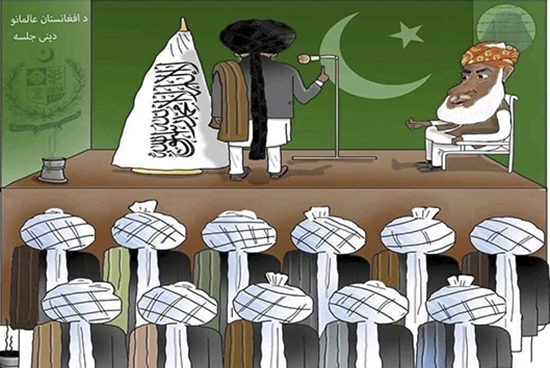
The Islamic Emirate is Islamic in name only but has nothing to do with Islam.
Author: Ahmad Saidi, Afghanistan and regional analyst (Germany), especially for "Sangar"
I leave this writing and analysis to the judgment of history. History will remember in time and the context of the objective and mental states of society what I wrote and how I predicted its consequences.
Over the past three years, Afghan politicians and ordinary people have been against the actions of the Taliban in their own way. Initially, the clerics and religious scholars supported the Taliban, but over time, especially after three years, many of them concluded that the orders of the Taliban leader did not correspond to the principles of pure and true Islam.
Thus, a group of scholars and clerics are now speaking out against the orders issued by the Taliban in the name of Islam and Sharia. The people of Afghanistan will soon see the consequences of these actions.
In this article, I will look at the reasons and motives behind the opposition of scholars and clerics to the orders of the Taliban leadership.
The opposition of scholars and clerics to the Islamic beliefs and ideology of the Taliban can be caused by many reasons, mainly due to the different interpretations of Islam, the behavior of the Taliban, and the way they implement the Sharia.
Some of these factors are:
1 - Extremist interpretation of Islam. Many scholars and clerics criticize the Taliban for their very strict and radical interpretation of Islam. The Taliban often offer interpretations of the Quran and Sunnah that differ from the generally accepted interpretations of scholars in the Islamic world.
2 - Human rights violations. Some clerics and scholars believe that the actions of the Taliban, especially about the rights of women, religious minorities, and individual freedoms, are contrary to the principles of justice, mercy, and respect for the rights of others that are emphasized in Islam.
3 - Violence and killing. The use of violence as a primary tool to achieve goals is one of the main criticisms of the Taliban by scholars. They believe that Islam is a religion of peace and that the Taliban are creating a false image of Islam through killing and violence.
4 - Misuse of the Name of Islam. Many scholars believe that the Taliban are misusing the name of Islam to achieve their political and power-seeking goals. They believe that the Taliban's actions are more political than religious.
5 - Hostility to Modernism. The Taliban are strongly opposed to social and cultural innovation and adhere to traditionalist interpretations of Islam. This has led some scholars who agree with modernism and Islamic reform to oppose the Taliban.
6 - Rejection of the consensus of Islamic scholars. Many reputable scholars in the Islamic world emphasize the importance of scholarly consensus in religious matters, but the Taliban often make arbitrary decisions and implement their fatwas without taking into account the consensus and opinions of other scholars.
7 - Religious Monopoly and Religious Narrow-Mindedness. The Taliban generally consider only their interpretation of Islam to be legitimate and label other interpretations and Islamic schools of thought as disbelief and heresy. This has led to opposition from other scholars and clerics who believe in the diversity of Islamic interpretations.
All these factors point to deep gaps between the Taliban's interpretation of Islam and the broader and more diverse interpretations of Islam that many other scholars and clerics represent.
After this, I believe that most Islamic scholars, both inside and outside the country, will not remain silent about the Taliban's actions, which have been carried out in the name of Sharia but against Sharia for three years.


