


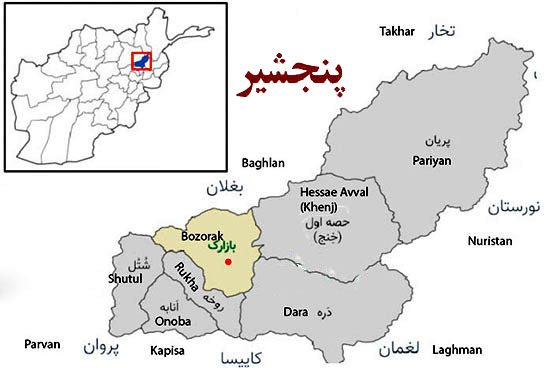
I asked Amrullah Saleh to go to Piyavasht or Parandeh Valley, but he refused.
Author: Fazl Ahmad Manawi, former Minister of Justice of Afghanistan, especially for Sangar
PART II
Among the other defenders of the Khawaq line is the experienced and brave mujahideen commander Aminullah Khusravi. He was seriously wounded in the Battle of Dashti Revad but was miraculously saved from death by the grace of God. When the Khawak Pass defense line was breached, he and some brave fighters of Dashti Revad moved through the Tul Pass to ambush and trap a Taliban convoy at Qalagah on the northern Khawak Pass route leading to Andarab. They followed this route, which was about twelve hours of walking, and reached the desired point, but the enemy quickly crossed the watershed of Obi Khawak and approached their forces, who were about to enter Pariyan from the Anjuman Pass. Thus, the question of a siege was excluded.
One can praise the role of the military leaders Haji Gulmirza from the Abdullakhel Valley, the military leaders Mohammad Hashem Tambana, Mahmudbekkhan Pariyan, Mohibullah and other Pariyanian warriors. Each of them worked day and night, and we are all indebted to them.
A prominent role in the defeat of the enemy was played by such brave and noble commanders of Andarab as the martyrs Khairkhakh, Asadullah, Yakub, Imam Nurzad and Zubairkhan. And also Abdulgani and dozens of other brave and courageous commanders from Andarab. They and their courage, which created many problems for the enemy from Andarab to Panjshir, will be discussed in a separate article.
At the height of the Khawak Pass war, I, along with Muhammadalam Izdayar and the late Mavlana Qurban Farid, went to Dara (Dara and Obshor districts) to talk to the commanders there and the Mujahideen to create a defensive line in the area called Bambardar (a difficult pass connecting Dashti Revad with Khavak and Pariyan). In the evening, in the Tambana area, which belongs to the village of Sedaha in the Dara district, we talked with Nawab Khan and other local commanders. They promised that they would lead the Mujahideen there at night. Of course, a number of Mujahideen from the Dara and Obshor regions were already present on the defense lines of Khawaq and Pariyan. The people of these areas are renowned for their courage and resilience among the people of Panjshir. They showed much courage and sacrifice during the periods of jihad and the First Resistance, fought fiercely in the Second Resistance and lost several young brave men. The war in Dara itself has a different detailed history, which I will write another time.
In any case, I was sure that the enemy's advance would be stopped when the Mujahideen of Dara reached the front line. But perhaps time was lost then - it was not possible to prevent the advance of the enemy, who was passing through the valley with heavy equipment, countless personnel, and many vehicles with heavy equipment.
As mentioned above, there was a fierce battle between the resistance fighters and the aggressors in the Dashti Revad area, as a result of which the enemy suffered heavy casualties, but when the commander Aminullahan Khusravi was wounded, the resistance fighters retreated to the heights, and the Taliban continued their movement towards the village of Safedchehr and the district of Khenj. Along this route, scattered battles took place and strikes were struck against the enemy.
In the Peshghur region, the Taliban faced a difficult confrontation. The resistance fighters under the command of a famous old man, one of the respected commanders of Panjshir, Commander Idimuhammad Tariq known as Tariq Sahib, accompanied by the young brave commando Zabihurrahman and commander Mirzajan, inflicted heavy losses on the aggressor group. Crushing blows were dealt to the enemy here. History and people will never forget the bravery of commander Tariq and his comrades. They continue to resist. May God protect them.
General Bazmuhammadkhan's commanders, along with the Pariyanian patriots, fiercely defended the Anjuman Pass line (the mountain between Badakhshan and Panjshir), but when the Khawak Line was breached, they were forced to retreat for fear of being surrounded. It should be noted that during the attack on the Anjuman Pass, the Taliban were accompanied by several foreign terrorists, mainly Chinese Uyghurs, some of whom were blown up by mines.
We were very worried about the Anjuman line of defense at the end of the Pariyan valley, but until the last moment, the stubborn Pariyan resistance remained steadfast under the command of the commander Bozmuhammadkhan (Iron Man). When the Pariyan line failed, they were ordered to retreat, and despite this, they dealt crushing blows to the enemy in this wide and green area. It goes without saying that during the period of jihad, Pariyan was the cradle of the war against the Soviet Union and its people were brave and sincere. They have always welcomed the mujahideen and resistance fighters with open arms and sincere hospitality.
It is appropriate to thank Mawlawi Zabihullah Atik, the representative of the people of Badakhshan in the parliament, for his efforts. He tried his best to prevent the Badakhshan Taliban from attacking Panjshir through Anjuman and Andarab, but he failed.
In the Ummarz area, the Taliban faced successive ambushes and suffered heavy casualties. The resistance fighters of Shaba and Ummarz under the command of Shamun, a brave and fearless warrior, and the commander Ahmadyar, who later drank the cup of martyrdom along with his children, taught the aggressors an unforgettable lesson. The bravery of this man and his children - heroes - will never be forgotten. Enormous enemy forces, dispersal of hostilities, and communications blackouts helped the enemy pass through this area.
It should be noted that a series of negative propaganda in favor of the enemy by individuals further aggravated the situation. Moreover, the role of the Hizb ut-Tahrir group in propaganda in favor of the enemy was quite clear. Never in history will those who in any way propagandized in favor of the enemy and caused fear and anxiety among the people, helped the enemy, or left the people to fend for themselves in difficult times, be forgotten.
 In the Barak area, the enemy encountered stiff resistance from the army and young commando and suffered heavy casualties. But the war came to Bazarak with the martyrdom of some young and brave people. General Gulistonkhan Astana, known as Doctor Guliston, bravely resisted the enemy, fought bravely, and held the camp. We should be proud of his courage.
The enemy faced the iron shield of brave resistance fighters in the Bodkul and Malaspa area of Bazarak district under the command of Sheragakhan, of the famous Mujahideen of Panjshir. A heavy battle took place, and finally, having inflicted heavy losses on the enemy, the commander Sheragha was wounded, and his strong and brave son died a martyr's death there. The courage of Commander Sheragha and his comrades is a great lesson for freedom-loving generations.
In the area of Rahmankhel, commander Jabbar, known as Doctor Jabbar, and the Mujahideen accompanying him dealt a strong blow to the enemy and proved their courage in the war against the aggressors. No one can forget the courage of Commander Abdulwadud Rashidi, known as Wadud Shirinhan. He also fought bravely and drank the cup of martyrdom.
After the aggressor forces passed through the Khawaq Pass and occupied one area after another after suffering heavy casualties, I went to the house of Amrullah Saleh, the Vice President of Afghanistan, and informed him of the events. It is worth noting that he took on most of the military expenses. He asked us to spend the night at his house and prepare for tomorrow's war, but I asked him to go to our village (Piyavasht) or to the Parande valley because his village was on the main road and was too inconvenient for fighting and retreating. In the end, he did not agree and we returned to Rukha and Bazarak.
On the other side of the line, at the mouth of the Panjshir, a fierce battle took place at night on the Darband and Shutul mountains. After a tank group stationed on top of Mount Darband fell into enemy hands, fire from the same tanks rained down on the defenders of Mount Shutul. As the fighting took place in the area of Hawak and the upper part of the Panjshir, after several nights of intense fighting, the line of defenders at the mouth of the Panjshir was finally broken and the resistance fighters were forced to retreat.
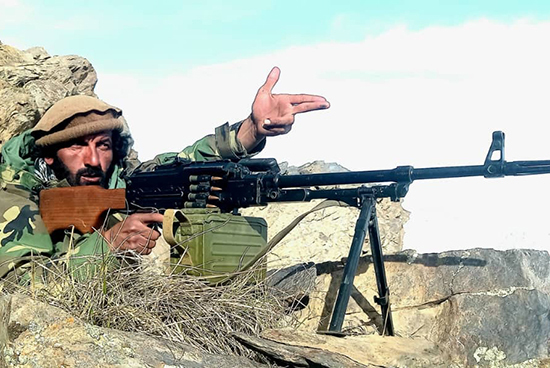 Commander Sufi Muhammad Said Shutul, the famous and old but proud Mujahideen who stood to the end defending his people and land with a wounded body, Commander Wazir Shutul who showed great courage in subsequent wars and his beloved brother suffered martyrdom, and other Mujahideen Shutul, along with the fighters of the Paranda, Talha and Manjahor camps (camps of the Bazarak region) under the command of commander Muinuddin Sangari (poet, mystic, ascetic and selfless) were among the defenders of Mount Shutul. In one night, five brave young men of Bazarak died as martyrs in the Battle of Poimazar, but inflicted heavy losses on the enemy. To such an extent that to transport the bodies was beyond the capabilities of the enemy and the next day they resorted to the help of local residents to transport the bodies.
The hill opposite Poimazar and Jelanak was defended by the general Nur Jabalussiraj, known as Nur Sikandar, and the worthy old commander Padarkhon Gulbahari, whose son was martyred there. The role of commandos such as Khalid Kabizan, Hanagha Delavar from Kulacha, and their associates, whose names, unfortunately, are unknown to me, deserve special praise. With a counterattack, they forced the enemy to leave the battlefield, as a result of which the aggressor group was forced to renew its forces and replace them with others.
The bravery of Shamsuddinkhan Hamid in the battle of Paimazar and Khawaq should be commended. He did not take a direct part in the war but helped wounded soldiers. He is a kind and sympathetic person. One can also praise the military skill and heroism of Sharabuddinkhan Tankman. He completely stunned the enemy with a giant old chain tank. General Engineer Mohammad Wasil Bazigh was in charge of the area.
In this article, it is impossible to mention all those local commanders who generally enjoy high authority and good reputation in Panjshir. But it would not be fair not to mention the bravery of the famous and illustrious commander and former governor of Panjshir, the martyrs Bahlulkhan Bahij, commander Mirzaji and Zardadkhan, who fought with valor until the last moment of their lives until they achieved the high degree of martyrdom. The bravery of these people will remain in the history of the struggle for freedom of this country. The main heroes of the Panjshir War are free and proud people who fulfilled their promise to their God, and some are still waiting in the wings.
(To be continued)


