


A new stage of resistance to the Taliban has begun in Badakhshan, a strategic province of Afghanistan
Kunduz, September 27 - Sangar, Jamshid Badakhshi. Badakhshan borders China, Pakistan, and Tajikistan. Last week, clashes took place in at least five districts of this province - Kohistan, Raghistan, Yaftal, Yaftali Bolo, and Arganjkhah.
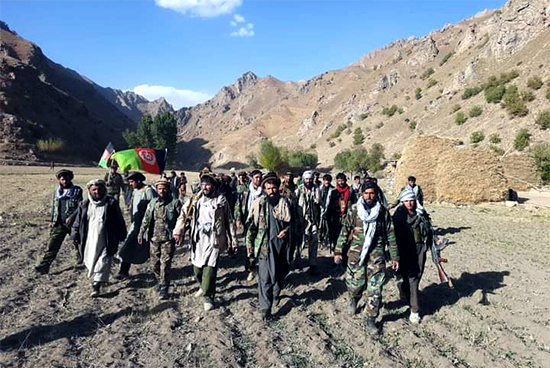
IN THE PHOTO: September 27th. Ehsanullah Mubariz, the commander of the Kuhistan district, in military camouflage with a white scarf; on his right hand is Abdulhamid Mujahid, the commander of the Yaftali Bolo district, and the second person on Mujahid's right is Jalal Raghi, the commander of the Raghistan region.
One of the commanders of the National Resistance Front in Badakhshan told the Sangar website that a new page in the history of the Badakhshan resistance began from the Kuhistan region with the ascent of commander Ehsanullah Mubariz from the village of Buzkush to the mountains two weeks ago.
“When the Taliban suspected him, he realized it and went to the mountain with 30 people. Meanwhile, 18 fighters from the Raghistan region joined him. It was in this area that the Taliban carried out two operations against them that failed,” he said.
According to this source, a week ago, Abdulhamid Mujahid, known as Mujahid Irti, from the village of Irt in the Yaftali Bolo district, who was the intelligence chief of the Taliban's Umar III division in Badakhshan, left this group and joined the resistance.
“He was one of three important people in the unit. The reason why he left this group was the insult and humiliation of the Tajiks, especially the removal of the inscriptions "donishgoh (university)" in Farsi from university buildings, the strict teaching of the Pashtun language in Badakhshan, the priority of Pashtun in the personnel policy of the Taliban. He left their ranks in protest. He said: “Now is not the time to work in this corrupt government, you need to serve your people,” the source said.
According to him, the Taliban sent a delegation of the elders of Badakhshan to return Mujahid Irti. Mawlawi Safiullah Samim, the current commander of the Taliban police in Baghlan province, called Irti, who was one of his commanders, and promised that if he surrendered, he would be promoted to the rank of general.
“But Mujahid told him that even if you give me the post of governor of Badakhshan, I will not give up. We thought the system would be Islamic, but the system you serve is purely ethnic and Pashtun. I am no longer fighting for this fascist system, I will fight for our national identity and values,” the source said.
According to Sangar's interlocutor, Mavlavi Safiullah sent another of his men, Qari Abdulrahman, the commander of the central brigade of the Umar III division, who hails from the Yaftal district to the Sheva area of the Yaftali Bolo district in order to suppress resistance and "correct the situation."
“Qari Abdulrahman was very nervous because Mujahid took with him part of the weapons of his depot. But before reaching the resistance fighters, his forces were ambushed by a group of 15 people who were about to join the resistance fighters from the Yawan district under the command of Mohammad Osman, as a result of which 15 Taliban fighters were killed and wounded," he said.
According to the source, Kari Abdulrahman was wounded during the battle, he was taken by plane to Faizabad and then to the Chaharsadbistar hospital in Kabul, and his condition is assessed as serious.
“Qari Sajjad, commander of the Taliban battalion in Rags, and Abdulrahman Anwari, commander of the Taliban battalion in Kuhistan, were killed. Qari Sajjad is not Gujur, as they say. He is Tajik, from the village of Sumchan, Yavan district. Also wounded were two Taliban peshmerga from Raghistan named Wadud and Anwar, who are experienced fighters. The condition of the first is stable, and the second is serious,” the source said.
According to the information received, two more groups of 17 and 20 men are operating in the Yaftal district, one under the command of Shermuhammad, known as Sher Palangdara, one of the commanders of the late General Nazirmuhammad Niyazi, and Sirajuddin Sayyad.
“A group of 17 fighters operates in the Dzhuzgan valley. The news reported that two resistance soldiers were killed and two others wounded. They belonged to the same group from the Juzgan valley, and not to the group of Mujahid Irti," the source said.
Another district of Badakhshan where resistance forces are present is Arganjkha. There are two groups operating there, one commanded by Mohammad Amin and the other by Mohammad Qadeer, and they are linked to Commander Habib Warduji.
“All Badakhshan resistance groups belong to the National Resistance Front. Rumors about disagreements between Mavlavi Safiullah and Qari Fasihuddin or about the struggle for the gold of Rags are false. And the information that they will raise the flag of the Jamiat Islami (of Salahuddin Rabbani) party is not true. All of them are subordinate to the National Resistance Front under the command of Ahmad Massoud,” the source said.
Badakhshan's resistance appears to have waned since the suppression of the Pamir Tigers in April this year. Meanwhile, it has made its presence felt throughout the province in recent months, but with the dominance of Tajik Taliban forces there, resistance groups have had little chance. The vast majority of the Badakhshan Taliban factions are divided between Kari Fasihuddin, chief of staff of the army, Mawlawi Amanuddin, commander of the Air Force, Najib Ragi, chief of police of Laghman province, and Mawlawi Safiullah Samim, chief of police of Baghlan province.
Mawlawi Najib broke the oath on the Quran: what happened in Raghs?
Badakhshan is a strategic province of Afghanistan, bordering China, Pakistan, and Tajikistan. Sources of the Sangar website report an increase in the number of fighters of foreign terrorist groups associated with Al-Qaeda and ISIS in this province, whose position is becoming stronger day by day.
Leaders of ISIS and Al-Qaeda in the North: who and where?
The Afghan National Resistance Front is currently the only force not only against the Taliban but also against terrorism in the region and the world. After the Taliban came to power, all terrorist organizations in Afghanistan operate freely and strengthen.


