


Why Is Badakhshan Becoming the Center of Crisis?
Author: Green Trend of Afghanistan
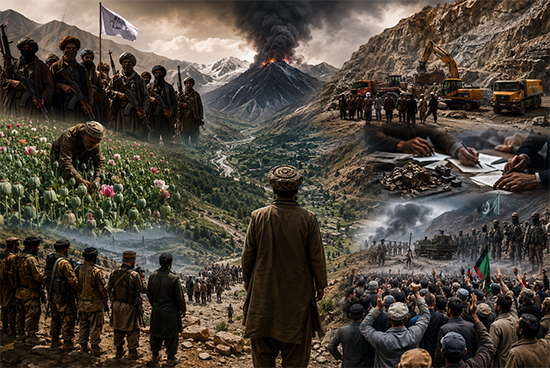
The establishment of control by the Taliban movement over the province of Badakhshan has led to the emergence of at least five parallel crises. In this commentary, we will briefly examine these five crises.
The province of Badakhshan, due to its enormous natural resources, its eastern borders with a superpower such as the People’s Republic of China (PRC), with Pakistan — an ally of both China and the United States — as well as with the Republic of Tajikistan to the north, which is a member of the Collective Security Treaty Organization (CSTO), has become one of the most sensitive geopolitical regions.
It should be noted that within the Eurasian space, Tajikistan is regarded as a frontline state in the struggle against instability and security threats stemming from the ominous presence of the Taliban in Afghanistan.
FIRST CRISIS: The Presence of Ethnic Militias from the South as an Assault on the Dignity and Honor of the Local Population
Possibly thousands of residents of Badakhshan fought in the ranks of the Taliban to overthrow the legitimate republican system. They did not know that Islam, in the hands of Hibatullah and his clan-based group, was merely an instrument for consolidating control and evading responsibility before the people of Afghanistan. They saw only the external side of the issue. Now, however, they feel its inner reality with their entire being.
Among the thousands of deceived Badakhshanis, the majority have now realized what a grave mistake it was to join the Taliban ranks. They have understood that by taking this step, they strangled their own identity and history. Some are trying to correct this mistake before it is too late and do not want their children to live with the shameful legacy of the Taliban. That is why a rebellion of Taliban members against the Taliban themselves is now beginning. More accurately, this could be described as an uprising of the “internal” or “non-native” Taliban against the “core” Taliban.
SECOND CRISIS: Poppy Cultivation as a Protest Against the Taliban’s Economic and Predatory Policies
According to data from the Green Trend of Afghanistan (GTA) and documents published by Western organizations, opium poppy cultivation in Badakhshan has increased five to seven times compared to previous years. This year, even in some areas where there had never been a tradition of poppy cultivation, people began growing it as a form of protest.
Last year, to destroy the poppy fields, Mullah Hibatullah sent around three thousand militia fighters to Badakhshan, which led to armed clashes: 26 people were killed, and more than two hundred were arrested, yet the crops could not be destroyed. This year, poppy cultivation in Badakhshan has become not only a sign of the weakening control of Hibatullah’s militias but also a form of economic and symbolic protest. People want to say that poppy is “more halal” than obedience to Hibatullah.
Reports indicate that around one thousand fully ethnic militias from Helmand were sent to Badakhshan to suppress the resistance. However, it can be said with confidence that they will achieve nothing.
Bloody clashes are expected. The residents of Badakhshan ask: why does Hibatullah tolerate poppy cultivation in the fenced and protected areas of Helmand, yet sends forces to suppress Badakhshan?
THIRD CRISIS: The Plundering of Natural Resources and Minerals
The largest mining and natural resource extraction contracts have been handed over to companies from Kandahar and their Chinese partners. Chinese companies often operate in the province like mafia-style structures and do not enjoy respect or a good reputation among the local population.
The Green Trend of Afghanistan (GTA) possesses documents indicating that the Chinese Embassy in Kabul also does not maintain good relations with these companies and considers their uncontrolled and predatory activities, aimed at незаконное enrichment, to be damaging to the reputation and dignity of the People’s Republic of China.
Another part of the contracts is linked to the use of rented transportation, which is likewise controlled by Hibatullah’s group. Only at the very lowest level — in the hiring of laborers — are some residents of Badakhshan employed. In other words, Badakhshanis participate in the extraction of their own natural wealth merely as wage laborers, not as owners or employers.
This process of resource plundering has provoked protests among various layers of society — both peaceful and violent — and these protests continue to expand.
FOURTH CRISIS
Modern Badakhshan can be described in one sentence: the most geopolitically sensitive province of Afghanistan, whose internal crises resemble a sleeping volcano. Smoke is already rising above the crater, and people are waiting for an eruption that will consume the thieves, oppressors, and Hibatullah’s mafia, after which the people of Badakhshan will take governance into their own hands.
Badakhshan borders three extremely important and sensitive states: Pakistan and China to the east, and Tajikistan to the north. Tajikistan is an important member of the CSTO of the CIS countries, whose activities are closely linked to the strategic interests of the Russian Federation.
After 2021, the People’s Republic of China sought in various ways to fill the vacuum created by the U.S. withdrawal from Afghanistan. However, Beijing quickly realized that the Doha Agreement had effectively become a secret contract for the employment of the Taliban — an arrangement in which the Taliban are publicly condemned, but in practice supported and financed as agents of instability and enemies of civilization.
Now Beijing is attempting, through more active covert operations, to prevent potential threats to its borders and security interests. These activities are not necessarily coordinated with the Taliban.
At the same time, Pakistan is consumed by anger. The reasons for this have already been discussed many times, so there is no need to elaborate further. In order to ease its dissatisfaction, Pakistan has effectively established low-cost control over parts of Nuristan and Kunar provinces by reaching agreements with local leaders. Islamabad also maintains contacts with various groups within the population of Badakhshan.
The invisible presence of various foreign forces in Badakhshan will undoubtedly lead to a new situation. In the absence of a legitimate state, people consider establishing external relations for the protection of their interests to be lawful and justified.
FIFTH CRISIS
Badakhshan is one of the most densely populated provinces of Afghanistan, and in the past, many of its educated residents worked within Kabul’s bureaucratic apparatus. Today, virtually all Badakhshanis have been excluded from the state structure.
The province of Badakhshan has turned into a prison for its own people, where the wardens are appointed from Kandahar. The question is not whether two million prisoners will one day rise against several thousand jailers sent from the south, but rather when this will happen. The signs of this just uprising are already clearly visible.
We wish success to dear Badakhshan and its historic people. The Green Trend of Afghanistan (GTA) seeks to play its role in saving Badakhshan from the aforementioned crises so that the people of Badakhshan may once again regain control over their land and their wealth, and so that Badakhshan may once again be connected with Kabul.
At present, however, Kabul and Kandahar have become two centers from which Badakhshan feels completely alienated: one has become a center for issuing fatwas of destruction and repression, while the other has become a center for implementing orders based on discrimination and anti-national policies.


