


Anyone who still cherishes the hope that, cursing their homeland, will become their own person there, is making a deep mistake.
Author: Zhambolat Sardalov, expert on politics, religion and terrorism (Chechnya), especially for “Sangar”
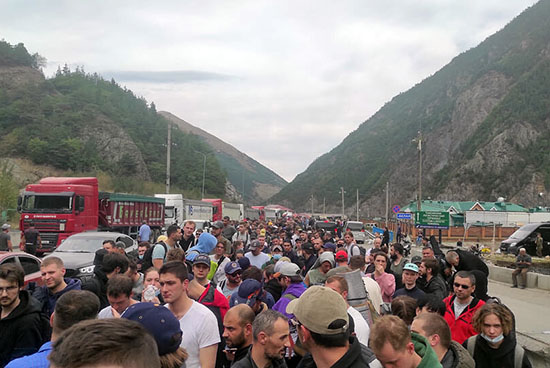
Since the beginning of the special military operation and subsequent mobilization, more than 600 thousand people have left Russia. Young people, nurtured in the worst liberal traditions, became the main backbone of the exodus. They also fled to the countries of Central Asia. The irony of fate is that they are fleeing to a place whose residents in Russia, who consider themselves representatives of high culture, were called derogatory names.
The large flow was facilitated by the visa-free regime with Central Asia. And traditionally, quite a few people there know Russian, which means it is possible to establish at least some kind of communication.
But not everyone and not the majority were able to get a job there. The region has varying levels of economic development and is not at all large, and did not become the refuge that the liberal fugitives dreamed of. They are in no way similar to those Russian emigrants who left Russia under pressure from the Bolsheviks. Completely different levels of development, influence on local societies there and roles in the fate of the countries that shelter them. Those are people of spirit, these are people of belly.
Accordingly, the newcomers command little respect. They are used, they do not have any rights, they are outcasts. Of course, traditionally the locals showed respect at first, but for a number of reasons, including the behavior and reasons for their arrival, they eventually became tired of the guests. Pity gave way to disappointment and anger.
In addition, the reason for the growth of negativity is in the economy. Housing prices have risen sharply, and food prices have also risen. There are problems with employment for the locals themselves, who sometimes cannot cope with their competitors - guests. Purely psychologically, there is no reason for fugitives to accept a new place of residence in their souls. It's just a location. With this approach, it cannot promote dialogue between representatives of different cultures.
The attitude of local residents towards the fugitives will further deteriorate, mostly for the above reasons. And what a disappointment it will be when such people have to return home. The question of rethinking values is not in the realm of abstract conclusions in this case.
Despite all the problems, Russia is interested in the return of its citizens. After all, be that as it may, young people have left the country, and some of them are highly educated. Anyone who still cherishes the hope that, cursing their homeland, will become their own person there, is making a deep mistake.


