


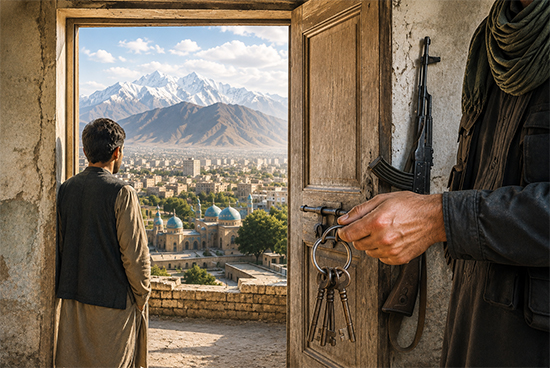
In many districts of Kabul, families of Taliban members avoid close contact with their neighbors because they are afraid and understand that these very streets may one day turn into a trap for them.
Author: Amrullah Saleh, leader of the Green Trend of Afghanistan (GTA)
First: Do not give America advice on combating terrorism. It knows both you and the terrorists. Moreover, it has supported both sides at times.
Second: Do not rely on people who waver and cannot make up their minds. Do not attach too much importance to them or tie the fate of your struggle to them.
Third: Do not waste your time on Taliban lobbyists. Their logic is switched off. They will begin to regret their position and reconsider their views only after the fall of the Taliban, not before.
Fourth: Do not invite the Taliban to negotiations, and do not explain the advantages of the negotiating process to them. It may ultimately work against you.
Fifth: If you speak of your strength and capabilities, demonstrate them in practice. Strength that exists only in words does not create deterrence. It is action that turns statements into reality.
Sixth: If you were part of the republican system, do not present yourself as an expert on the reasons for its collapse. Focus first and foremost on your own role and responsibility. Interviews by former Republic officials attacking the Republic itself are petty and undignified. However, God has not bestowed dignity and a sense of proportion upon everyone in equal measure.
Seventh: During the period of the Republic, the country could broadly be divided into two major groups. The first consisted of people who had already been present on the political and social stage before the fall of the Taliban and the events of September 11. The second consisted of those who entered state institutions through charitable organizations, mainly owing to their connections and contacts with representatives of the West. One should not expect a revolutionary spirit from the second group.
Young people and educated members of the Republican-era generation also mostly belonged to one of these two segments. Alongside them, there is a large part of society that, figuratively speaking, stands in the middle of the road: whoever occupies their street, they will invite him in for tea and bread and prepare mantu. Therefore, do not worry too much about the reaction of this part of society. This is the so-called “gray layer.”
Eighth: The Taliban predetermined the criteria and instruments through which it would come to power: deals and conspiracies with foreigners, crimes inside the country, and the justification of any means necessary to achieve its goals — from mass killings to using women’s clothing as cover, planting explosives inside the bodies of the dead, and carrying out terrorist attacks in maternity hospitals.
The Taliban cannot be politically whitewashed. Therefore, believe in your struggle and do not be afraid.
Ninth: Your struggle is getting on the Taliban’s nerves — so much so that its representatives, from the highest to the lowest levels, have resorted to insults and street-level rhetoric. When a side runs out of arguments, it resorts to abuse. Insults are not a sign of strength; they are evidence of a lack of arguments.
Tenth: The Taliban has many weaknesses. Yet most people, instead of focusing on its vulnerabilities, look only at its strengths. Change your perspective, and you will see that the fall of the Taliban is not something unattainable. This outlook in itself will give you greater confidence and fighting spirit.
For example, in many districts of Kabul, families of Taliban representatives avoid close contact with their neighbors because they are afraid and understand that these very streets may one day turn into a trap for them. Inshallah.
Eleventh: Do not reduce Afghanistan’s national crisis solely to the issues of women’s education and women’s rights. This is only one part of a much broader and deeper crisis. Do not blindly repeat a narrative in whose formation you yourself played no part. First study it carefully, understand it and reflect on it — and only then reproduce it.
Restrictions on women’s education and employment are only one of the problems, not the whole problem. Target the system of power itself, rather than merely its individual political decisions. Our people have a fundamental and irreconcilable conflict with the structure, objectives, and leadership of the Taliban.
Even if this same system were to reopen the doors of universities, Afghanistan’s problem would not disappear by itself.
The fundamental historical question is this: Who does the homeland belong to, and who is its owner? Who does this land belong to, and why should any single group determine the boundaries of what is permissible for you and me? On what basis?
First and foremost, it is precisely this foundation that must be defined. As long as the boundaries of the rights and freedoms of the homeland are determined and divided by a single illegitimate and fanatical group, the crisis in Afghanistan will not be resolved.
And we must remember: many of the tragedies and crimes that have been committed and continue to be committed in Afghanistan were and remain the work not of an external stranger, but of an internal stranger — one who seized his own country and turned its citizens into strangers in their own land. Every Afghan feels this reality in their everyday life.
With God’s help.


