A contagious example of the Taliban* or do people need to save their history?
Author: Sabriddin Badakhsh, Historian, especially for Sangar
Some events that took place in Ukraine remind me of the past. The question is why people do not take a lesson from the past? Why do people torture history?
And I start my thoughts with another question: why do normal people like to study their past? Probably the same reason why a person who has fallen while running, after getting up, always looks back at the place of his fall. He does this in order not to fall again. History teaches people not to repeat mistakes, history gives people spiritual strength, unites them and makes them invincible. But the question arises: “Does everyone need a close-knit and united people who know their past and create a peaceful and bright future for themselves?”
By the way, the Afghan Taliban were the first in modern history to openly and demonstratively destroy historical monuments. 200 km northwest of Kabul, back in the 1st-2nd centuries. AD Buddhist monasteries were founded, which existed there until the 8th century, when Buddhism, as a result of Islamization, was ousted from the territory of Afghanistan. More than a thousand years have passed, but the abandoned Buddhist monasteries and the famous giant statues of Buddha remained untouched - neither the Arab conquerors, nor the local Persian and Pashtun rulers, nor the Turks, nor the Mongols destroyed them. And only on February 26, 2001, the Taliban leader Mullah Mohammed Omar ordered the demolition of the famous architectural complex, which was considered a monument of world cultural heritage. Despite the protests of the world community, the Taliban had destroyed historical monuments.
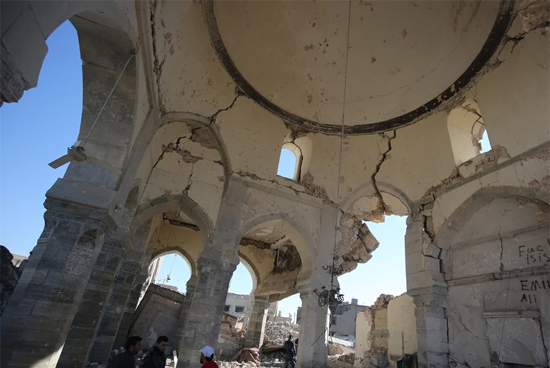
The relay race from the Taliban was intercepted by ISIS*. The request for the total destruction of historical and religious sites was supported in Syria, Iraq and Libya after the rise of religious extremism there, sponsored and supported by Western intelligence agencies. Only in Mosul, one of the oldest cities in Iraq, ISIS militants destroyed 28 religious sites from June 2014 to February 2015. The historical values stored in them were taken out of Iraq for the purpose of sale, and the radicals financed their activities with the proceeds from the trade in antiquities. In February 2015, militants blew up the central library of Mosul, as a result of which between 8,000 and 10,000 books, including unique ancient manuscripts on philosophy and history, disappeared forever. The militants set up a bonfire of books in the yard of the library.
In 2014, the media reported the destruction of several mosques (both Sunni and Shia) and shrines in ISIS-occupied territories. Among them were the Al-Kubba Husseiniya Mosque, the Sheikh Javad al-Sadiq Mosque, the Arnaut Mosque, the Kado Mosque, the Askar-e-Mulla Mosque, as well as the temple and tomb of the Sufi Ahmed ar-Rifai and the Sheikh Ibrahim Temple. In June 2014, ISIS bulldozed two buildings in the Fathi al-Qaen shrine complex. On July 25, 2014, the 13th century Imam Aun al-Din Shrine in Mosul, one of the few structures that survived the 13th century Mongol invasion, was also destroyed by ISIS. On September 24, 2014, the mosque and temple of Arbain Vali in Tikrit, which contained forty tombs from the era of Umar, were blown up. On February 26, 2015, ISIS bombed the 12th-century Green Mosque in downtown Mosul. In March 2015, ISIS bulldozed the Hama al-Qadu mosque in Mosul, built in 1880. In 2017, ISIS destroyed the Great Mosque of al-Nuri and its sloping minaret. It was the mosque where ISIL leader Abu Bakr al-Baghdadi had announced the establishment of the Islamic State Caliphate three years earlier.
At present, some European states have already declared war on their own history and cultural heritage. The authorities operating in Ukraine, having not achieved military successes on the battlefield, are pursuing a policy of separating their history from everything connected with Russia. The Kyiv regime began the systematic destruction of monuments to writers and poets, monuments to Soviet soldiers-liberators who bravely fought against the Nazi invaders during the Great Patriotic War, giving their lives, including for Ukrainian territories. So, in the city of Kharkov, radicals demolished the bust of G.K. Zhukov, and neo-Nazi slogans are written on the pedestal, in Ivano-Frankivsk it is planned to change the name of about 20 streets named after Soviet and Russian writers and scientists. In Odessa - to dismantle the signs of sister cities (Moscow, Volgograd, Rostov-on-Don, etc.) from the memorial sign located in the city center. A similar line of conduct is followed by the Baltic countries, where the Latvian authorities are passing a law on the demolition of the monument to the soldiers-liberators in the city of Riga.
Thus, the answer is found: “Not everyone needs a close-knit and united nation, knowing their past and creating a peaceful and bright future for themselves.” Someone really wants to wake up one day in a world where there was no Great Patriotic War against the Nazi invaders, where education is not welcome and people believe in God, who was invented by militants of terrorist organizations running around with Kalashnikov assault rifles. Another question arises: “Who benefits from all this and how to resist it?”
Ukraine and the Baltic states appear to be European countries. Their governments, which deny ties to fascism, why are they destroying anti-fascist relics? They think that in this way they can break off relations with Russia and its people. You can run away from everything, but not from yourself. You can run away from everything, but not from yourself. European power should be European or civilized, not like the Taliban and ISIS. If all this is done by them to please the United States, then this is nothing but servility and history will never forgive this, just as it does not forgive us in Afghanistan. Meanwhile, Ukraine is turning into a new Afghanistan in all respects.
* The organization is under UN sanctions or banned due to terrorist activities.