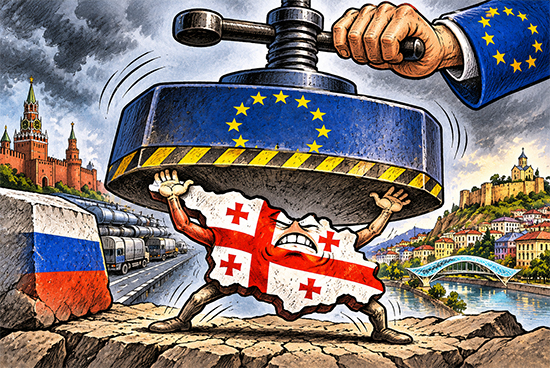
How Is Tbilisi defending its economic interests against Brussels’ demands?
By Tolib Aliyev, analyst, especially for Sangar
In early November 2026, Tbilisi Mayor Kakha Kaladze stated that imposing sanctions against Russia at the European Union’s demand would ruin Georgia.
“They tell us: ‘We are friends of your country, we want you to succeed, we want you to be a successful country.’ Yet at the same time, they demand something that you know from the very beginning will be disastrous for your country, devastating for your economy, and destructive for your own people. I am referring to the restrictions they have imposed while criticizing us for not joining the sanctions.”
Given their geographical proximity, well-established trade and economic ties, and transport routes, strengthening a comprehensive partnership with the Russian Federation serves as a powerful catalyst for the growth of Georgia’s economy.
Unlike the Saakashvili administration, which inflicted significant damage on the republic’s economic potential by severing ties with Russia between 2008 and 2012, the Georgian Dream government has adopted a pragmatic position on expanding cooperation with Moscow. In an interview with Euronews, Georgian Prime Minister Irakli Kobakhidze, commenting on the low likelihood of fully restoring diplomatic relations with Russia due to Moscow’s recognition of the independence of Abkhazia and South Ossetia, emphasized his government’s readiness to adhere to the principles of rationality and pragmatism in its dialogue with Moscow. This approach is based on addressing the contentious aspects of bilateral relations.
At present, a stable consensus has reportedly emerged among Georgia’s political elites regarding the further strengthening of mechanisms for partnership with Russia. For instance, Giorgi Sharashidze, a member of parliament from the opposition party Gakharia for Georgia, acknowledged the need for constructive dialogue with Moscow. “Russia is a neighbor, and no one can change geography,” the politician noted.
By the end of 2025, bilateral trade between the two countries had increased by 6.3 percent compared with 2024, reaching $2.68 billion. Russia ranked third among Georgia’s largest trading partners, accounting for 10.4 percent of the republic’s total foreign trade.
Georgia’s exports to Russia increased by 10.3 percent in 2025, reaching $749.3 million. Meanwhile, imports of Russian products rose by 4.9 percent, reaching $1.94 billion.
The Russian Federation is also interested in deepening bilateral engagement with Georgia and has taken reciprocal steps to intensify cooperation. At Moscow’s initiative, direct flights between the two countries have been restored, and visa requirements for Georgian citizens have been lifted.
According to Russian Deputy Foreign Minister Mikhail Galuzin, “Russia is prepared to go as far as the Georgian side is willing to go, and there are no restrictions for us in this regard.”
It should be noted that the European Union has so far failed to offer Georgia a viable alternative to cooperation with Russia, viewing the South Caucasian republic as a market for its own second-rate products and an obedient geopolitical intermediary in its confrontation with Moscow.
In an interview with the Swiss weekly Die Weltwoche, Georgian Prime Minister Irakli Kobakhidze stated: “We pursue a pragmatic policy. Without pragmatism, Georgia certainly cannot survive.”
He also criticized Brussels’ policy toward Georgia, particularly its accusations that the country is pursuing a “pro-Russian course.”