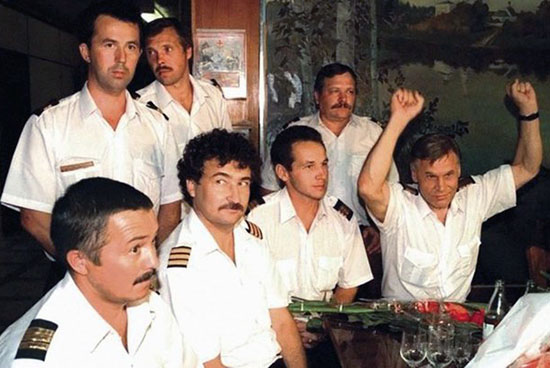
The escape of Russian pilots from the captivity of the Taliban in Kandahar, which happened in 1996, was a mysterious, incomprehensible, and even unbelievable incident. This story is almost written in one plot, which is repeated and which is still believed. Our story is completely different, at least it denies the previous story.
Author: Fahriddin Kholbek, member of the Sangar Advisory Board
IN THE PHOTO: IL-76 crew: Aircraft commander - Vladimir Sharpatov; co-pilot - Gazinur Khairullin; navigator - Alexander Zdor; flight engineer - Askhat Abbyazov; flight radio operator - Yuri Vshivtsev; lead engineer - Sergey Butuzov; Leading Engineer - Viktor Ryazanov.
AUTHOR'S NOTE: This article was published on April 19, 2019, on the Rushnai website. Four years later, we are republishing it with a new edition and some changes in Sangar so that readers can understand this important and interesting page of the history of the “Great Game” of powers in Afghanistan better and more.
***
In February 2006, a conference on Afghanistan was held in London. Russian Foreign Minister Sergei Lavrov pointed to the "undesirability" of the presence of the Taliban in the Afghan parliament.
The statement of the Russian Foreign Minister brought the author of these lines, then a correspondent for Radio Ozodi in Kabul, to Abdusalam Raketi, one of the former Taliban officials and in those days a member of the Afghan parliament.
Raketi, who knew little Farsi, spoke with a Pashtun accent in a state of anger and pride, talked about the defeat of the Russians by the Mujahideen, and accused Lavrov of interfering in the internal affairs of Afghanistan.
At that moment, I remembered the case of the escape of Russian pilots from Kandahar. In continuation of the conversation, I reminded him of this high-profile escape in 1996, which took place not just anywhere, but in Kandahar itself - the real capital of the Taliban - and under the nose of Mullah Omar, their "amirulmuminin".
I will never forget: Raketi listened carefully to my words and said: "Even if they turned into genies, they could not escape from us. This is a completely different matter and this is not the time to talk about it."
Raketi (from the word "rocket") was one of the senior commanders and from 1995-1996 the governor of the Taliban in the province of Wardak. The most important thing that I learned from his words is that the Russian pilots did not make a heroic escape, but were freed.
Important historical events are always retold with new narratives. Below we present a completely different story about the escape of Russian pilots from the captivity of the Taliban in 1996.
DUDAYEV'S WILL
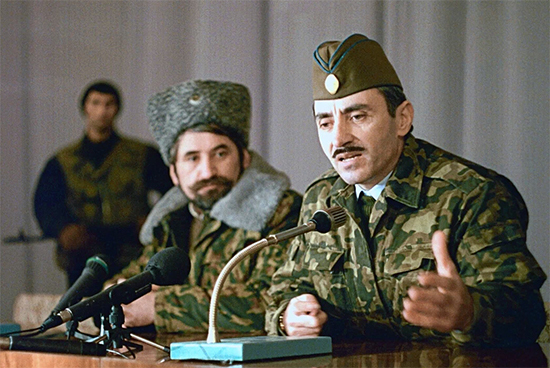 This story was told to me by one of my friends and people close to Ahmad Shah Massoud. His story casts doubt on the 25-year history that dominates the global media, especially in Russia.
This is Naeem Amiri (a pseudonym) who was in Islamabad in the summer of 1996 to meet with the Pakistani authorities. At the time, Pakistan was openly at odds with Burhanuddin Rabbani's government in Kabul, but cooperate on some issues such as humanitarian aid.
Amiri accidentally meets Vakha Ibragimov, a former adviser to Dzhokhar Dudayev, president of the Chechen Republic of Ichkeria (1991-1996), in Rawalpindi. They met several years ago at a conference in Moscow. Ibragimov came to Islamabad to find a way to meet with Mullah Omar, the leader of the Taliban and needed the help of the Pakistanis. He said he wanted to take the seven Russian pilots who were in captivity by the Taliban so that the government of Ichkeria could make a political deal with the Russians.
The Chechens, according to the will of Dzhokhar Dudayev, planned to exchange these pilots for the severed head of Kenesari, the last Kazakh khan, which was kept in one of the museums in Russia.
Kenesary, the son of Kasim Sultan, was the sixth and last khan, as well as the leader of the Kazakhs who fought against the Russians in the 1940s. The Emir of Bukhara recognized him as the Khan of the Kazakhs, but the white Tsar Nicholas I did not accept him. Kenesari was expelled from the territory of Kazakhstan by the Russians, and he found shelter with the Kyrgyz manaps. But the manaps killed one of his important commanders. A war began between the Kenesari and the Kirghiz. Khan's companions, two Kazakh sultans, Rustam and Sypatai, betrayed him and, leaving him alone on the battlefield, fled to the steppe. Kenesary was defeated and taken prisoner. The Kyrgyz manap - Dzhantai (according to other legends, Ormon) cut off his head and sent it to the Governor-General of Western Siberia as a sign of the Kyrgyz loyalty to the white king.
For two centuries, the Kazakhs believed that the head of their khan was kept in the Kunstkamera, or Museum of Rare Artifacts in St. Petersburg, founded by Peter the Great. In 2004, Kazakhstan officially sent a request to Russia for the return of the head of the khan but received a negative response. The answer was that there is no such exhibit in any of the Russian museums and what they say is nothing more than a legend.
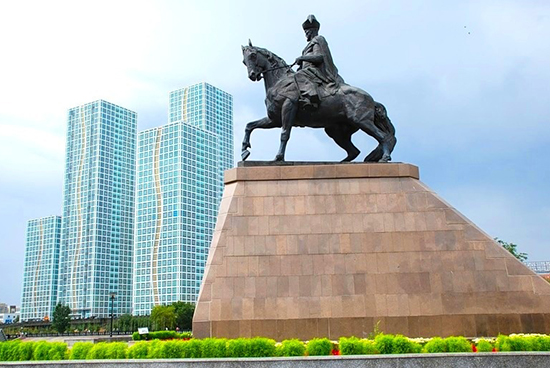 IN THE PHOTO: Monument to Kenesary Khan in Astana.
However, Dudayev, a former Soviet general, had his own convictions and calculations. He wanted to bring the head of the Kazakh khan to Kazakhstan and attach it to the rest of the body, thereby “arousing the wrath of the Kazakhs” and turning them against the Russians.
But when Vakha Ibragimov arrived in Islamabad, Dudayev was no longer alive. On April 21, 1996, the president of Ichkeria, one of Russia's most staunch opponents, was assassinated by that country's intelligence. The First Chechen War (1996-1994) continued.
At that time, Vakha Ebragimov was an adviser to Zelimkhan Yandarbiyev, Dudayev's successor. He came to Islamabad to fulfill the dream of Dzhokhar Dudayev. He believed that the Taliban would help the Chechen Muslim brothers in the struggle for their independence. Amiri advised him to go to Peshawar and meet Mawlawi Amir Kabir, a man with access to the Taliban leader.
But Vakha Ibragimov was still in Islamabad when the bad news overtook him...
ANOTHER COINCIDENCE
 IN THE PHOTO: Young diplomat Zamir Kabulov visiting the Il-76 crew
Fate in those days drew another chance meeting for Amiri. That day, in the so-called "diplomatic enclave" of Islamabad, he met Zamir Kabulov, a Russian diplomat (now the Russian president's special envoy for Afghanistan). Amiri also met him at one of the conferences in Moscow on Afghanistan.
Kabulov's resume does not indicate who he was or where he worked that year (1996). His association with Pakistan dates back to 1991-1992 when he was an adviser at the Russian embassies in Kabul and Islamabad. However, his diary indicates that in 1995 Kabulov actively participated in negotiations with the Taliban regarding the release of the Il-76 crew captured in Kandahar. He was even called the "chief negotiator".
By that time, Kabulov had twice tried to meet with Mullah Omar, but without success. The Taliban leader did not accept him. On the third attempt, and with the help of the Pakistanis, he managed to shake Mullah Omar's hand.
According to Amiri, Kabulov was very happy that day - the Taliban agreed to release the Russian pilots. Kabulov did not elaborate on the details of the terms of their release. It was a diplomatic victory for Russia. The news greatly upset Vakha Ibragimov, who was preparing for a trip to Peshawar...
The captivity of Russian pilots was recorded by the world media in one story: on August 3, 1995, an IL-76 aircraft of the Tatarstan company "Aerastan" with 30 tons of cargo (1300 boxes of only bullets or other ammunition for small arms) flew from Tirana, the capital of Albania, to Bagram airport in Afghanistan. The Afghan government, led by Burhanuddin Rabbani, bought these munitions from Albania. But as the plane flew over Kandahar in Taliban territory, it was pursued by the Taliban attack planes. The MiG pilot, who spoke fluent Russian, ordered them to land at Kandahar airport. While inspecting this aircraft, the Taliban found several illegal projectiles along with the ammunition. 7 crew members who were carrying ammunition for the enemies of the Taliban - the forces of Ahmad Shah Massoud, were captured.
At press conferences, the management of the Aerostan company assured that the transportation of ammunition by their aircraft does not contradict international laws. On the other hand, this was already the third (according to other sources, the second) flight of the IL-76 to Bagram, which also proves Russia's cooperation with the government hostile to the Taliban.
 Pilots of IL-76 were held captive for one year and 13 days. At this time, the UN Security Council twice asked the Taliban to release the Russian crew without any conditions. The Russian Foreign Ministry turned to the United States, Saudi Arabia, and Pakistan for help, but received no results.
In exchange for the prisoners, the Taliban asked Russia to hand over former leaders of the communist government and the National Security Service (KHAD). Moscow did not accept these conditions. The Russians offered the Taliban KamAZ trucks, which were very easy to drive in Afghanistan, a helicopter, aircraft parts, and even two million dollars in cash, but all of this was not accepted by the Taliban.
Finally, US Senator Hank Brown, one of the supporters of the Taliban in the US, got involved. But all he could do was convince the Taliban to let the pilots inspect their plane from time to time to prevent its destruction. This allowed the crew to escape.
On August 16, 1996, while the Taliban were performing their Friday prayers, an IL-76 crew captured three Taliban fighters and flew through Iranian airspace to Sharjah Airport in the United Arab Emirates.
The Taliban called an emergency meeting of their Supreme Council. On August 17, Tehreek-e-Taliban spokesman Vakil Ahmad Mutawakkil confirmed from Kandahar that Russian pilots had escaped and kidnapped three Taliban. According to him, two MiG fighters were sent for them, one of which failed to take off, while the other took off after 45 minutes and lost the Russian plane due to bad weather. However, Mutawakkil said that the Russian plane did not have enough fuel to fly to Sharjah and that the Taliban were investigating the case. Denying Iranian collaboration with the Russians and bribing the Taliban guards, Mutawakkil succinctly said, "It was a bold move and they succeeded."
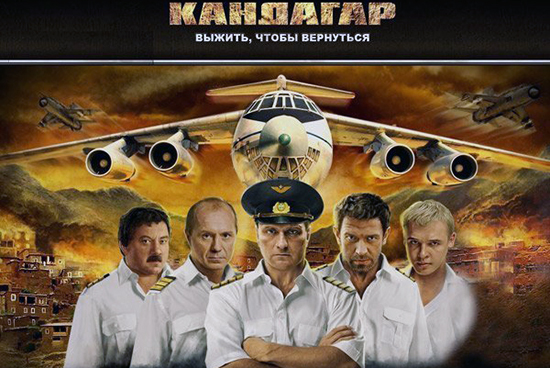 The crew returned to Russia. By order of President Boris Yeltsin, the commander, and co-pilot was awarded the title "Hero of Russia", and the rest were awarded the Order of Courage. In 2010, based on this event, the film “Kandahar” was released.
Based on assumptions, the media presented the option of paying a large ransom to the Taliban, but there were no witnesses or evidence. No one paid attention to Mutawakkil's admiration for the courage of the Russian pilots and the "bad weather" of Kandahar.
The commander of the IL-76, Vladimir Sharpatov, interviewed journalists several times during these years. He talked about the harsh life in Kandahar, where summer temperatures reach 50 degrees, poor nutrition, mental pressure, threats to their life, forced conversion to Islam, and the bleak future of the crew.
This story also had its controversial points, in which the media did not show interest. There were the things that Sharpatov voluntarily or involuntarily did not talk about them...
BOUT WAS...
 IN THE PHOTO: "Bad nutrition, psychological stress, life threat, forced conversion to Islam and a bleak future for the Il-76 crew."
In fact, the life of the Russian crew in Kandahar was not so bad. What is said in Sharpatov's stories and shown in the film "Kandahar" does not match the photographs of those days published later. These photographs show that the pilots were being held as hostages, not prisoners. Local residents visited them freely. The crew members were under the care of a doctor who had come from Moscow. He also examined the Kandaharis. The Aerostan company also took care of them - its representative visited them and provided them with food and other necessary things.
Before, the author of these lines heard many stories from former prisoners of the Taliban. The stories were different and very scary. The fact is that the members of the Al-76 crew lived in the "heart" of Kandahar, the capital of the most extremist government in the world, right under the nose of Mullah Omar - "the emir of the extremists of the world." Osama bin Laden himself, the No. 1 terrorist in the world, also lived in this city. Moreover, in the house of a Taliban official, the crew members walked naked and in shorts, which raises many questions. It wasn't captivity, but something else.
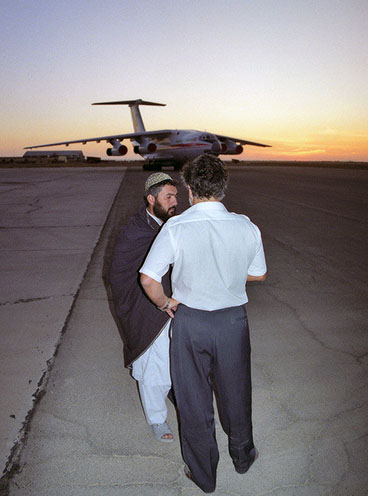 IN THE PHOTO: Taliban pilot Ghulam and Aerostan company representative Munir Fayzulin, who often visited the crew and provided them with everything.
Ghulam, a Taliban MiG pilot who spoke Russian, graduated from a Russian school and was a communist from the Khalq faction. He freely met with the pilots. The Khalqis, led by Shahnawaz Tanai, former Afghan Minister of Defense (1988-1990) in the Najibullah government (1986-1992), played an important role in Taliban military operations, combat planning, and the use of their tanks, heavy weapons, and aircraft.
In the 1990s, Alexander Malovechkin worked as an An-12 flight mechanic (for some time he was also the general director of Air Union). He flew on the UAE-Afghanistan route and was in Kandahar during the captivity of the pilots. He tells a different story from a man named Aziz, who worked as a dispatcher at the Kandahar airport. According to him, Sharpatov knew well that he was carrying illegal cargo and he was warned not to fly this route, as the Taliban knew about it and planned to detain the plane.
The transfer of 30 tons of ammunition to the forces of Ahmad Shah Massoud was carried out by the company "Transavia" of the famous arms smuggler Viktor Bout. Bout was born in Tajikistan and graduated from Russian military and aviation universities. In the early 90s of the last century, after the collapse of the Soviet Union, he founded the Transavia company, whose business was the transportation of civilian and military cargo around the world. But in 1996 he wasn't as famous as he is today. He participated in the release of the pilots along with Zamir Kabulov and other intermediaries.
In 2008, Bout was arrested in Thailand at the request of the Americans and later handed over to the United States. The United States accused him of drug trafficking for the first time. Later it turned out that Bout was engaged in the arms trade in Asia, Africa, and Latin America. After the incident with Il-76, Al-Qaeda and the Taliban also became his clients. According to information from the British intelligence services (MI6), Bout supplied weapons to the Taliban alone in the amount of 30 to 50 million dollars.
Amiri says that the ammunition that the Il-76 was carrying to Masud's forces, under the agreement and with the mediation of the Russians, was purchased not in Albania, but in Bulgaria. In 1998, Massoud once confirmed that he was receiving weapons from the "Russian mafia".
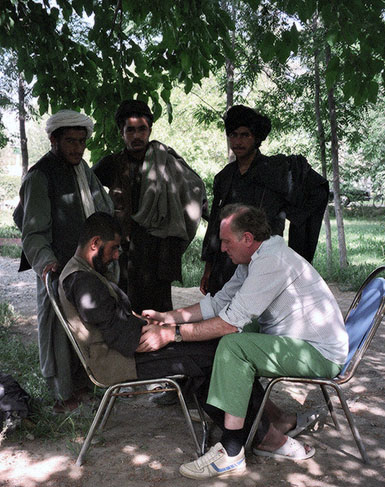 IN THE PHOTO: Medical examination of the residents of Kandahar by the doctor of the Il-76 crew.
At that time, the countries of Eastern Europe, including Albania and Bulgaria, were taking the first steps towards becoming members of the North Atlantic Treaty (NATO). They no longer needed weapons left over from membership in the Warsaw Pact (1955). Soviet weapons became a commercial commodity, and companies like Transavia moved them from Eastern Europe to different parts of the world.
The rumor that the Taliban want to hand over the pilots to Dzhokhar Dudayev has been around since the very beginning. Only it was not known what the Chechen leader was going to do with them. There was also a rumor that even Mintemir Shaimiev, the president of Tatarstan, met with representatives of Dudayev in Sharjah on this occasion. To what extent did Dudayev manage to convince the Taliban to extradite the prisoners? Nothing is known. But Vakha Ibragimov's trip to Islamabad shows that the Chechens had no success in this matter.
And all this remains the tip of the iceberg, the main part of which is underwater. No one paid attention to the hidden main part of this incident either.
"ZAHIRSHAH" PROJECT
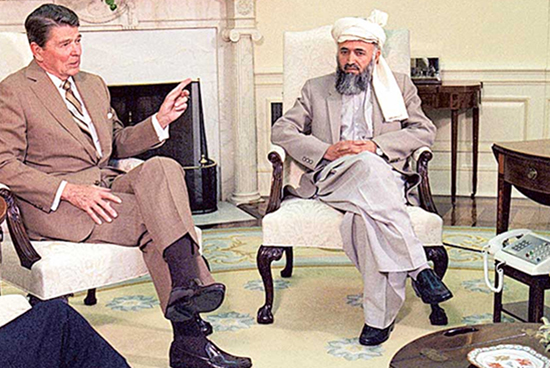 IN THE PHOTO: Burhanuddin Rabbani was also with Reagan, but the US did not accept his government.
In the summer of 1996, US Assistant Secretary of State for South and Central Asian Affairs Robin Raphel held his third and final meeting with Afghan Defense Minister Ahmad Shah Massoud in Qasr Istalef, Parwan Province. She told Massoud that US interests were behind the Taliban and that he should come to terms with them. She said that the US wants to create a government of technocrats, and Massoud's wars with the Taliban interfere with their plans.
The Americans did not accept the Rabbani-Massoud government for several reasons: 1) the US did not participate in its creation; 2) Tajiks have ethnic ties and a common language with Iran, the fierce rival of the US and Saudi Arabia. Turki Faisal, the Saudi security minister, made it clear that Massoud and his mujahideen spoke the language of the Iranians; 3) Pakistan, the US strategic partner in the region, supported the Pashtuns and, like the Soviet Union, wanted to put its henchman on the throne of Afghanistan. Exactly what Massoud never put up with; 4) The Tajiks have never been considered the main partner of the United States, the successor of England in regional politics, and never will be. The 20-year presence of the US in Afghanistan has proven that although they entrenched themselves in the region by relying on Tajiks and other non-Pashtuns, they never showed them a favor and eventually ceded power to Pakistan and the Pashtuns.
Massoud clearly told Raphel that if they want to impose their rule on the people of Afghanistan, then this is completely unacceptable. “If there is land the size of this pakul left in Afghanistan, I will stand on it with one foot and fight against you.”
The Americans also did not accept the government of such a religious group as the Taliban. They had a different agenda - the creation of an interim government headed by Zahirshah, the former king of Afghanistan (1973-1933). But this plan was not new.
More details are needed here in order to understand what role the case of Russian pilots played in the history of Afghanistan and the eternal rivalry between Russia and America, or the so-called “new big game”.
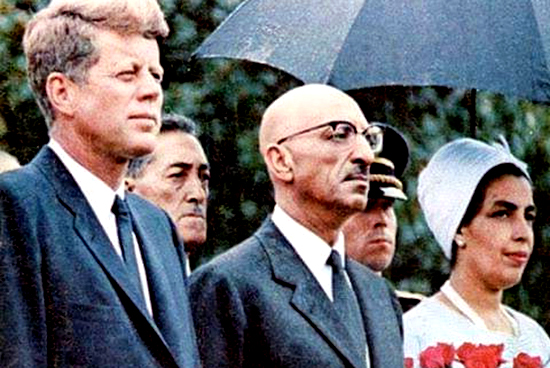 IN THE PHOTO: Zahirshah and his wife Humayra Begim with US President John F. Kennedy (1973).
Zahirshah was an exceptional leader in the history of Afghanistan. Although his regime was Shah's, the 40 years of his reign were perhaps the only period in history when Afghanistan lived in peace and prosperity and took the first steps towards the development of democracy, which was not noticed in neighboring countries. Tired of the long wars of the 80s and 90s, the people of Afghanistan fondly recalled the times of Zahirshah. It has become a symbol of peace, security, reform and development. From here, internal and external forces tried in every possible way to attract him to the implementation of their plans.
The first supporters of Zahershah appeared among the Mujahideen. Of the seven parties of the Peshawar Seven, three (Mohammad Nabi Mohammadi's Islamic Revolution Movement (one of whose commanders was Mullah Omar, leader of the Taliban), Muhazi Milli Saeed Ahmad Gilani and Jabhae Najat Sibigatullah Mujadadi), which were considered "moderate", were monarchists or royalists. They even asked Zahirshah to lead a jihad against the Soviet Union and its regime in Kabul in order to bring an elected democratic government to power in Afghanistan, but the leaders of four other parties, including Burhanuddin Rabbani and Gulbuddin Hekmatyar, who were called "radicals", did not accept this proposal and supported the Islamic system.
On November 13, 1986, the USSR Embassy in Kabul sent a confidential letter to the Politburo in Moscow. It said, referring to Dr. Najibullah's words, the new leader of Afghanistan, that Zahirshah should be returned and appointed head of the National Front of Padare Watan (Father of Nation) or chairman of parliament. On the same day, the Politburo of the Communist Party of the Soviet Union, headed by Mikhail Gorbachev, convened a meeting and set the task that in order to resolve the Afghan crisis, it was necessary to establish contact with the former Shah. At that time, the Soviet Union came to the conclusion that there would never be a truce between the communists and their Islamic opponents, therefore, to end the civil war, it was necessary to create a moderate political center led by Zahirshah. Soviet diplomats and intelligence contacted Zahirshah several times, but these efforts did not produce positive results.
In 1987, the first draft of a ceasefire agreement was presented by Diego Gordovez, the UN special envoy for Afghanistan. This plan called for the creation of a coalition government with the participation of the Mujahideen, refugees, elites, communists, and political leaders of Afghanistan, who were in exile. Washington, Islamabad, and the Mujahideen did not accept him. They saw no place in the future government for the communists and a former king named Zahirshah.
In 1990, Washington changed its approach and contacted Zahirshah about the formation of an interim government. Moscow supported this plan, but the Mujahideen rejected it. Washington was especially outraged when the Afghan politician and intellectual Syed Bahauddin Majruh was killed in Peshawar. The leader of the Islamic Party of Afghanistan, Gulbuddin Hekmatyar, was accused of killing him. Majruh conducted a poll among Afghan refugees in Pakistan, in which 72 percent preferred Zahirshah to mujahideen leaders as the future leader of Afghanistan.
In January 1992, United Nations Secretary-General Boutros Boutros-Ghali invited the political groups of Afghanistan to submit a list of their representatives to the national assembly to form an interim government and hold elections. Najibullah expressed his readiness to transfer power to Zahirshah, and not to the Mujahideen, who could not defeat him. The project was rejected by the Mujahideen and not a single list was submitted to the UN.
 IN THE PHOTO: Ahmad Shah Masood - the skillful actor of the "chessboard" of the "Great Game"
Commander Massoud also had his own plans for Zahirshah. In 1994, he established the Shura Ahl al-Khal wa Aqd in the city of Herat. This Shura is one of the councils for appointing a ruler in Islamic jurisprudence. The goal was to transfer executive power to one neutral and technocratic government. Massoud convinced Rabbani that "the cabinet should be executive, not political." According to his plans, Rabbani will remain president, and the prime minister will take over the executive power. It was Dr. Muhammad Yusuf, Zahirshah's former prime minister of Democracy Decade's time. Ismailkhan, at that time the governor of Herat, ruined this plan. Dr. Yusuf returned to Europe.
The Advisory Council was another plan that was proposed in 1994 by Mahmoud Mestiri, the United Nations Special Envoy to Afghanistan, after consultation with Zahirshah. The council asked Rabbani to hand over power to the former shah. This plan called for the convening of the Loya Jirga, the Afghan National Council, which was supposed to create an interim or transitional government. Rabbani, Hekmatyar, and other leaders agreed to this UN plan.
But it was then that students of religious schools appeared on the horizon of Afghanistan. This was the beginning of a new chapter in the Afghan crisis. The Rabbani-Massoud government, through Ashrafshah, President Rabbani's economic adviser, sent a message to the US embassy in Dushanbe that until these guys join the plan, they will not hand over power to the interim government.
AMERICA'S "GOOD GUYS"
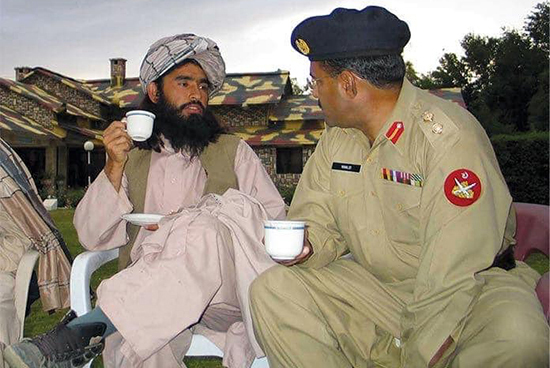 IN THE PHOTO: Taliban and Pakistani military - one army in two uniforms
In fact, the Taliban were thrown into the Afghan battlefield in a different way and according to a different plan, which was prepared by Pakistan, the US, and Saudi Arabia. The United Nations had nothing to do with this project. At least there is no evidence for this.
In December 1992, Asif Ali Nawaz, chief of staff of the Pakistani army, in the company of 10 leaders of Pakistani border tribes, secretly met Zahirshah in Italy. After this trip, Nawaz mysteriously died. His place was taken by General Wahid, a Pakistani Pashtun.
But the agreements between Nawaz and Zahirshah have entered the stage of implementation. Among them, two specific cases were related to the previous Shah: 1) propaganda in favor of Muhammad Zahirshah in the Pashtun border areas of Afghanistan and 2) the resumption of the activities of his representation in Pakistan.
These two points were part of a "global jihad" - a major plan that included the expansion of extremist and terrorist groups into Kashmir, the Caucasus, Central Asia, Yugoslavia, and Russia. It was supported by American and British intelligence, carried out by Pakistan, and funded by Saudi Arabia.
At that time, in Tajikistan (1992-1997), Bosnia (1995-1992), and Chechnya (1994-1996), civil wars were going on or brewing with the participation of "graduates of the Afghan Jihad school" - members of Al-Qaeda and other terrorist and jihadist organizations. The Nagorno-Karabakh war between Armenia and Azerbaijan (1994-1992), in which the Mujahideen of Hizb-i-Islami Hekmatyar also participated, was also considered part of this plan.
According to this plan, the government of Rabbani in Kabul was to be overthrown through widespread propaganda and the creation of divisions, and religious and ethnic conflicts. Mujahideen - "radicals" who were in power against Zahirshah, should have disappeared from the political scene, and Zahirshah should have returned to power. The force that was supposed to bring him to power was the Taliban.
 IN THE PHOTO: US Special Representative for Afghanistan Robin Raphel. This smile is the vanguard of the great suffering of the Afghan people caused by the "black army".
Siddiq Chakari, Rabbani's deputy in the Jamiat Islami Party of Afghanistan, who witnessed the meetings between Raphel and Massoud, says that when the Taliban were still in Helmand, Kandahar, and Ghazni, Mrs. Raphel clearly said: “They are the troops of Zahirshah, do not fight with them".
Amiri says that in 1994 when there were rumors about the emergence of a new force in the region, he went to meet with Nasrullah Babur, the interior minister of the Benazir Bhutto government. “When I was sitting in the waiting room of Babur's office, the door opened and some people with long beards and big turbans came out. I was wondering what kind of people they are," Amiri said.
These were the Taliban, and Babur was their "godfather". Amiri says that when he told Massoud what he saw, the commander said, "In the future, we will fight with this force."
At the end of that year, Amiri traveled to Islamabad to meet with foreign and international charities to find ways to attract humanitarian aid to internal refugees (after the fall of Kabul and Shamali, many people took refuge in the Panjshir Valley). He met with the US Deputy Ambassador to Pakistan named Nowak. When it came to the Taliban, who had just appeared in Afghanistan, but made significant progress, Navok said: “They are good guys!"
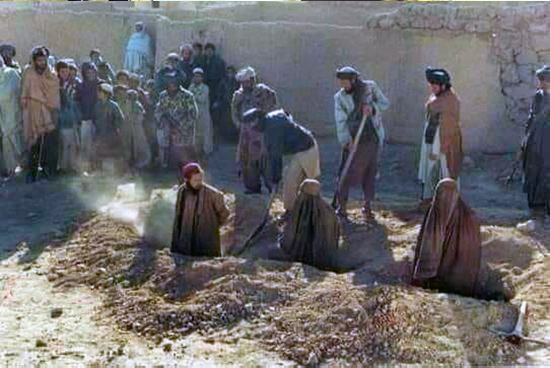 IN THE PHOTO: Burying people alive by “good guys”
The southern provinces - Kandahar, Uruzgan, Helmand, Herat, Farah, and Nimroz - were considered the most important people bases of Zahirshah. The Taliban entered Afghanistan on 12 October 1994 from Spinboldak in Kandahar, which is the gateway to these provinces. From November 5, 1994, to September 5, 1995, they occupied Kandahar, Uruzgan, Helmand, Paktia, Paktika, Khost, Nimroz, Farah, Ghazni, Herat, and two neighboring provinces of Kabul - Wardak and Logar. The name of Zahirshah made their lightning victories easy. Police posts surrendered, they were simply bribed by offering them insignificant sums.
Although the supporters of the Taliban - the United States, Pakistan, and Saudi Arabia - implemented Zahirshah's plan step by step, but after many wars and victories, the "furious students" came to the conclusion that they no longer needed the former king. On April 4, 1996, their leader, Mullah Omar, gathered about 1,500 sheikhs and religious scholars in Kandahar and, in their presence, wrapped himself in the cloak of the Prophet Muhammad. This meant his claim to power not only in Afghanistan but with the entire Islamic world. He announced himself as "amir al-muminin", that is, amir or leader of all believers, which is the highest religious and political position in Islam.
On April 19, Mrs. Raphel arrived in Kandahar to unravel this Sharia trick. According to the US embassy in Pakistan, the Taliban, who already knew the rule of the game, assured her that they would stick to the UN plan to form an interim government.
There was also agreement that the Taliban were not to enter Kabul, which meant the plan “neither Rabbani nor Taliban!” was realized. Mahmoud Mestiri said that neither the Taliban can take Kabul, nor Massoud can take Kandahar. “Even if the Taliban occupy Kabul, how will the rest of the regions accept a different kind of Islam, characteristic of the Taliban?” he asked. The diplomat correctly diagnosed that Afghanistan is on the verge of a new war.
It was at such a delicate moment in the history of the Afghan wars that the case of Russian pilots played its role. If Russia had not acted in such a situation and had not destroyed the plans of the United States and its partners, it would not have been Russia as a power and the other side of the Great Game.
The Taliban needed money to capture the capital - Kabul, and Jalalabad - the key city of the south and east of the country. This was also wanted in Pakistan, but it could not provide such a significant amount, on the other hand, in Islamabad, no one wanted to interfere with the United States and Saudi Arabia, which were against the capture of Kabul by the Taliban. At this stage, Russia came to the aid of Pakistan and the Taliban.
According to Amiri, with the mediation of the Pakistanis, a secret agreement was reached between the Taliban and the Russian delegation headed by Zamir Kabulov. Based on this, the Russians pledged to provide a large amount of money demanded by the Taliban under the pretext of releasing the hostages.
 IN THE PHOTO: Taliban selfie with the bodies of Najibullah and his brother. The Taliban hanged Najibullah, the leader of Afghanistan and protege of the Soviet Union, on the very first day they took Kabul.
Amiri says the Russians printed 12 tons of 10,000th Afghan banknotes at one of the Goznak factories in St. Petersburg and airlifted them to Kandahar in August 1996. Thus, in a very short time, Jalalabad (September 11) and Kabul (September 27) fell into the hands of the Taliban in the same old way - by bribing police posts. Massoud also left the capital without any resistance, perhaps out of respect for the Russians, his real partners, and a practical response to Rabin Raphel. It is also interesting that on August 31, the Russians managed to stop the first Chechen war, although not in their favor.
After the fall of Kabul, Salman Amri, the Saudi Arabian Ambassador to Afghanistan, met with Mullah Hassan Akhund, the Taliban foreign minister (now Taliban prime minister), in the capital's Gulkhana Palace, and poured out all his anger on him, condemning the sabotage and arbitrariness of the Taliban. Earlier, Amri agreed with Mullah Hassan and Mullah Rabbani, the second leader after Mullah Omar in the ranks of the Taliban, that the Taliban would not enter Kabul.
It is not known how much 12 tons of paper cost the Russians, but Russia and Pakistan did their job, which the US and Saudi Arabia did not expect. In order to keep their faith in the "Zahirshah project", the former king's office in Italy issued a statement saying that Zahirshah would return to Afghanistan very soon. But while the Taliban were there, the Shah could not enter Kabul.
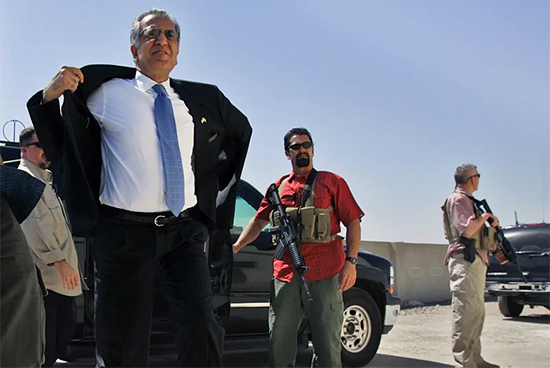
In the photo: Zalmay Khalilzad - the leader of neo-Talibanism
The United States also did not go in cycles in this failure. There was a more serious project. In 1997 - during the presidency of Bill Clinton - Zalmay Khalilzad, one of the supporters of "Project Zahirshah" (his father was an adviser to the former king) and at that moment an adviser to the American oil company Unocal, was able to organize a trip of the Taliban delegation to Washington to attract them in the TAPI gas pipeline project (Turkmenistan - Afghanistan - Pakistan - India). This project failed, and of course, not without the efforts of Massoud and his allies - Russia and Iran.
On July 15, 1999, in the city of Quetta, Pakistan, the Taliban killed former senator Abdul Ahad Karzai, one of the prominent nationalists of Afghanistan. The incident occurred after his meeting with Zahirshah in Rome. This angered the United States and the United Nations, as the Taliban made it clear that the "Zahirshah project" should no longer be discussed and that they were the only real power in Afghanistan.
But the US has not forgotten about the former king. Abdul Ahad Karzai was the father of Homid Karzai, the former president of Afghanistan (2001-2014), who came to power with the help of the Americans and the United Front left after Massoud. The interim, and after it the government of technocrats and Mujahideen, which were created by the efforts of Zalmay Khalilzad, were a logical continuation of that “Zahirshah project”. This is how the US responded to Russia. But the history of the 20-year stay of the US and NATO in Afghanistan shows that the Russians did not sit idly by and gave their answer.
HISTORY WHEEL
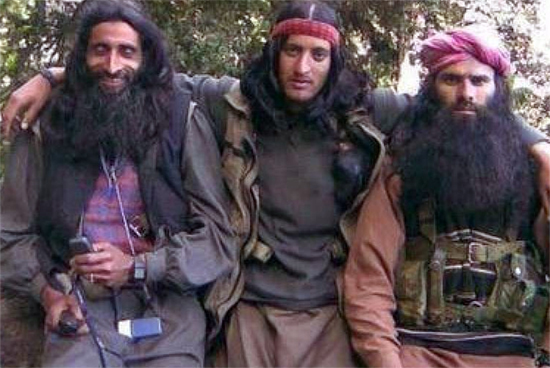 IN THE PHOTO: Homo Tolibus is a rare and new discovery of the world's special services for the people of Afghanistan and all mankind.
On April 18, 2002, Zahirshah returned home after 29 years of exile, but already as an ordinary Afghan. He still remained a threat to the new rulers of Kabul, since there were many supporters of the monarchy and its opponents in the country, primarily the Mujahideen. But he did not claim the throne, because he was too old, he could not even speak. He received the title "Father of the Nation" and left this world in 2007.
On April 5, 2012, an American court sentenced Victor Bout to 25 years in prison. It is not clear how much he was connected to Russian intelligence, but news of his case showed that the Americans were also interested in his connection to Kreml. Moscow was also not indifferent to his fate and, finally, on December 8, 2022, this “owner of a small airline” was exchanged with Brittney Greiner, an American basketball player.
Vakha Ibragimov returned to Chechnya in 1996. For some time, he was a special envoy of the Chechen government in the Islamic Emirate of Afghanistan. For some time, he worked in the government of Aslan Maskhadov and Shamil Basayev. In 1999, he went to Baku to organize financial assistance and logistical support for Chechen fighters in the war against Russia. In the same city in 2003 he was killed by unknown people.
On January 16, 2000, the Taliban government officially recognized the Chechen Republic of Ichkeria, and on January 23 its embassy was opened in Kabul. Zelimkhan Yandarbiev was appointed the first ambassador.
The Taliban, whose government was not officially recognized by the world during the first period (1996-2001), fell in 2001, but they regained power on August 15, 2022. Russia was one of the countries that supported them against the US and NATO. But this time, too, no one is ready to recognize their government.
Zalmay Khalilzad and Zamir Kabulov became the main soldiers of the "New Great Game" on the Afghan stage. After 2001, both of them were ambassadors of their countries in Kabul, and then special envoys for Afghanistan. By signing the Doha Agreement, Khalilzad returned power to the Taliban, one of whose well-known lobbyists is Kabulov. Khalilzad left, and Kabulov stayed, but the game continues. Nothing strange will happen if Khalilzad returns again. This is the "Big Game". Nobody wins here for 300 years.
After the incident with the Russian pilots, the world has changed many times, but what does not change is Afghanistan and its unfortunate people, with whom misfortunes and harsh experiments of fate always happen.
And if in 1996 the Taliban had handed over Russian pilots to the Chechens, would the wheel of history have turned differently?
The past cannot be changed, but history can. It can be told differently, but the only thing that nothing and no one can change or hide is the historic truth.
Telling the story of the escape of Russian pilots, the author does not pretend to be precisely the truth of this story. Perhaps some of her sides are still hidden, but they, too, will someday appear, and there will be nothing strange if there is confirmation of the narrative that we presented about this incident.