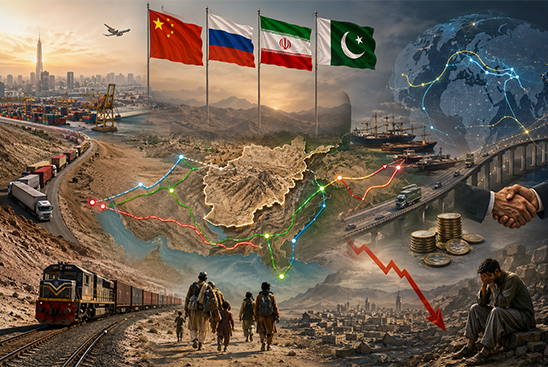
How Did the Political Isolation of the Taliban Turn a Golden Transit Opportunity into an Economic Threat?
Author: Kazem Homayoun, Expert in Environmental and Pollution Economics
Geopolitical changes in South and Central Asia entered a new phase in 2026 — a phase in which geography, transit, and economic corridors have become instruments of political and hard power more than ever before.
In April 2026, Pakistan, by activating six land corridors with Iran, created a new route for the transportation of goods between the two countries. This step, implemented on the basis of the 2008 road transport agreement between Tehran and Islamabad, gained vital importance amid the security crisis in the Persian Gulf and the pressure caused by the naval blockade of the Strait of Hormuz.
Iran managed to import part of its needed goods through the ports of Karachi, Port Qasim, and Gwadar, and then transport them by land to its own territory. The shortest route between Gwadar and Gabd takes only a few hours, and this advantage has further strengthened Pakistan’s strategic importance. However, behind this economic development lies a bitter reality for Afghanistan — a country that could have become the heart of regional transit, but has now been pushed to the sidelines.
If Afghanistan had possessed a legitimate and inclusive government based on national interests, the country today would not only have avoided suffering from these developments, but could also have become a connecting link between Central Asia, Iran, Pakistan, and South Asia. However, the Taliban’s ill-considered policies, tensions with neighboring countries, the “Lar and Bar” policy (Pashtuns on both sides of the Durand Line – “Sangar”), and the division of Afghanistan’s citizens into “Afghans” and “non-Afghans” have placed the country on a path of isolation.
From a geographical point of view, Afghanistan possesses one of the most important strategic positions in Asia. The country lies between Central Asia, China, Iran, and Pakistan, and naturally could become the shortest route connecting the North and South of Asia. Many economic researchers believe that with political stability and balanced regional relations, Afghanistan could annually earn hundreds of millions of dollars solely from the transit of goods.
Projects such as TAPI, CASA-1000, the Lapis Lazuli Corridor, and regional railway corridors were all designed around Afghanistan’s geographical position. However, political instability, the return of the Taliban, and the absence of regional trust forced neighboring countries to seek alternative routes.
After returning to power, the Taliban, instead of pursuing a balanced foreign policy, effectively entered into confrontation with neighboring states. Tense relations with Pakistan, accusations of sheltering anti-Pakistani radical groups, and the increase in attacks by Tehrik-i-Taliban Pakistan led Islamabad to conclude that Afghanistan is no longer a reliable economic and security partner.
In addition, the Taliban’s domestic policies further deepened the crisis. The “Lar and Bar” policy and ethnic-based approaches caused a significant portion of Afghanistan’s citizens to feel excluded and treated unjustly. A country torn by internal ethnic and political divisions cannot become a center of regional trust.
The launch of the corridors between Pakistan and Iran has, in essence, become an open signal to the Taliban. Pakistan is now striving to transform itself into the logistical hub of the region. Iran, by using these routes, is also reducing part of the pressure caused by sanctions and maritime crises. Bilateral trade between the two countries could exceed ten billion dollars in the coming years.
Against this backdrop, Afghanistan is suffering the greatest losses. The decline in customs revenues, the loss of its transit role, rising unemployment, the reduction of foreign investment, and the mass emigration of Afghan citizens are among the most significant consequences of this situation. If Afghanistan were on the path toward stability, it could have used these developments in the interests of its national economy.
The port of Chabahar also holds special importance in this competition. For many years, India attempted through investments in Chabahar to create an alternative access route to Afghanistan and Central Asia to reduce its dependence on Pakistan. However, the increasingly close rapprochement between Pakistan and Iran has already affected part of Chabahar’s strategic significance.
From a geopolitical perspective, the region is moving toward the formation of a new bloc consisting of China, Russia, Iran, and Pakistan. These countries have come to the conclusion that regional stability is impossible without the creation of a stable political structure in Afghanistan. The growing rapprochement between Pakistan and Iran will lead to even greater isolation of the Taliban and increased regional pressure on them.
If Pakistan, China, Russia, and Iran reach a political consensus, they could, through coordinated pressure on the Taliban, create conditions for the establishment of a stable and inclusive government in Afghanistan. Many analysts believe that the countries of the region have already realized that the continuation of instability in Afghanistan threatens the economic and political security of the entire region.
The social consequences of this situation are also extremely far-reaching. Poverty and unemployment are increasing in Afghanistan, and many citizens are being forced to emigrate. The continuation of this process could further contribute to the recruitment of disillusioned young people into extremist groups.
From an environmental perspective, the new corridors also carry consequences. The increase in freight truck traffic in the border regions of Balochistan is causing air pollution, increased consumption of fossil fuels, and the destruction of fragile desert ecosystems. If Afghanistan were stable, it would be possible to create multilateral transport corridors that would distribute the environmental burden among several countries.
Conclusion
The launch of six land corridors between Pakistan and Iran is not merely an economic development, but a sign of a changing balance of power in the region. Pakistan is strengthening its position as a regional logistics center, Iran is bypassing part of the economic pressure placed upon it, and China and Russia are also benefiting from the formation of new routes.
At the same time, Afghanistan is suffering the greatest losses. These losses are the direct result of political isolation, the absence of an inclusive government, tensions with neighboring countries, and the Taliban’s ill-considered policies. If Afghanistan had a legitimate government based on national interests, the country today could have become the heart of regional transit.
The increasingly close rapprochement between Pakistan and Iran will lead to even greater isolation of the Taliban. The countries of the region have come to believe that the stability of Afghanistan is the key to resolving many of the region’s economic and security crises. If regional pressure on the Taliban increases, the likelihood of forming a more stable political structure in Afghanistan will grow.
Afghanistan’s future depends on the return of political rationality, the establishment of an inclusive government, respect for the rights of all citizens of the country, and the development of balanced relations with neighboring states. Otherwise, the process of isolation, poverty, and Afghanistan’s exclusion from regional affairs will continue.