Well-fed and developing, and, as a result, calm Afghanistan is beneficial to neighbors, but not to Western "partners".
Source: Telegram channel Rybar (Russia)
On China's economic interests in Afghanistan and their prospects
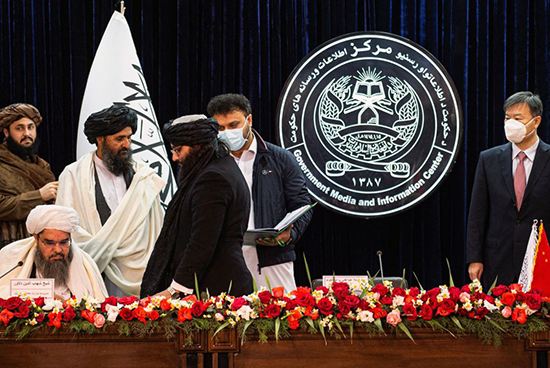
In early January, Taliban spokesman Zabiullah Mujahid announced that the Taliban had signed a contract with the Chinese company CAPEIC (Xinjiang Central Asia Petroleum and Gas Co) to develop an oil and gas field in Afghanistan.
According to the agreement, the Chinese will receive the primary right to extract oil and gas from deposits in the Amu Darya river basin in the provinces of Sari-Pul, Jawzjan, and Faryab. For this, the Taliban will be paid about 150 million US dollars a year, and in three years the amount will increase to 540 million.
Despite emerging security problems, the Chinese side is actively increasing its presence in troubled Afghanistan. At the same time, investment in the oil and gas sector is due to the need to provide assistance to the Taliban in exchange for the priority right to mine lithium and other rare metals.
What is it for?
A couple of weeks ago, we made a detailed review of the situation with the production of microchips and batteries and the metals necessary for them, in particular, lithium.
Now Chinese companies are actively investing huge resources in the development of this area not only in China itself but also abroad.
Afghanistan has huge reserves of this metal in the east and west of the country.
The Taliban also announced large deposits in the province of Ghazni, which together exceed deposits in Bolivia, one of the world's leaders in lithium reserves.
Prospects
The Chinese are trying to act with a long-term vision: now the potential gain in Afghanistan far exceeds the possible failure - a kind of "creeping" expansion tactic with a backlog for decades.
Success in this direction will make it possible to gain control over other deposits of various resources in the country, and in theory to realize the long-standing concept of the old "Silk Road" through the Wakhan corridor.
The option of enriching the Taliban and developing the economy is beneficial for Russia and the countries of the post-Soviet space. Financing Taliban projects will create prospects for improving life, and in the future - stabilizing the situation not only in Afghanistan but also in the region as a whole.
First of all, this will help to curb the militant spirit of the Taliban, which was largely due to the lack of conditions for a normal life. There was and is no fertile soil, no money, and no pastures for raising livestock in the country, so the Pashtuns simply have nothing to eat.
War was the only option for survival. The investment will allow the Taliban to see a different path of development without bloodshed and the prosperity of drug trafficking.
At the same time, there are plenty of obstacles to such a plan: Afghanistan has neither infrastructure nor qualified personnel, not to mention the investment climate. The dire humanitarian situation, Taliban incompetence, and terrorist activity are deepening the crisis.
In addition, we must not forget about external forces. The exit of the NATO contingent did not actually change anything in the region: the collective West left Afghanistan to create permanent tension next to Russia, Iran, China, and India.
The United States and its allies, as well as Pakistan acting in their wake, need an ever-boiling "cauldron of instability" projecting chaos on the entire region. Artificial maintenance of the desired degree of tension in Central and South Asia allows you to impose your protectorate on neighboring republics, to put pressure on Russia and China.
Well-fed and developing, and, as a result, calm Afghanistan is beneficial to neighbors, but not to Western "partners". Manipulating the Taliban is an effective way to push your interests in the region. For the Anglo-Saxons, the Taliban are "watchdogs": they clearly do not intend to lose them, allowing China, Russia, and India to strengthen their positions.