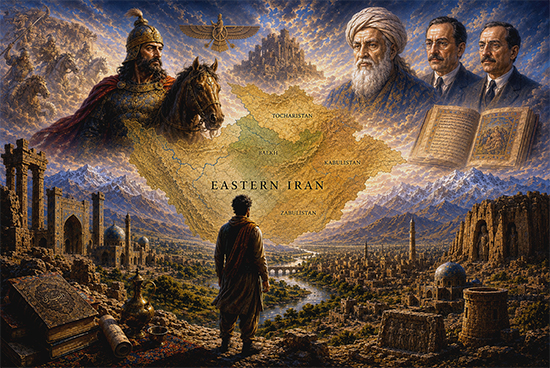
Why have many Persian-speaking inhabitants of the eastern Iranian Plateau — from Balkh and Badakhshan to Kabul and Zabul, Bamiyan and Herat — lost their natural connection with that part of their civilizational memory which is reflected in the Avesta, the Shahnameh, the Siyasat-nama, and thousands of other written monuments?
Author: Fayaz Bahraman Najimi, analyst of regional and international affairs, member of the Sangar Advisory Council
When I put forward the theory of the “Normalization of Eastern Iran,” I expected that the discussion would lead to a conversation about historical memory, civilizational consciousness, and the place of the eastern Iranian Plateau in our historical narratives. However, the reactions that followed revealed that a significant part of society still perceives this concept in a completely different context. Some regarded it as a project to change the name of a state; others interpreted it as a form of historical nostalgia; a third group associated it with future political and geographical projects; and some attempted to understand it through the prism of contemporary identity conflicts.
For me, these reactions were not so much a sign of disagreement as evidence of a deeper problem: we do not have a common language for discussing our own historical memory — indeed, we do not truly know it ourselves.
The principal misunderstanding lies in the fact that “Eastern Iran” is perceived primarily as a name, whereas in my understanding, it is first and foremost a paradigm of memory. The essence of this theory is not the redrawing of maps or the renaming of territories, but a reconsideration of society’s relationship with its own past. The central question is not what a particular land should be called, but why a portion of our historical memory has been excluded from collective consciousness and how it can be restored to the sphere of public awareness.
For this reason, the theory of the “Normalization of Eastern Iran” should be viewed in the context of the philosophy of memory and the sociology of historical consciousness, rather than as a subject of ordinary political disputes. It is an attempt to restore a part of memory that was once present in the works of historians, researchers, and intellectuals of this region, but was gradually displaced from public consciousness. In other words, my goal is not to create a new identity, but to restore a memory that existed long before us, yet whose connection with society has been lost.
When I speak of “Eastern Iran,” I am not seeking to give preference to one name over another. What interests me is something different: why has a part of our historical memory been pushed so far out of collective consciousness that even a reminder of it surprises many people? Why has a society that for centuries stood at the center of one of the world’s greatest civilizational zones become so detached from the roots of its own memory?
Why have many Persian-speaking inhabitants of the eastern Iranian Plateau — from Balkh and Badakhshan to Kabul and Zabul, Bamiyan and Herat — lost their natural connection with that part of their civilizational memory preserved in the Avesta, the Shahnameh, the Siyasat-nama, and thousands of other written works?
This question becomes even more significant when we examine the condition of other forms of historical memory that exist in the region. Pashtunism is not merely a political ideology; it is also a living and dynamic memory in which everything from the code of Pashtunwali to such historical figures as Mirwais Hotak, Ahmad Shah Abdali, Khushal Khan Khattak, and Malalai is present in the consciousness of every Afghan or Pashtun from early childhood. These are nodes of memory. Each of these names activates an entire network of meanings, pride, narratives, and a sense of belonging. For this reason, Pashtunist memory does not require daily reaffirmation of its legitimacy—it has become part of everyday life.
A similar situation can be observed with Southern Turkestan. For many Turkic-speaking peoples, Turkestan is not merely a geographical term. It is a memory that connects a space stretching from Samarkand and Tashkent to the images of the Ghaznavids, Seljuks, Timurids, and other historical dynasties. Even when this memory remains on the periphery of political life, it continues to exist culturally and psychologically within pan-Turkist conceptions. People find themselves within it and use it as a means of connecting with their past.
Persian-speaking inhabitants of the eastern Iranian Plateau and the territory known today as Afghanistan, however, find themselves in a different situation. They possess a common language, yet their collective memory is not systematically reproduced. They have great poets, yet a gap has emerged between those poets and the everyday life of society. They possess a great history, yet that history is absent from their consciousness as a living memory. As a result, most Persian-speaking people speak about their language, but far less frequently reflect upon their own historical memory.
The problem begins precisely here, because people cannot live by language alone. Language is, of course, the “house of being” and the vessel that contains it, but memory constitutes its content. If the content disappears, the vessel too will sooner or later become empty. That is why I have repeatedly argued that merely preserving the Persian language and speaking it is not sufficient for liberation and development. What can transform our society into a historical subject is not language in itself, but the memory that fills it with meaning.
At this point, the concept of collective memory developed by the French sociologist Maurice Halbwachs becomes particularly important. Halbwachs demonstrates that memory is not an exclusively individual phenomenon. People remember the past within social frameworks. What a society remembers and what it forgets is not accidental. Memory is always shaped within a field of power. Therefore, forgetting is not merely the absence of recollection, but a social and historical process.
If we examine the condition of the Persian-speaking population in the territory known today as Afghanistan from this perspective, it becomes clear that the principal crisis is related not to language but to memory. We have forgotten not only part of our distant past, but have also, to a considerable extent, lost memory even of our recent past. A vivid example is the question of “Eastern Iran” and the place occupied within this discussion by Mir Ghulam Mohammad Ghubar.
Today, many of those who oppose the paradigm of “Eastern Iran” do not even know that this concept has well-established roots in the history of modern intellectual thought. According to the testimony of Asif Ahang, Mir Ghulam Mohammad Ghubar, in a letter addressed to Mohammad Naim concerning the change of the official name of Persia to Iran, raised the issue of “Eastern Iran.” The significance of this letter does not lie in the claim that Ghubar advocated renaming Afghanistan. Its importance lies in the fact that he understood the consequences of a major historical transformation for the collective memory of society.
After the name “Iran” became the official designation of the state that had previously been better known internationally as Persia, a significant portion of the historical and symbolic heritage of the Iranian world naturally began to concentrate around that state. Mir Ghulam Mohammad Ghubar understood well that such a symbolic concentration, if not accompanied by the reproduction of an independent historical tradition in the east, could gradually push the contribution of the eastern Iranian Plateau to the periphery of the broader civilizational memory. It was precisely for this reason that, when speaking of “Eastern Iran,” he sought to preserve the living thread of historical memory — a memory nourished by the Shahnameh, ancient Iranian traditions, national legends, and the historical significance of Balkh, Zabulistan, Kabulistan, and Tokharistan.
In this sense, “Eastern Iran” was not, for Ghubar, an alternative name. It was a form of resistance against forgetting. He understood that if the eastern Iranian Plateau failed to preserve its own narrative of the past, it would gradually be pushed to the margins of the historical memory of the Iranian world. What Ghubar perceived was the danger of a rupture between the Persian-speaking population of the territory known as Afghanistan and their civilizational past. Perhaps in his own time this danger did not yet appear obvious, but today its consequences can be observed quite clearly.
This is precisely where Ghubar’s significance lies. He was not the creator of a new name, but rather the continuator of a particular intellectual tradition. The roots of this tradition can be found in the historical narratives of the region and in the cultural self-awareness of a segment of the Persian-speaking intelligentsia. From this perspective, “Eastern Iran” is neither a sudden invention nor a situational reaction. It is part of the intellectual memory of this land, a memory that was gradually displaced from public consciousness.
Perhaps one of the most enduring and visible consequences of Afghan dominance over the past century has not been the conquest of territory, but intervention in the historical memory of the Persian-speaking population. Power reaches its most perfected form when it does not merely govern the present, but also redefines or severs a society’s connection with its past.
The Persian-speaking inhabitants of the territory called Afghanistan have encountered precisely such a process. They have not only become detached from their historical space and civilizational heritage, but have also gradually lost memory of their recent past and intellectual tradition. Today, we can clearly see that a significant portion of the educated generations are unfamiliar even with the name and content of the “Eastern Iran” paradigm proposed by Mir Ghulam Mohammad Ghubar, and know little or nothing about his reflections on the place of the eastern Iranian Plateau in history.
Likewise, many of them have never encountered the valuable work of Ahmad Ali Kohzad, Afghanistan in the Shahnameh; the Shahnameh in Khorasan, or the Shahnameh in Ariana, nor are they aware of the intellectual efforts of Persian-speaking thinkers in the second half of the twentieth century who wrote in defense of their people’s historical memory, history, and cultural identity.
Such forgetting is not merely a knowledge gap. It is a sign of a broken chain of memory transmission. When memory is not transmitted, each new generation is forced to begin from zero, to ask the same questions again, and to retrace paths that have already been traveled.
Under such conditions, thought does not develop into a tradition, historical experience does not accumulate, and collective consciousness, instead of standing on the shoulders of previous generations, constantly returns to its starting point. The greatest victory of hegemonic and dominant systems lies in their ability to detach “other” peoples from their historical memory and turn them into communities suffering from historical amnesia, so that they forget that before them there were also those who reflected, wrote, and struggled to preserve their historical ties and traditions.
This is why, when I speak of the “Normalization of Eastern Iran,” my goal is not the normalization of a particular name, but the normalization of memory. What is at stake is the restoration to the people of that portion of historical consciousness which has been displaced from the intellectual life of Persian-speaking society.
People who lose their short-term memory will sooner or later lose their long-term memory as well. And a society whose connection with its own historical memory has been severed will remain vulnerable to historical rootlessness and confusion even if it manages to preserve its language.
If we view “Eastern Iran” merely as a geographical term, we will never truly understand its significance. The importance of “Eastern Iran” lies not in where exactly it was located on a map, but in how it should exist within our civilizational memory.
Every civilization requires a center of memory to sustain itself—a space where myth, history, religion, epic tradition, and collective imagination intertwine to create a sense of historical continuity. For the ancient Greeks, this role was played by Homer; for the Jewish people, by the biblical narratives of the Torah; and for the Iranian world, this role found its most complete expression in the Shahnameh.
Yet the Shahnameh is not merely a story of kings and wars. Alongside its philosophical and wisdom-centered themes, it also serves as a kind of map of Iranian historical memory. A careful reading reveals that the original center of its narrative is located not in the west of the Iranian Plateau, but in its east. This is neither an accidental literary detail nor simply the author's preference. Ferdowsi inherited a tradition that had lived within Iranian memory for many centuries before him—a tradition whose roots extended back into the Avestan world.
In the most ancient layers of Iranian historical memory, the East appears not merely as a geographical direction, but as the cradle of order in the Iranian world. It is there that the kings of the Kayanian dynasty emerge; it is there that the struggle between Ahura Mazda and Ahriman, as well as the conflict between Iran and Turan, acquires meaning; and it is there that the great heroes enter the stage of history and myth. Balkh, Zabulistan, Kabulistan, and Tokharistan are not merely cities and regions within these narratives—they are spaces in which memory itself is born. For this reason, the East occupies a more prominent and significant place in the opening layers of the Shahnameh than any other region.
If we look closely at the narrative structure of the Shahnameh, it becomes evident that its greatest hero also emerges precisely from this region. Rostam does not come from Persia, Media, or Azerbaijan; he is the son of Zabul and Kabul. This is not merely a literary detail. Collective memory never chooses its principal hero by chance. The fact that the most powerful epic symbol of the Shahnameh arises in the East reflects the special place that this region occupied within the historical imagination of the Iranian peoples.
At the same time, the significance of this issue does not lie in an attempt to prove ownership of the Shahnameh for any particular territory. The very effort to divide this work among modern states is itself evidence of a limited historical understanding. The Shahnameh belongs not to any contemporary state, but to an entire civilizational community. Yet this civilizational community also possessed different levels and centers, and one of its most important centers was located in the eastern Iranian Plateau and across a substantial part of the territory known today as Afghanistan. Ignoring this reality is just as mistaken as denying the role of Persia, Media, or other parts of the Iranian world.
The question I raise is connected neither with appropriating Ferdowsi nor with monopolizing history. Ferdowsi does not need an owner. What requires reconsideration is our relationship with the memory of which he was a bearer. The question is not which modern country Ferdowsi belongs to. The question is why the people among whom a significant part of the mythological geography of the Shahnameh took shape no longer recognize themselves within that memory.
It is here that the concept of the “Normalization of Eastern Iran” acquires a deeper meaning. Normalization means restoring a connection that was once natural but later became severed. It means that when a Persian-speaking person speaks of Balkh, the name should evoke not only a modern city but also a multilayered heritage of history, myth, and culture. It means that Zabulistan should be more than a term in school textbooks—it should form part of the living collective memory of society. Ferdowsi, Nasir Khusraw, Jalal al-Din Balkhi, Sanai, Abdurrahman Jami, and others should exist in people’s consciousness not as isolated islands, but as elements of a unified system of meanings.
This is precisely what Pashtunism succeeded in achieving for itself. This is also, to a considerable extent, what Turkestani historical memory has achieved. These communities possess not only history—they have transformed their history into a part of everyday memory. The difference between having history and having memory is similar to the difference between a library and life. History may remain on the pages of books, whereas memory lives in language, symbols, objects of pride, feelings of belonging, and the collective imagination.
In my understanding, “Eastern Iran” is an attempt to transform a forgotten part of history into living memory. It is an effort to enable the Persian-speaking inhabitants of the eastern Iranian Plateau to see themselves once again as a continuation of a single historical narrative—a narrative that begins in the Avestan world, reaches its culmination in the Shahnameh, finds expression in the works of Mir Ghulam Mohammad Ghubar and Ahmad Ali Kohzad in the modern era, and is capable of continuing in the consciousness of future generations.
Ultimately, the normalization of “Eastern Iran” means nothing other than restoring this historical continuity to everyday life, so that memory ceases to exist only within texts and once again becomes part of the living consciousness of our people.
The reason I speak specifically of “Eastern Iran” rather than Khorasan is also connected to the question of memory. In our historical consciousness, Khorasan is primarily a geographical and political concept associated mainly with the Islamic period. By contrast, the concept of “Eastern Iran” makes it possible to connect different layers of memory—from the Avestan world and the world of the Shahnameh to the present day. For this reason, “Eastern Iran,” in my view, is not simply the name of a vast territory, but a conceptual framework for restoring the historical continuity of memory that was gradually broken and from which a significant portion of Persian-speaking society became detached.
A society that has lost its memory, even if it preserves its language, will continue to suffer from a form of historical homelessness, because language without memory cannot serve as a carrier of civilizational consciousness.
This is why the theory of the normalization of “Eastern Iran” represents an attempt to restore historical continuity—an effort to reconnect the past, present, and future within the collective consciousness of Persian-speaking communities. This theory is not founded upon nostalgia, nor does it seek to restore any lost historical order. Its foundation lies in the understanding that a conscious future is possible only when a society is able to establish a living and natural relationship with its own memory.
In this sense, “Eastern Iran” is neither a name nor a geographical space, but a form of living memory—a memory that begins in the Avestan world and the world of the Shahnameh, continues through the works of our historians and thinkers, and can once again become part of the everyday consciousness of Persian-speaking peoples. The normalization of “Eastern Iran” is, ultimately, an attempt to bring this memory back from the periphery to the center of public consciousness, because no people can attain civilizational self-awareness without historical memory, and civilizational self-awareness itself cannot exist without continuity of that memory.
“Eastern Iran,” in the final analysis, is not the name of a political dream, but an attempt to put an end to historical homelessness and return memory to its rightful home.
A society that rediscovers its memory gains consciousness before it gains power. And there is no greater capital for the future of a people than their historical consciousness.