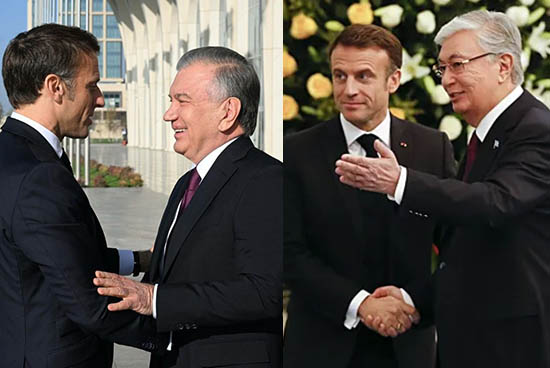
What is France looking for in Central Asia?**
Author: Ghaus Janbaz, political expert and former Afghan diplomat
This article makes an attempt to intensively analyze and evaluate the main factors of France’s activation in Uzbekistan and Kazakhstan.
Countries and the modern world are involved in new competitions in almost all areas.
France, as a powerful and historical state, has not been an active player in recent decades and has been practically in the second row in global politics (including the Central Asian region) and is trying to correct its position.
What matters is the territory of Central Asia, including Afghanistan and Iran. Over the past two hundred years, the region has been the target of "successive games large and small", mainly between the Russian and British empires. Meanwhile, France was busy occupying lands and playing similar games in North Africa, Central Africa, and Indochina.
With the transformation of the “Great Game” [New Great Game] that arose after the collapse of the Soviet Union and the formation of new states in Central Asia, influential actors in world politics tried (are trying) to maintain their powerful presence, as before, not only to maintain but also to strengthen it.
For example, the United States of America is consolidating its influence through the C5+1 format, providing assistance through USAID in deploying military programs under the slogan of “regional cooperation.”
Russia has undertaken extensive economic, social, political, and military security programs to attract and keep Central Asian countries in its orbit. In addition to thousands of historical, cultural, social, and human connections... with the elites and ordinary people of this region, Russia has tried to maintain mutual and inextricable ties with this region through the Collective Security Treaty Organization, the Eurasian Economic Union, the Customs Union, etc.
Russia is the largest economic and political partner of Uzbekistan and Kazakhstan. However, these countries are trying to pursue an open and balanced economic policy with other countries.
Russian Foreign Minister Sergei Lavrov outlined his country's position on this matter in an interview with the BelTA news agency as follows:
“Central Asia, look, how they are courting it. A dozen “Central Asia plus one” formats have already been created, with the Americans, the European Union, and Japan. By the way, in addition to the “Central Asia plus the European Union” format, the Germans have created their own format. The French, I think, will not wait long, they will do the same. That is, such frameworks for meetings are being created, during which, of course, they are trying to pull our Central Asian neighbors, friends, and allies towards the West, promising some economic, and trade benefits, and preferences and purposefully transferring to them some assistance programs that are not so impressive, if taken in absolute numbers, and are incomparable with the benefits that Central Asian countries have from cooperation with Russia within the CIS, within the Eurasian Economic Union."
For its part, China is increasing its economic and political influence by launching infrastructure activities, especially by implementing the huge project of the century, “One Belt, One Road.”
As can be seen, France, given the current and existing equations in the region, intends to play its role in ensuring that none of the powerful countries in the world is the sole leader in this territory.
Currently, France, taking into account the challenges it faces in Africa and South Asia, intends to gain access to the energy sources it needs by intensifying cooperation with relatively developed post-Soviet states (Uzbekistan and Kazakhstan).
The duration of the crisis in Ukraine has caused serious damage to energy and fuel supply markets in Europe and the world, completely changing the situation and causing economic and political crises.
There is no doubt that some Central Asian countries with rich fuel resources may be of interest to France in this regard. It should be noted that both Uzbekistan and Kazakhstan have huge reserves of uranium and rare metals, and these could be beneficial to France and other EU countries and to some extent reduce the growing dependence of these countries on China.
Being one of the advanced industrial countries, by intensifying strategic relations and cooperation with Uzbekistan, France is able to unite various areas of economic, political and environmental interaction. For its part, Uzbekistan finds an opportunity to diversify contacts and international relations, strengthen its positions, and use the opportunities of coordinated diplomacy in light of the changing global situation.
The declarations published following the visits of Emmanuel Macron (President of France) to Tashkent and Astana say that “France is determined to support Uzbekistan and Kazakhstan.” This promotion will undoubtedly increase the attractiveness of these two countries among Western European countries. Economic relations between Tashkent and Paris have long been flourishing, and proof of this is the threefold increase in recent years in the number of Uzbek-French joint institutions.
The main obstacle to the development of cooperation between the newly formed republics, but actively developing countries of Central Asia and France, is the problem of transportation and transshipment of cargo and fuel materials. Transshipment opportunities through the ports of the Caspian Sea are limited. This problem was especially evident in 2022 when the volume of transit through the above ports tripled compared to last year (2021).
The prospect of cooperation between Uzbekistan and France will most likely be profitable, but in the short term, the benefits that France will receive from such cooperation will be much greater than the benefits of Uzbekistan and Kazakhstan. At the same time, this cooperation does not solve regional security problems, including Afghanistan.
*Derived from the French word "Cherchez la", which means "to find".
** Emmanuel Macron recently made a two-day trip (November 1-2, 2023) to Tashkent and Astana.